Revisiting the issues of labor discrimination

It is generally accepted by economists that discrimination is an influential factor in affecting the functioning of a modern day economy. Theories regarding discrimination – its impacts on the global economy and possible solutions to the problem – have been debated and argued by influential economists over the decades. A key question that we ask ourselves is: will the market regulate itself and be able to eliminate discrimination, or does the government have to intervene? If so, what is the best approach to government intervention? This question can be seen as a part of the larger debate between the neoclassical economists and the Keynesian economists over the role of government in our economies and social lives.

This problem of whether or not to regulate the issue of discrimination has been debated by politicians and economists over the years, especially since discrimination is not only an economic issue, but also a social one. Historically, governments have taken a generally laissez-faire approach to economics in society, and regulations are few, especially in the US. This changed dramatically starting in the late 19th century, with the emergence of populist movements such as women’s suffrage, and accelerated dramatically during the two World Wars and the Depression era, when governments began to take a more active economic role in society and mandated fairness in hiring in order to receive federal funding. Finally, the Civil Rights movement of 1950s and 60s pushed the issue to the forefront and the government enacted broad legislations regarding labor employment practices. Two of the most notable legislations of the period are the Equal Pay Act of 1963 and Title VII of the Civil Rights Act of 1964. The Equal Pay Act have stated that firms should take into consideration a person’s gender in the determination of wages using the theory that that the same amount of work deserve the same amount of pay. Title VII of the Civil Rights Act made it illegal to discriminate based on a person’s “race, color, religion, sex or national origin”, and implemented a comprehensive list of anti-discriminatory methods.

However, in more recent years, the problem of discrimination takes on a new turn with the rise of “Deregulation” and the stepping away of government from some of its historic stances on promoting more equality in the market-place, and igniting the debates anew.

labor and management.jpgThe current consensus is, in a way, a reaction against the free-market advocates, which have become especially popular in the US since the 1980s. In fact, it has been argued by economists that discrimination has increased from the ‘80s onward, in large part due to the popularity of this line of argument. We can examine this opposite side of the argument by looking at the positions taken by two of the greatest economists of the latter twentieth century: Milton Friedman and Robert Lucas. Friedman had argued that the free market will resolve the problem of discrimination itself because discrimination is inefficient in the long-run (“Capitalism and Freedom”, 1962). In one of his most often quoted passages, he stated “It is a striking historical fact that the development of capitalism has been accompanied by a major reduction in the extent to which particular religious, racial, or social groups have operated under special handicaps in respect of their economic activities; have, as the saying goes, been discriminated against.” Friedman believed that the employer’s self-interest will cause them to overlook the other categorical attributes of an individual in favor of whoever can work the cheapest for the most amount of productivity.

On an interesting note, Friedman was himself the subject of discriminations during his times at the University of Wisconsin at Milwaukee, and one of the chief reasons he chose the University of Chicago for its PhD program was due to its open and more tolerant environment. In a sense, Friedman affirmed the idea that discrimination is detrimental to the employer (in this case the university) by “voting with his feet” to a location that was more tolerant.

Writing along a similar line, Robert Lucas stated that any irregularity in the “Market” introduces a distortion that will resolve itself over time. And in his view, government attempts in ending discrimination will simply introduce new inefficiencies in the marketplace that has to be resolved. What both of these economists suggested is that firms are very rational and they pursue the maximum amounts of profits possible. In order to do this, it only makes them to only care about costs and benefits, and since race/ethnicities/gender, etc. does not have a specific benefit or cost associated with them, firms will not discriminate. For those firms that do discriminate, in the long run they will become inefficient and the competition will eliminate them from the marketplace. The free market is the best left alone, according to Friedman and Lucas, since the mechanism of incentives in a rational society will help to eliminate discrimination and get rid of these inefficiencies.


Meanwhile, the mainstream have taken the view that in order for discrimination to be solved, the markets must be regulated through governmental legislations and acts. They are essentially arguing for a top-down, command-and-control method in regulation approaches to enforce those regulatory methods. Many noted that more regulation has been the historical trends, as more legislations have come on board over the years to prohibit certain behaviors from employers. They outlined two main approaches by governments to combat discrimination. The first is what is generally referred to as “Nondiscrimination” where employers are essentially blind to race, ethnicity, or sex, and to determine that those factors should not play any role in the selection of workers (This is the principle behind the Equal Pay Act). The other approach is termed “Affirmative Action”, where employers MUST take race, ethnicity, and gender into account to ensure fair representation, especially for historically disadvantaged groups. These two approaches have proven to be somewhat contradictory, i.e. how to ask ask employers to be blind to the differences between workers while at the same time be cognizant of the fact that certain groups should be considered more highly, holding other factors constant? This contradiction made it difficult to implement some of these methods in ending discrimination, and it is somewhat flawed as a result.

In addition, Title VII also distinguished between disparate treatment and disparate impact; where disparate treatment is defined as being proof that the workers are intentionally being discriminated against, while disparate impact are defined as result from actions, however unintentional, that results in some groups being disproportionately impacted. All of these are important considerations for firms that are trying to avoid discrimination.

In cases where it can be difficult to implement equal for equal work, they introduced the idea of comparable worth to help measure employee value. Often, many noted, it is impractical to “achieve equal pay for equal work”. Therefore, some have supported the goal of equal pay for jobs of “comparable worth”, and what determines the comparable worth is market forces. Comparable-worth policies have generally relied on job-rating schemes by employers to determine or justify pay differentials. However, this job-rating scheme is highly subjective and subject to great controversies.

As a case example, many pointed to the example of the Federal Contract Compliance Program, where governments monitor hiring and promotion practices of federal contractors. This program utilized affirmative action to ensure that groups that have been historically disadvantaged received preferences. In terms of absolute numbers, the federal contract compliance program increased opportunities for minority groups tremendously. The concerns with these programs is that when underrepresented groups are given preferences in hiring, this might result in less qualified workers being hired. And since the programs only covered the federal contractors, it is possible that while the program attracted talented minorities, there might be no overall gains in employment due to other sectors of the economies being neglected. As evidence of the effectiveness of the government programs, some have pointed out that government policies have distributed new employment opportunities among federal contractors towards blacks and Hispanics. The ratio of black to white incomes has risen since the 1960s, but we cannot effective draw causation relationships between this and the governmental legislations.

Finally, the mainstream believed that it is important to continuously monitor the economy to catch discriminators. One way to do this is to conduct an audit where blind experiments are conducted, telling auditors to look at firms and measure the effects of discrimination. However, these studies are very difficult to conduct since the auditors cannot know the purpose of the experiment (since that will introduce an element of bias), while at the same time, they are very difficult to conduct due to cost constraints. In another famous experiment, which has since been replicated worldwide, experimenters send out resumes to a number of different firms. It was found that white-sounding names needed 10 resumes to receive one call back, while black sounding names required 15 resumes to receive one call back, a 50% difference in employer response rate. However, even this experiment can be subject to bias, as the names may in themselves be a signal on the quality of the workers, and not necessarily having anything to do with race itself. For instance, it is possible to have a name of “Jared” being associated with a bad worker, but not necessarily to that person’s race.


I believe that while the the mainstream’s position is elegantly argued for, and we agree with the general premise that the markets need to be regulated. However, I believe that regulations may not work in all cases. The solutions many economists presented are excellent, but may not be adequate since it doesn’t allow a degree of freedom to the individual to decide in specific cases of discrimination. Governments can do a number of other things that can combat the effects of discrimination, besides direct, top-down regulation. I believe that the government should embrace a comprehensive, top-down approach in fighting discrimination, while at the same time, it might work with other players in the market so that anti-discriminatory laws can be used effectively and efficiently.

Firstly, I believe that free markets are efficient in the sense that it generally can allocate resources as needed to the market actors. Markets generally have a very remarkable ability to become efficient with the right incentives. However, in the case of discrimination, it may become inefficient due to the lack of those incentives. In many cases, discrimination can be good for businesses since they are able to charge different wages to different individuals, and they are able to get the same amount of work out of some workers while costing a fraction of the wage expense. This has historically been the case with what we call the “gender wage gap”, where men and women are paid different wages for essentially the same amount and quality of work. In addition, we often see firms hire workers whom they or their employee knows well (a network effect). This can be discriminatory because the results (disparate impacts) can be discriminatory in nature. The only way to solve these issues is by having firms being regulated directly by the government to change the historic legacy.

Secondly, I believe that governments should take a leading role, but not the only role in helping to end discrimination. A government’s approach should be based on both “carrot” and “sticks”. Governments can directly punish the worst discriminatory offenders, while at the same time, they offer incentives to encourage diversity in the workplace. Governments should consult the private sector to see why they may not want to hire women/minorities, and work with them to help design incentives to help end discrimination.

Thirdly, governments can also utilize other methods that are not direct regulations, for instance through education in non-discrimination. This in fact has been promoted in the schools’ educational curriculum in the past few decades and have been credited with helping new generations of workers and employers understand the value of diversity in the workplace. Educational changes can cause the deepest changes in the way workers interact with others and in a firm’s hiring practices. In many cases, the markets simply are not aware of the potential benefits a diverse workforce can bring along, and it takes some educational efforts, in part facilitated by the government, to change the firm’s hiring practices.

Lastly, I believe that the free movement of people has been extremely beneficial for firms and discriminatory practices would stop this free movement of people. Government should do all it can to make sure that worker mobility is not impacted, as historically, workforces that move around tend to reward firms that are the fairest and most efficient at utilizing labor. For instance, during mass construction projects that are undertaken by the government or large corporations in the past, people of different ethnicities often come and work together, albeit sometimes on different parts of the same project (i.e. the transcontinental railroad). This has been very beneficial for the employers as they are able to attract the best talents due to the mobile workforce.

To conclude, I believe that our solution is a compromise between the neoclassical, free-market advocates on the one hand, and the regulation-heavy advocates on the other. Businesses exist in an environment where discrimination exists and governments need to ensure that workers do not encounter discrimination through regulations, workplace incentives and education programs. At the same time, governments need to consult with private companies to see what works best to end discrimination. A collaborative environment between governments and businesses, we believe, is often the best one in ending discrimination. Behind all of these proposals in ending discrimination is our firm belief that markets, when given the right incentives, will come to the rational conclusion: Discrimination results in an inefficient utilization of resources, firms will lose out on some of the best talents, and in the long run, only firms that do not discriminate can survive in our global, interconnected world.

Another look on Valeant Pharmaceuticals (VRX)

Given the latest scrutiny over Valeant Pharmaceuticals, I would like to point to some of the inferences that I had drawn over this issue based on the facts; and the facts does not add much confidence for investors in this company.

The bombshell: Citron Research’s report[1]

Much of the recent decline in prices can be attributed to the publication of a negative report by Citron Research on Tuesday, October 21st, an online newsletter that has exposed many corporate frauds of recent years. Citron Research is fairly credible as a research group; based on a recent Wall Street Journal analysis[2], out of the 111 stocks that Citron has wrote about since the website was founded in 2001 (including its predecessor, StockLemon), 90 were lower one year later, and experienced an average stock price decline of 42%.

The main issue, as pointed out by the report, revolves around the issue of Philidor, which appears as a distributor of Valeant Pharmaceuticals that most sell-side analysts were unaware of until early last week. Citron reached out to the Philidor’s founders and key people that are associated with its operations; but they refused to talk about the company and its relationship with Valeant. However, as it turns out, Philidor is actually an exclusive distributor of Valeant’s products. Another issue came up when a company by the name of R&O Pharmacy filed a lawsuit claiming payment from Valeant in the amount of $69 million; however, based on Citron’s investigations, it appears that Philidor OWNS R&O pharmaceuticals. Moreover, it also appears that Valeant also have a network of other pharmacies, including westwilshirepharma, safexpharma, orbitpharmacy, that only does business with Valeant.

Before we delve into what these facts meant, we need to dispel several misconceptions regarding Citron Research. Many have made the argument that Mr. Left, the editor in charge of Citron Research, is a short-seller, and therefore have every incentive to beat the stock price down, and that this report is nothing more than a “bear raid”. However, before we start criticizing the short-sellers, investors should understand the enormous risks that Mr. Left had taken on by publishing this report. If it turns out that Mr. Left is wrong, the lawsuits that he will face will no doubt force him into serious financial distress. This report is not written without thoughts to its consequences. As Mr. Left himself have stated, he had been more right than wrong, and this is how he remain active.

The question that we have to ask ourselves is what exactly is the purpose of Philidor? It is simply very difficult to understand what is the purpose of these subsidiaries when a company like Valeant can distribute their products more directly. Philidor, as far as anyone can tell, is a secret distributor that Valeant tries not to publicize. Philidor ONLY distributes Valeant’s products and nothing else, and it appears that Valeant is selling to an off-balance sheet entity that buys only from Valeant.

Let’s assume that the intentions of Valeant are benign, and in this best case scenario, they have created a complicated financial structure and is simply making the accounting more opaque. If the intentions of the Company are more malicious, they have created a fairly convenient venue for them to conduct fraud and create fictitious transactions and sales (this is what Citron alleges). Next Monday, October 26th, the company will discuss Philidor and respond to criticisms; how the management explains the purpose of Philidor will be an issue of great importance.

Before moving on, I would like to point out on October 19th, the famed investigative reporter Roddy Boyd, had also discussed Valeant Pharmaceuticals in his article with the Southern Investigative Reporting Foundation[3] (SIRF) the extent to with Valeant Pharmaceuticals tried to obfuscate the relationships between the two companies.

Here are other issues of concern in addition to those that are brought up in Citron’s report:

Flawed business model:

Valeant operates by buying smaller drug companies and then raise the prices of those drugs to make a profit. The company does not really engage in original R&D and acts more as a marketer of pharmaceuticals. The company, therefore, was able to enormous margins on the drugs that they are selling. Hedge Funds, Bill Ackman’s Pershing Square Capital included, are absolutely in love with this model as shown by some of the largest holders of Valeant[4] as of Q2 2015,

  1. Pershing Square (Bill Ackman): 19,472,993 shares, 5.71%
  2. ValueAct Holdings (Jeff Ubben): 14,994,261 shares, 4.39% (sold 4.39 million shares in Q2)
  3. Paulson and Co. (John Paulson): 9 million shares, 2.64% (added 6.95 million shares in Q2)
  4. Lone Pine Capital (Steven Mandel): 5,310,143 shares, 1.56% (sold 259,317 shares in Q2)
  5. Viking Global (Andreas Halvorsen): 4,616,738 shares, 1.35% (added 558,395 shares in Q2)

In fact, at the annual Sohn Investment conference, Bill Ackman even claimed that Valeant could be the next Berkshire Hathaway due to its strategy of acquiring diverse companies in the pharmaceutical space[5].

Last year, Valeant attempted to take over Allergan in a much publicized deal. Valeant offered a tremendous sum to purchase the company using shareholders and lenders money. In many ways, this deal resembled the AOL-Time Warner deal in which an overvalued company attempts to take over another company with a more well-developed network of product and services. The deal failed and called into question the model that the company had been operating under. The company aims to grow through acquisitions at all costs and it is highly doubtful that they will be able to grow through outside purchases alone. In fact, the Company’s CEO stated that soon the Company would start having to produce their own drugs, as the prospective markets for future acquisitions have lessened[6], Valeant is running out of smaller drug companies and drugs to acquire. The market was not expecting this, and the stock traded down a bit on the news. To put it quite simply, Valeant’s model of growth up until this point is unlikely to continue forever.

Here is partial list of acquisitions that the company has made in the last couple of years[7]:

2014

PreCision Dermatology, Inc. (“PreCision”). July 2014

Solta Medical, Inc. (“Solta Medical”). January 2014

2013

B&L August 2013

Obagi Medical Products, Inc. (“Obagi”). April 2013

Natur Produkt International, JSC (“Natur Produkt”). February 2013

2012

Medicis. December 2012

OraPharma Topco Holdings, Inc. (“OraPharma”). June 2012

Certain assets of Gerot Lannach. March 2012

Divestiture

2014

Facial aesthetic fillers and toxins. July 2014

Metronidazole 1.3%. July 2014

Tretin-X® (tretinoin) cream and generic tretinoin gel and cream products. July 2014

2013

Divestiture of certain skincare products sold in Australia. October 2013

2012

Divestitures of 1% clindamycin and 5% benzoyl peroxide gel (“IDP-111”) and 5% fluorouracil cream (“5-FU”). February 2012

In addition, the company’s way of raising the price of the drugs (sometimes by over 1000%) had also faced serious scrutiny. Currently the company is facing a Congressional investigation on the price increases of two medications[8]: Isuprel, which is used to treat cardiac arrest, was raised from $215 to $1,346; while Nitropress, a medication used to treat congestive heart failure and life-threatening high blood pressure (hypertension), was raised from $257.80 to $805.61 a vial. As the New York Times have put it, “Valeant’s Drug Price Strategy Enriches It, but Infuriates Patients and Lawmakers”[9]. On October 14th of this year, the company issued a press release stating that the CEO, Michael Pearson, is now responding to these allegations and talked about Valeant’s reasoning “underlying Valeant’s pricing decisions, and Valeant’s programs designed to improve patient access, among other topics.”[10] As the regulators continue to scrutinize the company’s pricing decisions, we can expect certain regulatory actions that can impact the firm’s margins.

Aggressive and questionable sales techniques:

Valeant is aggressive when it comes to generating sales for its products, and they offer a number of incentives for the patients to purchase the company’s medications. For example, for several of the medications that the Company sells, Valeant’s venders offers to pay for the patient’s copay and to essentially give it off free of charge for the customer. Neither the doctors nor the patients have asked for it. The patients, of course, do not mind this as long as they need to pay nothing, and the patients end up having more medications than they possibly need. For Valeant, however, they are able to increase their sales volume and revenue tremendously. Moreover, the margins on those products are tremendous, and paying for the copays of the customers if it meant more sales made economic sense for Valeant.

However, the Company itself believes that their ability to generate sales is all due to organic growth. In the Q3 earning held by the company on Monday, October 19th, the company’s CEO, in response to a question regarding how Valeant was able to recognize revenue of about $460 million after initial projections of around $300 million, stated, “… again, there’s no sales incentive, I think it’s all growth. The products continue to grow above what we had forecasted in our deal model…”[11] The company insists that sales incentives are not the cause of their product sales, and that the Company’s products are extremely popular among users. This argument appears shaky at best.

In addition, the company received subpoenas from the U.S. Attorney’s Office for the District of Massachusetts and a subpoena from the U.S. Attorney’s Office for the Southern District of New York. Both are now requesting “documents with respect to our [Valeant’s] patient assistance programs, and also include requests relating to financial support provided by the company for patients, distribution of the company’s products, information provided to the Centers for Medicare and Medicaid Services, and pricing decisions.”[12] These “patients assistance programs” are highly problematic, and is one of the key drivers of sales for the company and what enables it to have such high sales growths year-on-year.

As can be imagined, insurance companies are the ones that are cheated by this deal. While the strict legality of these actions are questionable; in the past, several insurance companies have filed lawsuits against surgeons who waived copays for patients and who instead charge enormous fees on the insurance companies. It remains to be seen in court whether or not it is legal for drug distributors paying the copays of the patients[13].

Other new developments since Tuesday, 10/20:

Earlier in the week (10/21), the company halted the trading of the company’s stocks and called Citron’s report “erroneous”[14]. At that time, the stock was down 40%. On Friday, October 23rd, the stock rallied for a bit as many hedge funds, including Pershing, reiterated their commitment in going long on the stock, as well as Valeant’s announcement that they will address these issues at Monday’s conference call[15]. Other pharmaceutical companies – Akron, Allergan, Endo – all issued statements stating that they do not own other pharmacies for distribution and attempts to distance themselves from Valeant.

Finally, investors in this company should be aware of the fact that Valeant now have to face new lawsuits coming their way, such as Morganti Legal’s lawsuits[16] alleging that the company issued “materially misleading business information to the investing public including potentially inflating revenues by recording intercompany sales in its revenue figures” and many others; in addition, on Thursday October 22nd, a class-action lawsuits was filed against the company accusing the company of creating phantom accounts aimed at defrauding investors[17].

It remains to be seen after Valeant responds to these allegations on Monday what the market will do. Until then, investors beware.

[1] The full report can be found here: http://www.valuewalk.com/2015/10/valeant-pharmaceuticals-vrx-citron/

[2] http://www.wsj.com/articles/the-short-who-sank-valeant-stock-1445557157

[3] http://sirf-online.org/2015/10/19/hidden-in-plain-sight-valeants-big-crazy-sort-of-secret-story/

[4] http://www.businessinsider.com/hedge-funds-that-own-valeant-2015-10

[5] http://fortune.com/2015/05/04/bill-ackman-valeant-could-be-next-berkshire-hathaway/

[6] http://www.fiercepharma.com/story/valeant-changes-its-spots-promises-limit-price-hikes-spend-more-rd/2015-10-20

[7] Company’s 2015 10-K

[8] http://www.mccaskill.senate.gov/imo/media/doc/20150923McCaskilllettertoValeant.pdf

[9] http://www.nytimes.com/2015/10/05/business/valeants-drug-price-strategy-enriches-it-but-infuriates-patients-and-lawmakers.html?_r=0

[10] http://ir.valeant.com/investor-relations/news-releases/news-release-details/2015/Valeant-Provides-Update-Regarding-Government-Inquiries/default.aspx

[11] Earnings Transcript,

[12] http://ir.valeant.com/investor-relations/news-releases/news-release-details/2015/Valeant-Provides-Update-Regarding-Government-Inquiries/default.aspx  Emphasis are mine.

[13] http://www.bloomberg.com/news/articles/2012-07-19/silicon-valley-surgeons-risk-moral-authority-for-200-returns

[14] http://www.zerohedge.com/news/2015-10-21/vrx-halted-down-40-news-pending

[15] http://www.thestreet.com/story/13336555/1/valeant-pharmaceuticals-vrx-stock-rebounds-ahead-of-call-to-address-allegations.html?puc=yahoo&cm_ven=YAHOO

[16] http://finance.yahoo.com/news/shareholder-alert-morganti-legal-announces-155700510.html

[17] http://www.usatoday.com/story/money/2015/10/23/valeant-class-action-lawsuits/74457788/

Good versus Evil: international relations through American eyes

Recently, I finished reading of the biography of Kissinger by Walter Isaacson. Isaacson is an excellent biographer (he had completed biographies of Benjamin Franklin, Albert Einstein, and more recently, Steve Jobs.), who brought out the best of Kissinger and his brand of diplomacy. But what intrigued me the most is its comment on the way that Americans have historically viewed conflicts between nations; as a battle between Good and Evil. Invariably, the American nation saves the world from fascism, militarism, and during the Cold War, communism. This lens of good versus evil is how many Americans have historically viewed the role of the United States in the world.

This have lead me to think about issues of international relations based on this perspective. What is it like to apply this “Good versus Evil” mentality to the world stage? Does this sort of thing apply today, and is there an “evil ideology” or foreign entity that sought to overturn American democracy?

As mentioned before, Americans have traditionally viewed the world through black and white lenses, nations are either good or bad with scarcely any shade in between. As problematic as this may seem firsthand, in fact throughout America’s history, this has not presented problems for its foreign policies. Historically, American foreign policies have shifted between isolationism (it appears currently, we are in a state of isolationism, after years of conflict in Afghanistan and Iraq), and advent internationalism. In periods of Internationalism, we as Americans tend to think of the world as suffering from an evil that we must save the world from. And throughout much of America’s engagement with the world at large, the enemy does seem evil or capable of inflicting great damage and cruelty; and in the early 20th century at, does appear to be in great danger. I will list a few examples below:

  • Spanish American War: Spain’s oppression against the people of Cuba is indeed extreme, and American intervention (whatever the cause or intention) does succeed in removing the brutal Spanish rule
  • World War I: American involvement in the war can be thought of as to end a genocidal conflict resulting from extreme nationalism. So while it might not be a “War to end all wars”, it did end a bloody one more quickly than it might have been otherwise
  • World War II: This war is the classic example of the American view of Good versus Evil. Nazism’s evil influence cannot be disregarded or downplayed; without American intervention, it is doubtful that most of Europe and Asia will be free from the tyranny of German or Japanese rule.
  • Cold War: the menace of the Soviet Union in Europe cannot be exaggerated, even though, of course, no shooting war actually took place. American presence and intervention indeed secured many governments from revolutionary forces who would have had devastating consequences. (As to what the right-wing governments that the American government had done, that is topic for another day.)

Historically, both foreigners and Americans have characterize American role in the world in such terms as well. David Lloyd George, the prime minister of Great Britain who represented that country at the Paris Peace talks after World War I, even refers to Wilson as Jesus Christ. Ronald Reagan, the American president, referred to the conflict with the Soviet Union in Biblical terms, referencing the war od Gog and Magog.

When applying these ideas to the world at large, this meant that Americans intervened in the world stage after it is convinced that the enemy is evil (of course, there are other considerations as well, but the portrait of the enemy as evil is one of the chief reasons for the intervention, at least that’s the public perception of it).  Nations could be in ranked in the world on a line of good to evil, and nothing captured this better than the label “Axis of Evil” initially applied to Iran, Iraq and North Korea, applied by president Bush and Secretary Rice during their time at the White House.

The reality of the world is far more complex of course. Many nations are what can be called “Freemies”, not exactly friends, but also not exactly an enemy either. Almost all countries can be fit along those lines in the middle, since in one area, they may be considered to be “friends”, such as security, while in other areas they are direct competitors, i.e. the economic sphere. Many are baffled by this contradiction and how to resolve it using diplomacy.

The American public needs to be convinced that the world does not really operate on a principle of “good” vs “evil”, but in large measures are based on interests. Nations cooperate with one another not really because they are “friends”, which will stand by each other through storm and calm. But rather, they are working together because they have a shared interest in seeing each other succeed and that they can get the most out of the international system through working together. Lord Palmerston, prime minister of the United Kingdom, said it well when he stated: “We have no eternal allies, and we have no perpetual enemies. Our interests are eternal and perpetual, and those interests it is our duty to follow.” These are the governing principles of international relations that most of the world adheres too, and if America as a nation are to adapt to the conditions of international relations as it exists currently, we must adhere to this concept. Of course, that is not too say that we should be a hyper-Realist and see the world only in terms of interests and forget our roots in democracy and freedom, but that simply, we need to recognize that this is how the rest of the world operates and if we are a member of this global community of nations, it is in our best interest to be moderate in our thoughts and actions and to see the world not as a black and white image of good and evil, but rather as a collection and patchwork of interests and ideas that needs to be looked into.

A musing on the word “farmer”

Here in the United States, we frequently use the word farmer to describe someone who engaes in agricultural pursuits or who derive a large source of their income from farming activities. Accoding to the most commonly used definition (as defined by the Merriam-Webster dictionary): “a person who cultivates land or crops or raises animals (as livestock or fish).” Based on this definition, a large portion (over a billion in fact, according to official figure, but like with all statistics, the true figure is much higher) is engaged in agricultural pursuits. Farmers have always been recognized as one of the largest groups of people in society, and their role in the production of food is very well appreciated. But are all “farmers” created equal?

I remember hearing about people in my hometown who are considered to be “farmers” (in rural areas of California) but were in fact large landowners who owned thousands of acres of land (chiefly planted with almond trees) and whose revenue is in excess of 10 million dollars a year. Now compare a picture of this individual with a sub-Saharan “farmer” who engages in subsistence farming (like other 60% of the population of Sub-Saharan Africa), and whose produce can barely feed his own family of 7, and you quickly get a picture of the diversity in the word “farmer”.

The word “farmer” in its modern usage is essentially an American construct, as it implies ownership of the land you are working on and have to be associated, at least in America, with large estates and strong independent ownership. The millions of people who work on those farms on a contractual basis are termed “farm workers” rather than farmers, since they are merely needed for the harvesting and planting of fruits/vegetables/crops. In many ways, being a “farmer” in the United States doesn’t seem to be a bad occupation: you receive a steady source of income and derive a sense of satisfaction from working for yourself. Granted, no one in a capitalistic society is entirely free from the fluctuations on the market or the uncertainties of weathers, but with economy of scale (which many farmers in the US enjoy), over the long run, farmers seemed to be living a decent life. With increasing consolidation in the United States in the farming industry, the small family farms are increasingly becoming a thing of the past, and we entering an age where large corporate farmers are becoming the way of the future.

For the rest of the world, “peasant” is the more appropriate term. Even in advanced developing nations like China, over 30% of the labor force engaged in farming as their daily occupation, and in the rest of the developing and underdeveloped world, the peasantry ranges from 40% to 80% of the population of the area. The peasantry is a poor lot with none of the connotations that we associate with being a “farmer”. But unfortunately, this is also the state of the world that we live in. However, to capture the true state of the world’s farming community, we should use the word “peasant” a little more.

Fertility Rates: Why are they so different around the world

I wrote about this topic recently for a class of mine, and I thought I would share this topic here, since it’s an issue that have interested demographers and other social scientists for a long time.

Introduction and Significance of the Study:

It has been frequently observed that women around the world today have vastly different fertility rates. Last year, a news article from CBS news suggests that the dropping birthrates, especially in developed nations, is threatening global economic growth rate.(CBS) This is indeed a worrisome issue for policy-makers, from Germany to Japan. At the same time, we note that these developed nations are also among the most densely populated regions in the world, suggesting that these nations in the past have had high population growth rates, but subsequently slowed their birth rates. At the same time, many nations in Sub-Saharan Africa have relatively low density populations and abundant agriculturally productive land (Kenya, Tanzania), yet are economically underdeveloped. In class, we spoke about the “demographic transition”, i.e. each of these countries are in a different stage of this transition from high to low birth rates (Goldstein). However, given the observation that many nations that have low birthrate already have a high population concentration, we wondered if population density in fact affects the number of children a woman will have and if other underlying factors – such as governmental actions, social norms (especially for women), and levels of economic development – will affect the number of children a women have over the course of her lifetime.

Hypothesis: Regions with high population density would have lower fertility rates; this is due to economic development over time, the role of women in society and government policies.

In this study, we looked at 3 broad geographic regions: East Asia & Pacific, Middle East & North Africa, Sub-Saharan Africa and compared their developments over time. These 3 regions were used since the cultural practices, economic fortunes, and governmental influences were vastly different and provides a good cross-sectional study for analyzing the changes in global fertility rates. We will determine if the changes in fertility rates in these three regions are indeed negatively correlated with population density and other underlying factors such as economic development, women’s employment and other factors such as the availability of contraception.

2) Data Extraction and Methods:

All data for this study came from the World Bank Data, from 2012 and 2013 depending on its availability. We utilized all available data the following variables to complete the study:

  • Total fertility rates: the average number of children that a woman is expected to have over the course of her lifetime (for 1960-2013)
  • Overall population density: total population of the country divided by its total land, in people/km^2 (for 1960-2013)
  • GDP Per Capita. The Gross Domestic Product (GDP), a measure of total national economic output, divided by the country’s population for a given year (for 1960-2013)
  • Female labor force participation rate: percentage of women active in the labor force, aged 15 or older. (for 1990-2012)
  • Contraception prevalence: the percentage of women (or her partner) who were practicing any form of contraception; for women ages 15-49. Data available only for 1990, 2000, and 2010.

In this study, we used several different prospective factors that may affect the overall population density and were associated with changes in fertility rates for women: GDP per capita, female labor force participation and contraception usage. The three regions were chosen based on their differences in changes in Total Fertility Rates, such as timing and speed of decline, in order to study what could have contribute to this different variations in their respective patterns of decline. The observed period of time was selected as the maximum number of years for which data was available to ensure that whatever correlation we observed was not do to random variations within the data set. In addition, a separate study was done for China to measure a special case of the effect of government policies on the decline in birthrates.

For the sources of data, our date ranges are from 1960 to 2013 for fertility rates, overall population density, and GDP per capita; and ranged from 1990 to 2013 for female labor participation and contraception usage. We use the largest date range available for each variable in order to more accurately determine the long-term trends for each variable.

Methodology: We decided to analyze the data by presenting the relationship between the variables in a graphical format. For readability, we divided the variables into two sets of 3 graphs each, with each graph representing a separate region. The first set of graphs presented fertility, population density and GDP per capita in each of the graphs. For the next set of 3 graphs, we presented fertility rates with women’s labor force participation and access to contraceptives. Then we calculated the correlations between the fertility rates with each of the other variables to give a more definite, mathematical result. The final graph measured specifically China’s decline in birthrate and increasing per capita income.

3) Presentation of Results:

Graphs 1-3 records data for the three regions from 1963 -2013. It measured the changes through time of fertility rates, population density and economic output. Graph 1 depicted Middle East/North African fertility, GDP per capita and population density trends over time. There were several trends common to all. First, there was a very strong negative correlation between the fertility and population density/GDP per capita in all three regions measured (a correlation between -0.8 and -0.98). Second, population density had been steadily increasing for East Asia & Pacific and Middle East, while the Sub-Saharan African density had been increasing much more dramatically. Thirdly, the most rapid phase of GDP per capita increase occurred in all regions after 2000.

For Graph 1, we saw that the fertility rate for the Middle East steadily decreased from 1960 to 1985 (6.87 to 5.88) and then had a steeper decline from 1985 to 2000 (5.88 to 3.04), and finally the decline in fertility stabilized at around 2.75. Meanwhile, the population density increased dramatically from around 10 people per square kilometer to around 36 people per square kilometer, increasing roughly linearly. Therefore, there was a strong negative correlation between population density and fertility decline in this region. Meanwhile, per capita income in the region has also increased, most significantly from 1973 to 1980 and from 2000 onward. Graphs 2 and 3 told a similar story. East Asian &Pacific fertility declined drastically from late 1960s, from 5.5 children per woman in 1968 to 1.85 per woman in 1998; economically, the region’s per capita income steadily increased until 1995, and then stagnated from 1995 until around 2002, before starting to increase drastically once again. For Sub-Saharan Africa, the decline in fertility occurred much later, starting around 1987, and had been declining at a slower pace than for the other two regions discussed. Likewise, sustained per capita increases only occurred starting around 2001.

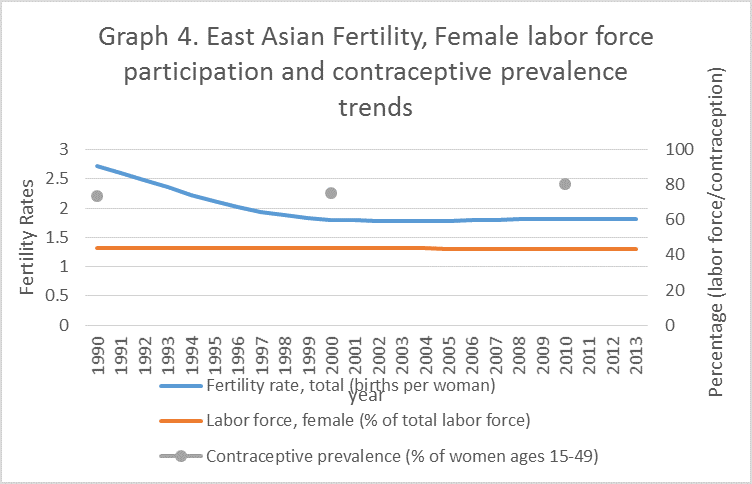
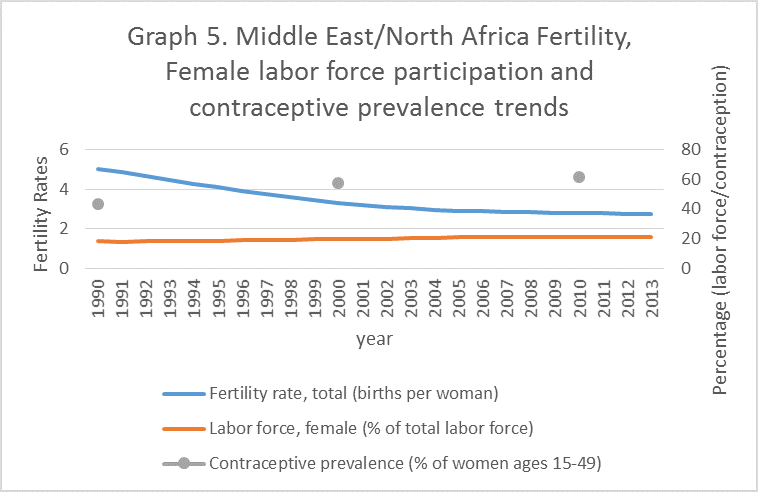
Graphs 4-6 records data for the three regions from 1990 -2010. It measured the changes through time of fertility rates, percentage of women in the labor force and the prevalence of contraceptives. All three regions witnessed the increased use of contraception: East Asia increased from 73% using contraception to 80% usage rates; Sub-Saharan Africa from 15 to 25%. Graph 4 depicted this increase in the East Asia/Pacific region and showed a roughly steady participation by women in the labor force. Aside from East Asia, there existed strong correlation between labor force participation by women and declining birth rates (-0.95 for both Middle East and Sub-Saharan Africa). Finally, a separate graph (Graph 7) was drawn for China by plotting its decline in fertility rates over time for the purposes of examining the effect of public policy on fertility. We see that fertility rates in China declined drastically from 6.3 in 1965 to 2.71 in 1980. Declining further until 1998, and it has held steady at 1.6 since then.

4). Conclusion

This paper studied the relationship between fertility rates and population density and prospective underlying causes for changing population densities. We found that there was a clear negative correlation between declining fertility rates and each of the individual factors measured: GDP per capita, female labor force participation and the prevalence of contraceptives. However, we cannot isolate any of these individual factors and point to it as a cause for declining fertility rates. Each of these factors are not mutually exclusive and acted to reinforce one another as well. For instance, increasing GDP per capita can increase contraceptive use since more women now could afford these new products; or along the lines of Boserup, increasing population could lead to greater density and more innovations and technological changes, which in turn increases income and decreasing the fertility rates. (Boserup) And it is possible that the variables examined are the result rather than the cause of fertility decline (i.e. a demographic “dividend” from having less child dependency) (Factsheet). The causes of fertility decline were complex and this paper only sought to examine a small amount of variables that can affect it.

The effect of family planning and government measures were more open to debate. For example, in China, we saw that fertility rates has already fallen to 3 by 1980, the year the so called “one-child policy” was implemented (Moore). Thereafter, the fertility rates steadily decreased, but based on comparisons with East Asia as a whole, it appeared that this fertility decline would have taken place even without the said policy. What appeared to be more significant in causing fertility decline remained the other factors discussed, such as increasing economic performances and contraception usages.

Limitations of the study:1. Exclusion of certain countries and regions from the study. There are incomplete information (missing fertility rates etc.) for certain country’s data. Therefore, these countries are not included in the regional averages. Some of the countries excluded have very high population density and relatively high birthrates (ex. some Pacific Island states) which are both factors we are attempting to draw conclusions from in this paper. This exclusion could result in errors that can affect our conclusions based on the graph and these data, once included, may result in slightly altered correlations and possible interpretations.

  1. Numerous other factors that may affect population density and fertility rates. There are other underlying factors that can cause a decline in fertility rates other than the economic development, women’s participation in the economy or government policy. Even though fertility rates negatively correlates between each of these factors, we cannot conclusively state that fertility rates rate is caused by these factors. Other factors that may be impactful include women’s educational attainment, and increasing quality and quantity of public health services. More studies need to be done how the effects of some of these other factors may directly impact fertility rates.
  2. The factors that contribute to fertility decline are not fully independent of one another. For example, the increased distribution of contraceptives may be the result of increasing economic output as measured by increases in GDP per capita, which enabled women to purchase contraceptives in the first place. The variables measured in this study can and do influence each other. Therefore, the conclusion drawn (that a negative correlation exists between fertility rates and all the other variables), may be an oversimplification.

Appendix:

Graph 1, Middle East GDP Graph 2, East Asian GDP Graph 3, Africa GDP Graph 4, East Asian labor force Graph 5, Middle East labor force Graph 6, African labor force Graph 7, China's GDP

Works Cited

Boserup, Ester. “Population and Technology in Preindustrial Europe.” Population and Development Review 13.4 (1987): 691-701. JSTOR. Web. 01 Apr. 2015.

“Contraceptive Prevalence (% of Women Ages 15-49).” World Bank, n.d. Web. 01 Apr. 2015. <http://data.worldbank.org/indicator/SP.DYN.CONU.ZS&gt;.

“Dropping Birth Rates Threaten Global Economic Growth.” CBSNews. CBS Interactive, 7 May 2014. Web. 01 Apr. 2015.

“Fact Sheet: Attaining the Demographic Dividend.” Fact Sheet: Attaining the Demographic Dividend. Population Reference Bureau, n.d. Web. 01 Apr. 2015.

“Fertility Rate, Total (births per Woman).” World Bank, n.d. Web. 03 Apr. 2015. <http://data.worldbank.org/indicator/SP.DYN.TFRT.IN&gt;.

“GDP per Capita (current US$).” World Bank, n.d. Web. 01 Apr. 2015. <http://data.worldbank.org/indicator/NY.GDP.PCAP.CD&gt;.

“Labor Force, Female (% of Total Labor Force).” World Bank, n.d. Web. 01 Apr. 2015. <http://data.worldbank.org/indicator/SL.TLF.TOTL.FE.ZS&gt;.

Moore, Malcolm. “What Is China’s One-child Policy?” The Telegraph. Telegraph Media Group, 30 Oct. 2014. Web. 01 Apr. 2015.

5 incredible facts about exchange rates

Currencies swap hands every second, and here is a look at some of the key (and often surprising, facts) about exchange rates. For a similar list about GDP, click here. For a list on inflation, click here.

  1. The floating exchange rate system.

The current system of international exchange rate is what is known as a floating exchange rate. Each country’s currency is not determined by a fixed rate to each other; but rather, they currency is set by the Foreign-Exchange market (Forex), which entails supplies and demands for that particular currency. Therefore, the currency can change freely and often by quite a bit, sometimes requiring central bank intervention to help maintain the currency’s values.

supply and demand for exchange rates

  1. The US dollar’s premier standing.

The US dollar is used in around 80% of international trade and it forms over 60% of the foreign exchange reserves currencies in the world. The dollar is used extensively to settle international trade and forms a large part of the foreign currency holdings in the world, which allows central banks to purchase the domestic currencies, sometimes to maintain a certain exchange rate. The largest holder of foreign exchange reserves holders are China and Japan, which holds around 4 trillion and 1.3 trillion respectively, of which a majority is held in US dollars.

Exchange_rate_03

  1. Currencies: Hard and Soft.

Not all currencies are valued equally as a store of value, and economists distinguish between hard and soft currencies. The US dollar, Euro, and Swiss Francs are generally considered to be among the top 3 hard currencies in the world, and the currency that people would move their money into in the face of economic and political uncertainty. In comparison, soft currencies are generally viewed as unreliable and fluctuates greatly in the foreign exchange markets. When the Eurozone debt crisis hits, European countries moved their currencies toward Swiss Francs and US dollars, therefore eroding the power of the Euro slightly as a safe-haven currency.

hard currencies

  1. Foreign exchange markets are among the most unregulated markets in the world and operates non-stop.

Internationally, there are few regulations on foreign exchanges, and each day, many traders (or speculators rather) enter and exit the foreign exchange market. Insider trading is not regulated on the Forex exchanges. Traders trade on any piece of information that they think is relevant and can move the market. The market operates non-stop and depending on the location (New York, London, Tokyo, etc), someone is always awake ready to do work.

dollar sterling exchange

  1. Foreign Exchange markets are enormous, and diverse.

Over 4 trillion dollars are exchanged on the foreign exchange markets each day. Profits to be made on Forex is actually pretty low, therefore the trades are done through borrowing on margins. Leverage is used to enhance profits and loss, with respect to the size of the account. Currencies are traded in pairs, and over 100 currencies are traded on exchanges. However, there are four major currency pairs, which accounts for most of the volume traded:

The British Pound and US Dollar (GBP/USD)

The Euro and US Dollar (EUR/USD)

The US Dollar and Japanese Yen (USD/JPY)

The US Dollar and Swiss Franc (USD/CHF)

The US dollar is the most traded as a part of currency pairs, accounting for 87% of daily shares (out of 200% possible since it’s traded in pairs.)

currency pictures

Related Articles:

GDP: how accurate are they?

6 Surprising Facts about Inflation

On Iran’s nuclear program: an alternative view

Iranian nuclear program has drawn a significant amount of international attention – and condemnation – since it was uncovered in the early 2000s. While the issue is complex and multifaceted, I believe a few points should be examined. First, why is the Iranian government desirous of a nuclear program? And do the people really want it? Second, how should the rest of the world respond to it? Are the current negotiations with Iran the best way to approach this issue? And lastly, how should we all proceed from here?

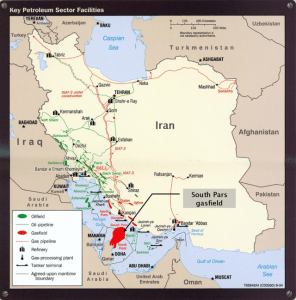
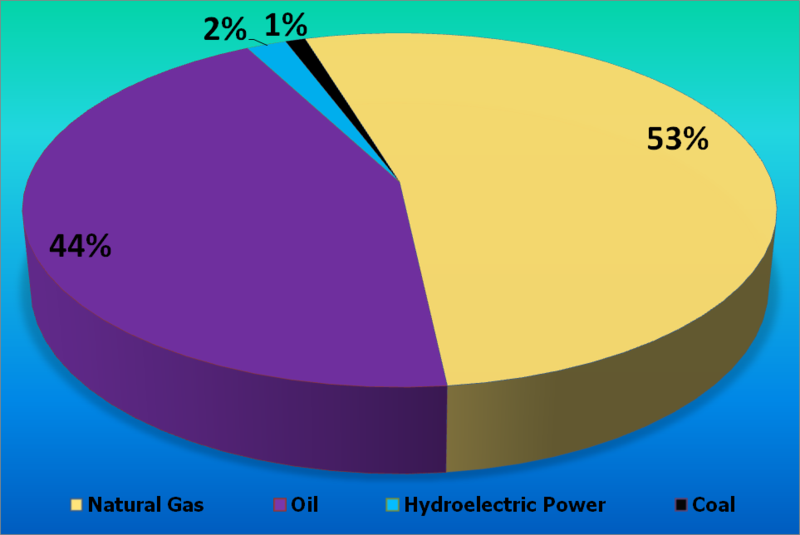
The Israeli historian Martin van Creveld once said that “Had the Iranians not tried to build nuclear weapons, they woul6a00d8341c4fbe53ef00e54f31467c8833-640wid be crazy.” Although his words may seem extreme, we need to understand what motivated the Iranian leadership to develop nuclear power, even in the face of mounting international oppositions. The Iranians’ own argument is that they need to secure their own energy needs in the form of nuclear power. This argument is hardly plausible: Iran is sitting on the world’s second largest reserves (after Russia) of natural gas. Iran’s South Pars gas field alone is estimated to contain 14×10^12 m3 of gas, around 5.6% of the entire world’s prove gas reserves. Moreover, the country contains the 4th largest reserves of oil in the world. Iran’s energy needs can largely be satisfied by its oil and natural gas, as can be seen in the chart below. iran energyIf energy security is not the real reason, then what is? The true reasons for such a program, I believe, includes the following:
  1. Scientific and cultural prestige: Let’s imagine that the Iranians do not in fact want to build a nuclear weapon (a highly unlikely assumption for reasons that I will explain later), the mere fact that Iran is capable of developing advanced technology is something that the Iranian government can be proud of. In Iran, like many other parts of the world, scientific advances symbolizes the greater progress made in a society. The Iranian government sought to legitimize itself by promoting science and technology (much like the Soviet Union spent tremendous efforts in space exploration to legitimize the ideology of Communism). The Iranian people want to see progress being made in a variety of different fields, whether it be a rocket launch or a prospective nuclear power generation plant. Iran is gaining prestige by possessing those technologies. In a sense, scientific prestige is also tied into cultural prestige. We need to remember that Iran is more of a historical civilization than a nation-state in the modern sense of the word. The Iranian people had inhabited the Iranian Plateau for thousands of millenniums, and for much of that period Iran (or Persia, as it is known for most of its history), is a leading force among the world’s nations, and not merely in technology. It is in early modern times that Iran had fallen behind. In a way, many Iranians want to regain that sense of pride which have belonged to them historically. As heirs to a rich cultural heritage, Iranians today no doubt want to relive a part of its ancient glories; developing nuclear powers along the lines of other advanced nations will symbolize a part of this regaining of prestige.Mideast-Iran-Nuclear-_Horo2
  2. Competition from regional powers: Let’s take a look at how the world appears from the position of Iran, and why its nuclear ambitions will likely lead to nuclear weapons. Geographically, Iran couldn’t be in a more dangerous position. As the map below shows, Iran is surrounded by potential or probable enemies. To its west, Iraq, despite its Shia majority (the majority religion in Iran), is embroiled in a complicated civil war with the radical Islamic State (IS). Further west, we see a similar situation in Syria, where Iran-backed government of Bashar al-Assad is fighting a multi-front war against IS and moderate rebel forces. Each of these governments, if they fall, would produce a serious threat to Iran itself; and these are just the militant organizations. Organized threats by nation-states posed a bigger problem still. In its southwest, across the Persian Gulf, the Kingdom of Saudi Arabia is ferociously anti-Iranian and possesses a powerful modern military and an alliance with the United States; other Sunni Gulf States are no more friendlier. Further to the west, Iran faces the strongest military power in the region in the state of Israel, which had spear-headed efforts to contain the Iranian enrichment program. Further to its north and east, Russia, China, Pakistan, and India are all nuclear powers. In such a dangerous neighborhood, Iran felt that by developing the bomb, it can achieve a sort of parity with the other regional and global powers, at least in part to compensate for its relatively conventional forces.
  3. Security and Geopolitical leverage: In a point related to the second one, we need to be aware of the fact that Iran really has no natural allies. Culturally, it is the product of thousands of years of Persian civilization centered in the plateau of Iran, influenced by the forces of Shia Islam for centuries (today, an absolute majority of the world’s Shia Muslims lives in Iran), and the rise of political Islam in the form of the Iranian Revolution of 1979. For good or bad, few other countries possess such a unique historical experience. While this is a point of pride for many Iranians, at the same time, this also meant that Iran cannot count on any natural allies in the sense that the UK can rely on the US or Kuwait can rely on Saudi Arabia. The allies and friends it does have among governments are less than appealing: Iraq is bogged down in a struggle of a sectarian nature between Shia-dominated government and Sunni militant Islamists; likewise Syria is fighting its seemingly interminable civil war; the militant group Hezbollah in Lebanon is considered an ally and a way for Iran to project power into the eastern Mediterranean, but is categorized as a terrorist group (its military wings at Shia_Crescentleast) by most governments around the world. Strategically, Russia can be considered an ally, but that nation is struggling in the face of western sanctions for its involvement in the Crimea and a falling oil price. (For a discussion of how falling oil prices are influencing foreign policies in Russia and Iran, see here). Iran is looking for new partners in China and India by offering them energy security; but this venture will be unlikely to result in any serious partnerships, especially if this partnership would result in possible international retaliations by the West. Iran is therefore left to defend itself against a myriad of threats. In this case, a nuclearized Iran can protect itself, or so the Iranian leadership believed, from military blackmailing. At the same time, Iran can project its power in what is known as the “Shia Crescent”, an area encompassing Iran, Iraq, Syria, and Lebanon, shaping itself into a regional power. Iran believes that thus nuclear power adds more muscle to its voice in regional and international affairs.

Needless to say, no matter what the reasons are for Iran’s acquisition of nuclear power, the rest of the world cannot be happy about the emergence of another potential nuclear power. However, the present countries that possess nuclear powers are in fact rebuilding their own respective nuclear arsenals even while they are denouncing the Iranian’s attempts to do so. We see that the rest of the world has been upgrading their own nuclear arsenals as well. In a recent article on Business Insider, the dangers of a nuclear war is emphasized more than ever before. However, the difference is that Iran is widely seen as an irresponsible government, and weapons in the hands of such a state is a worrying fact. But how should the rest of the world respond to it? Along the lines of journalist Fareed Zakaria, I believe that there are two main ways for the world to respond: 1. Forcing a Regime Change, or 2. Forcing a Policy Change. Let’s briefly define what each option meant and discuss their relative merits later:

  1. Regime Change:

In essence this would involve the fomenting of dissent, support democratic political movements, and with outside help in trying to overthrow the government of Iran in one form or another. Most likely, the United States would be the leader in such an effort. In the meanwhile, the US and other parts of the world should not have anything to do with Iran since it is an illegitimate government in their eyes. In the views many, the only way to properly address the nuclear situation with Iran is wait (or help) the government to change and then deal with them later.

  1. Policy Change:

This would mean that we will actively engage with the present government of Iran, treating them as an equal partner in these discussions, and really accept the fact that the government of Iran, however repulsive, is here to stay for some time to come. The dialogues will be conducted in an open manner and be peaceful in trying to reach a deal with Iran. For supporters of this option, they do not believe that this is a policy of appeasement, but rather, a step-by-step method toward achieving our objective, whatever they may be.

As a sophomore in college, I may not be in the best position to recommend foreign policy to those in the highest levels of government. But, nevertheless, I believe that here in the US and the rest of the world that does not desire to see a nuclearized Iran, have to decide on an option fast and not to oscillate back and forth between these two options. How can you possibly struck a deal with a government that you have every intention to help overthrow? Personally, I believe that the best option remains to bring Iran back into the international system, which it had been an outcast member since 1979, and to engage with it in more direct dialogue. We need to bring in international partners, which must include China, India and Russia, to discuss options with the Iranians on what to do. We must make Iran as an equal partner in its negotiations and not treat it as a criminal state. We need to recognize Iranian interests and why they sought to nuclearize themselves and to stress our own positions and concerns in why we do not want to see a nuclear program: no, it is not that we desire to encircle Iran on all sides, and no it is not that we desire to see a weakened Iran that is susceptible to invasions at any given moment. There are too much distrust and misconceptions between Iran and the West at the moment, each is mistrusting the other’s intentions. Therefore, if we can build an international coalition on resolving the issue, we can legitimize our intentions and make the Iranians understand that it is in the interest of the rest of world for them to denuclearize.

Current policies in delaying Iran’s nuclear programs have many merits to them. Firstly, the alternative, that of calling Iran to immediately destroy their nuclear facilities, will only strengthen their resolves in continuing to build them. If not in open, then in secret. Therefore, delaying what Iran has been attempting to do, by years (a very possible prospect), leaves the rest of the world with more options in dealing with the government. But more importantly, it buys the rest of the world time. The structure of government itself may likely change with the passage of years. I do not necessarily mean a revolution, but rather a gradual process of liberalization that will see a new generation of Iranian leaders that do not want to confront the world and or is filled with xenophobia, but rather sought peaceful coexistence. Younger generations of Iranian do not have the fervors of religious fanaticism that may have characterized some of their parents; in fact, I believe that many young Iranians today want to embrace the international system and be a part of modern society. I believe that will the passage of time, Iran can be a more responsible stakeholder in the international system and we can work with Iran toward this issue. However, in order to do this, we must first talk openly with Iran.

The importance of continuing dialogue with Iran cannot be overstated. If left isolated, Iran will retreat into itself and develop and deepen a paranoia of the rest of the world and perhaps the unthinkable will happen: a nuclearized Iran ready to use its weapons on its neighbors and beyond. As a historical analogy, imagine what if Henry Kissinger had never traveled to China to open up dialogue with that secluded nation, China today would possibly have been another North Korea: a government that is isolated and clung to an outdated ideology with a belligerent attitude toward the rest of the world. But to the credit of the US government (both the executive and the State department), rather than seeing this happen, the US government actively engaged with Chinese leadership and brought China into the international community of nations; a community that China has a stake in. In a similar line, I believe that by keeping the dialogue option open with Iran, we can hope to make some progress. Of course, this can only happen with Iranian commitment as well, and it needs to tone down the rhetoric against its neighbors and their allies, most notably Israel and the United States; it needs to show real commitment in following through with its promises; but above all, Iran needs to see that it is to its own security and benefit that it becomes a part of the international system rather than a challenger to it. Perhaps, eventually, Iran will be able to develop its own peaceful nuclear program, much as how Japan and South Korea has developed them, without feeling the need to weaponize it. All of these will likely take an enormous amount of time, likely decades; but I believe that in the end, the path of continued negotiations and dialogues with Iran will be preferable to any other alternative.

For related topics see:

Resource dependency, oil price decline, and the reshaping of the international order

Oil companies and the ethics of overseas investment

The complicated story of the conquest of the American West: ideologies, economic pressures, and social forces

I realized that on this blog, I haven’t yet written much on the topics of history and have mostly been focused on current events with international or economic implementations, therefore, I have decided today to write about topics of history which interests me. As the first part of a series on history, let’s examine the story of the American West.farmers of the west

The expansion of the United States is a complex process that took place over the course of centuries and left behind a legacy that is still being felt today. The process of the “conquest” of the West involves the interactions of not only different groups of people but also different ideas that contrasts and clashes with each other often violently. In forming a true understanding of the West, we must look at three things in particular, the power of ideologies in westward expansion, the role of commercial/practical interests, and the way the whites interacted with the natives (in many ways defined by the first two ideas).

The traditional stories of the West is a story involving the ideals of Enlightenment and Liberal Humanism, the idea that all mankind has certain inalienable rights and a belief that all humans, by using logic and reasoning, can bring about improvements to society. Central to Enlightenment thinking is the concept of Progress; which in the case of the American West, is the ideas of “Manifest Destiny”, the idea that it is a God-ordained right of the American people to populate the continent.American_progress

However, this idea of progress is inherently problematic, as the Western notion of progress is not applicable everywhere, and it is most certainly hard to define. What is defined as Progress – with a capital “P” – is all political, and often progress is a way for people to legitimize the actions they have undertaken. What is progress for the Whites in the early nineteenth century is certainly not the same as those for the Indians who have been living on the land for hundreds or thousands of years. However, for the Whites, the Indians have made no progress. In many cases, the land has not been modified in any noticeable ways, especially among the Plain Indians (such as the Lakota Sioux). To White Americans, Progress is defined as having farming as well as industry as the backbones of the economy, and not in a nomadic lifestyle. However, for the natives of the Plains, the land is being used productively, as they are entirely self-sufficient in using the land and its products for their needs. Here we see the contrasting notion of what is Progress and what is being productive, with white farmers and industrialists pushing toward the West for what they believed was being productive, with Natives viewed as counterproductive forces that inhibited the full exploitation of the West and must be removed in order to fully exploit the area for the benefit of all.Native Americans group

This perceived lack of progress is also used as a justification for the taking of the land from the Natives. An example would be the taking of the land from the Plains Indians. Since the introduction of the horse, the tribes of the Northern plains have been living in a largely nomadic lifestyle. In their case, it is the view of many Americans that by bringing farming and large-scale mining of the Black Hills of South Dakota, the land can be used productively.

Enlightenment ideologies also serves as a guiding force for the expansion of the country, and not merely for its justification. For example, the one of the central argument for the early expansion of the United States is the need for the country to find agricultural land for its expanding population. This is part of the Jeffersonian ideal, as the yeoman farmer is believed to be the very foundation of the democracy and stability, and best serve the interests of the country by being tied to a stable home and resources; or as John Adams stated, “Power always follows property”. However, this assumes that the land is empty for the taking, which it is not. Hundreds of tribes lived here and some have been farming for many years, such as the Five Civilized Tribes of the Southeast, who have even adopted many aspects of US laws. The Whites wanted the land, but to simply rob the land of its rightful owners is in contrast to Enlightenment ideals of equality. Therefore, in order to justify this taking of the land, Whites interpreted theses rights of the individual as belonging to White males only, and the rights of the natives were largely ignored, and that a Native no matter how educated he becomes or how he adapts western culture will never be fully integrated. Here, we see a double standard: where whites are superior to natives and the forces of western civilization is stronger than the forces of native ideals, and we assume that these relationships will hold true in any situation. This is a way for certain groups to systematically deprive the Natives of their rights and their claims on the land and to clear them unto reservations where they will be truly “civilized”.

The Jeffersonian ideals of the early 19th century did not last very long, already, with Jackson we see a trend of having governmental powers serving the interests of industrial and corporate needs rather than that of small independent parties. For instance, the clearing of the Cherokee Indians is in large part due to the discovery of gold in the region, and this is a pattern that will repeat itself over and over again in the course of the 19th century, in the discovery of silver in Nevada and Colorado, and in the discovery of gold in the Black Hills of South Dakota. Every time, a need for natural resources arises, the natives that controlled the land would often be the first ones to go, to be moved to a barren reservation. Indeed, in many cases, what motivated Westward expansion is not so much as a commitment to ideals as desire for money and other natural resources.

In looking at the West, we must understand how the Nature of the West appears to Americans from the colonial era into the 19th century. While the borders of frontier is being constantly pushed westward, there is the constant idea that the wilderness beyond the frontier is filled with danger. The West is perceived as a wild land that needs to be tamed. To many White Americans growing up with the Christian tradition, the Wilderness is a hostile place where the devil resides, and it takes the forces of civilization, of mastering nature to turn the West into a civilized place. To different people, the West can be personified either as a seductive female waiting to entrap the civilized man if he is not careful, or a virgin waiting for civilization to come. In any case, we see Nature being personified as a female as contrasted with the largely male explorers and later miners and other workers. Again, this is an example of hierarchal dualism, where the female (perceived as weak but potentially dangerous) as being subordinate and subjected to the forces of the male dominated civilization of the Eastern US. For the Indians that have always call the “wilderness” home, the construction of the pre-settled West as a wild uncivilized land is certainly inaccurate. Here we see the social construction of nature, where White civilization imposes its view of what is Nature and what is wilderness on the environment, with little regard to what the Native inhabitants of the land believed in.

With connection to the nature and exploration, a uniquely American concept was also introduced in the 19th century, the concept of “rugged individualism”. look outThe myth of this individualism states that the American Protestant man and his family overcame great hardships to venture West and establish for himself a home in the wilderness, where he, again, through his hard works and resourcefulness, overcame all sorts of difficulties and prospered. In every stage of his home-building, he is always independent of the society around him and is always. This is also part of the grand narrative of the West, where individualism (as exemplified by cowboys, rangers, and sheriffs as well homesteaders) is praised.

However, nothing could be further from the truths. One woman who moved to Nebraska in the 1880s, commented that everyone seems to “live out of cans”. This demonstrates an intimate connection to the East, where manufacturing and canning occurs. Indeed, while the people is living in the West, the people have not severed from their roots. Besides relying on the East for manufacturing support, the West is also reliant on the East for market and for exports to Europe and the rest of the world. The economy of the West is based on commodities: Gold, minerals, cattle, crops, etc, which cannot be consumed in the West alone. The West is not self-sufficient and has never been so. To argue the opposite would run contrary to historical facts.

So the next time you hear or read about the American West, do not merely think of gold rushes, cowboys, individual heroisms, or other things we normally associate with the region. Instead, remember that the west is a part of the larger historical narrative of America, something that is far more complicated than it first seemed to our mind.

6 Surprising Facts about Inflation

While we encounter inflation everyday in our lives, and most of us don’t think too much about it. But here are 6 surprising facts about inflation that might make you rethink how inflation might impact you. Click here for a similar list about GDP.

  1. Inflation in the US

While here in the US, we do not really have an inflation problem, and many simply ignore inflation altogether. On average (from 1913 to 2006), the rate of inflation in the US is 3.45 percent per year, at this rate, price level doubles every 21 years. This is equivalent to saying that a dollar today is worth only 50 cents 21 years from now. Keep this in mind the next time you decide to invest in a bond or want to plan for your retirements – inflation really do eats away at those returns!

value-dollar over time

  1. Frequencies of hyperinflation

Hyperinflation happens more often than you think. From 1900 to 2013, there have been 56 recorded cases of hyperinflation (essentially runaway inflation that made that results from a combination of bad fiscal policy and a lack of public confidence in the value of the currency). It happened not only during 1920s Germany or Zimbabwe in the 2000s, but also places like Argentina and Brazil in 1989, Russia in 1992, and the former Yugoslavia in 1994.

Russian-Inflation-1996-2011

  1. When hyperinflation occurs

Historically, hyperinflation generally occurs during periods of political transitions or after a national catastrophe, usually war. Examples: in the former Soviet republics from 1992 to 1993 (in Armenia, it reached monthly inflation rates of 438 percent, in the Ukraine it reached 285%); in China immediately after the collapse of the Nationalist government in 1948 and shortly before the Communist victory; and during the devastation in the 1990s of the Yugoslav wars, etc.

historic cases of hyperinflation

  1. Inflation does not necessarily increase the cost of living

Inflation is defined as the average increase in price levels over a given period of time. However, not all of us purchase the same type of goods and services. Therefore, inflation for each person is different. For someone who spends a large chunk of their income on transportation might experience very modest increases in cost of living even if other products on the market increased in prices dramatically.

fisher-investments-Inflations-Impact-300x231

  1. Inflation in certain sectors of the economy dramatically out-paced that of others

Inflation can vary dramatically, depending on which sector of the economy we look at. Certain products and services like college tuition and hospital services increased in prices by 300% from 1989 to 2012; Compare this with the increase in the price of a new car, which increased by about 20-30% over the course of the same period. Clearly, while no doubt inflation affects all sectors of the economy, some sectors are clearly more impacted. (Personally, as a college student, the high increases in college tuition is indeed a source of constant worry).

  1. Inflation is not necessarily bad

In fact, a modest amount of inflation is normal in a healthy and growing economy. Price volatility is a normal part of the economic picture and no central bank had ever set the interest rate at 0%. What is truly bad for the economy is the prospects of deflation, a general fall in prices over a certain period of time. In this scenario, businesses would invest less (resulting in lowered economic output), layoffs and mass unemployment will follow. Unsurprisingly, deflation often occurs hand in hand with recession and can in fact worsen an economic contraction. In 2009, the United States had its first case of deflation since the Depression years of the 1930s.

United-States-Inflation-rate-History

GDP: how accurate are they?

As educated citizens, there is no single measure of economy that we care more about than the GDP figure. Any increase or decrease in the change of GDP growth rate are bound to make national headlines. Witness the news media frenzy following the GDP figure release for China:

China GDP 2015 GDP news

Clearly, as a society, we regard the GDP figure as something more than a number that measures how large the economy is or the rate at which it is expanding (or contracting); but rather, we see GDP as almost a sacred figure. We take pride in our national economic output, we base our consumer confidence based on these numbers, and more importantly, politicians and decision-makers based their course of actions upon the changes in these numbers from year-to-year. We take the number as something that’s grounded in reality and something that’s unquestionable. And while some would argue about the usefulness of the GDP figure as a measure of the standard of living, most would accept the accuracy of those numbers. But how accurate is it really of a nation’s economic output? Here are several surprising facts that shows that perhaps GDP is not all that it seems. (For a similar list about inflation, click here)

  1. Ghana GDP revision: In 2010, Ghana decided to reexamine its GDP figures by using a different base year to calculate growth over time. The result? GDP was revised upward by over 60%.

Ghana GDP

  1. Nigerian GDP revision: In 2014 Nigeria recalculated its GDP (using a different base year) to include more sectors of the economy such as telecommunications. This recalculation resulted in Nigeria shifting its economic output by upwards of 80% and leading it to become the largest economy on the African continent, surpassing South Africa.

Nigeria's GDP revision

  1. Japan’s GDP calculation mistake: For the 4th quarter of 2012, Japan’s GDP was calculated as shrinking by 0.3%. In reality it increased 0.1%. This miscalculation was the result of a failure to correct seasonally-adjusted figures and misreporting of the GDP deflator (a measure of inflation).

Japan's cities at night

  1. An Excel error and its impacts on public policy debates: In 2010, two economists, Carmen Reinhart and Kenneth Rogoff, published a report claiming that countries with High Debt/GDP ratios have lower growth on average. To support their argument, they used data from 20 advanced economies and calculated their average rate of GDP growth. However, they neglected to select 5 countries (Australia, Austria, Belgium, Canada and Denmark) with both high Debt/GDP and GDP growth rates, skewing their result and the conclusions they draw. This mistake had profound implications. Congressmen and others within the federal government cited this as proof that our federal deficit each year needs to be reduced by cutting a variety of programs, so that our economic growth rate may remain unaffected.

GDP excel error

While this is not strictly a GDP error, it shows how a small mistake in calculating GDP data can seriously affect the conclusions drawn from it.

  1. US quarterly GDP revisions: For the first quarter of 2014, US GDP was revised downward a couple of times, each time suggesting that the GDP contracted further on an annualized basis. Much of the downward trend is the result of less-than-expected consumer spending on healthcare, and the lackluster performance of exports. In part, the GDP contraction was due to an exceptionally cold winter in the US.

US quarterly GDP revision

  1. Bank of Canada’s forecasting errors: Even in developed countries, economic forecasts can often go wrong. The Bank of Canada (Canada’s central bank) failed to forecast the small economic downturn in the fall of 2012. The bank of Canada’s forecasts are often overly optimistic. Out of 5 of 7 time periods studied, the average economic growth forecast is 0.6 percentage points higher than the actual; and 75 per cent of medium-term forecasts by the Bank of Canada were overly optimistic.

GDP growth in Canada per capita

So here it is. So the next time you hear in the news about GDP figures, remember that GDP is a number that’s created by people. Most often, these numbers are correct and give a good picture of our nation’s economic health. But at times, we base our GDP figures, past or future, based on faulty or incomplete information. And sometimes, we make plain simple mistakes.