12 Important metrics for short selling

Intro:

In my previous experience in short-selling, many different quantitative and qualitative metrics were used to filter through prospective short-sell candidates. Many of these that I am about to discuss are frequently used in the entire industry, and you will definitely find a list that are even more comprehensive elsewhere on the web. Of course, as the sophisticated investors know, each fund is unique in its approach in determining what metrics are important and weigh it accordingly in their overall model. For instance, some more quant-driven funds prefer to include as many variables within their models as possible and to encompass all possible factors that can affect a company’s earnings (causing the earning to go lower, in the case of short-selling); while more fundamental funds focus on a few core variables and do more in-depth investigations to build up a story of the company and decide then whether or not to short the company’s stock.


Most of the information presented here can be found through one of the financial services websites/tools commonly used in the industry. Personally, I have used Capital IQ for many of the financial metrics. More sophisticated investor may decide to use a combination of different services and/or build their own tools to gather data. In this article, I have used the words “quantitative” and “financial” rather loosely and at times interchangeably; and “qualitative” and “non-financial” as well. I apologize in advance some of the confusions this may cause.


Without further ado, here are some of the most important metrics, 6 each for both quantitative and qualitative factors:


Quantitative/Financial factors:


  1. Short Interest: This ratio essentially tells us what percentage of the shares outstanding is held for purposes of short-selling a stock. The higher the short interest, of course, the more likely the investor believed that the stock is likely to fall in price.


What it means: For investors, this can be an indicator that the market is overly pessimistic on the stock or that everyone already knows that it is a bad stock. I would recommend that investors not get into stocks with high short interest for a few reasons. First, this suggests that there is likely few profits to be made if everyone already recognized the mispricing. Second, for short-sellers to profit, they must buy back their position, which causes a spike in the price. This can be a rapid increase if too many short-sellers “cover” at once, resulting in a situation that is termed as a “short-squeeze”. Investors many not profit in this case. Finally, as hedge funds and active investors in general want to “beat” the market, it is important to realize that you can’t “beat” them if you invest like what the rest of market is thinking.


  1. Stock Loan Fee: This is the price that an investor will have to pay to borrow a stock. This is provided in a percentage (the cost of borrowing/share price). Generally the short-seller’s prime brokers (the guys who loans out the stock) will provide the borrowing cost number to the borrower.


What it means: As with short-interest, a higher percentage of borrowing cost suggest that many investors are expecting the stock value to fall. Depending on the demand and supply, borrowing cost can become exorbitantly high, and investors should be aware that this interest can eats away at returns substantially the longer the short position is held out.


  1. Days Inventory Outstanding: This financial ratio from the balance sheet is simply how long the company takes to collect its inventory. It is calculated by (inventory/COGS)*365. This ratio – also going by the name of “Days Sales of Inventory” – generally gives a good indication of how long the inventory is held by the company before sales occur.


What it means: In general, the longer the inventory is stored, the worse it is for the company. This means that the company is having a ton of inventories but aren’t able to generate sales on those inventories. This can suggest that a firm is incapable of selling goods due to operational issues. As with all ratios, comparisons over time is crucial, if the firm has been increasing its in Days Inventory Outstanding, that is definitely a bad sign. Similarly, horizontal analysis between different firms within the same industry tells us how the firm is doing in comparison to its peers.


  1. Days AR Outstanding: like its cousin “Days Inventory Outstanding”, this ratio also measures a company’s collection period. In this case, it measures how long it takes for companies collect on their accounts receivables, and turn them into cash.


What it means: This ratio is frequently used in forensic accounting due to the fact that many accounting frauds involve 1) overselling to their buyers even when there are no demands, and thereby increasing their revenues or 2) companies book fictitious AR sales when in fact no such transactions happen. Higher Days AR outstanding is certainly not good, and a pattern of increase days AR outstanding is certainly worrisome.


  1. Comparison between cash flow from operation increases and net income increases: There probably is an actual name for this type of comparison, but the name is escaping my mind right now. Company’s net income and cash flow from operations should move in the same direction, and with some exceptions, be of the same magnitude.


What it means: comparisons between cash flow and net income is important because this tells us whether or not the company is truly turning those “net incomes” – which is an accounting construct – into something more tangible – cash. The general idea is that while earnings (net income) can be easily manipulated, cash flow is much harder to be tinkered with.


  1. EV/EBITDA: This is perhaps the most commonly used and the most important among all the ratios discussed. It is calculated by EV: (market common stock value +debt + preferred equity + minority interests – cash/cash equivalents) divided by EBITDA (Earnings Before Interest, Tax, Depreciation, and Amortization). This is the theoretical value that an outsider buyer would have to pay to by this company from the market.


What it means: Value investors use this frequently to find the whether or not a company is undervalued, and this offers a much more comprehensive look than the more commonly used P/E ratio, since it takes into consideration debt. It is often thought of as giving a “truer” value of the company.


Experienced investors will notice from the above list that several of the mostly important metrics that the long-side use to discover “value” stocks are not used; namely: P/E ratio, P/S, Debt/Equity, Interest Coverage ratios, etc. These ratios are absolutely necessary to look at as well, but for the purpose of this article, I am emphasizing only the important ones for short-selling. Value investing and short-selling are in fact two-sides of the same coin; whereas value investors want to find undervalued companies, short-selling want to find overvalued ones.
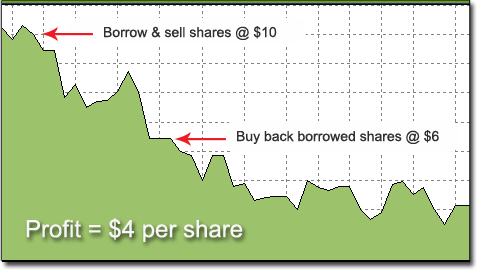
short-selling graph 

Qualitative/Non-Financial Factors:


This section is much more open to debate and I included only the 6 that I have come across the most often to give a sense of the wide variety of non-financial factors that can affect stock performance. Many of these can be tracked, and especially with advancements in natural language processing, these qualitative factors can in fact be quantified and placed into a model.


  1. Location of firm’s headquarters, region of operation, etc.: Always beware of where the company is based at, as some locations are inherently more questionable than others. An investor should also beware of constant changes in a company’s location as well.


What it means: Location, location, location. This matters in more than just a real estate sense of the word. Where a company is headquartered matters and having its operation based in a region with more governmental oversights versus less oversights is vital in evaluating the firms’ long-term survivability when the regulations do tighten.


  1. Number of years of experiences of management team: Looking at the average number of years of experience for the managers of a company can give a good idea of how the firm will be able to weather the next financial storm.


What it means: A younger average age for a management team is not necessarily a bad thing, as the young can always bring fresh ideas to the top. It is however, always questionable when someone with no real prior experience in managing companies suddenly becomes a more senior member of the team. Experience at the top is generally a desired quality.


  1. Number of documented SEC filing changes: This is a very well know one, and academic studies have been done on this subject. Firms must file to the SEC certain material changes to their operations, namely that of 8-K (current report), and other mandatory press releases. More frequent filing generally does not bode well for the company.


What it means: It has been found that firms that file more SEC filings have a tendency to engage in fraudulent activities, since they may be constantly trying rebrand themselves to investors. Firms, as a rule, should expand orderly and methodically, and any changes to its operations should be done infrequently and with plenty of preparations. Frequent SEC filings suggest otherwise.


  1. Number of CEO/Top Management changes: Technically this counts as part of SEC filings. But I would like to break this out because management is such a critical component of a company. As with SEC filings, the more frequent the management changes, the less credible the company becomes.


What it means: As the people in charge of setting a strategic direction for the company, we want to see consistency in the direction-setting for the company. Frequently changes at the top affects the morale down to the employee, and suggests that the company do not really have a good sense of where is heading toward.


  1. Executive pays in relation to firm’s performance: While it is difficult to fix a ratio to executive pay to firm’s net income, a much more realistic ratio lies with percent of executive pay increases versus earnings increases. Executive pays tie into stock performance (This is all part of the “shareholder model” of corporations where there is a perceived “principal-agent’s problem” and be partly solved by incentivizing management with stocks), and the pay can be lopsided in favor of management even when they are not really delivering value to shareholders.


What it means: When management team have been paying themselves a handsome salary while the firm is still deep in the red or have a lackluster performance, that should most certainly be a red flag.


  1. Insider transactions: SEC also requires this to be disclosed, as it shows how much stocks the company’s executives are buying or selling.


What it means: While insider buying almost always is a good sign for the company, as it shows the insider’s confidence in the company’s ability to generate revenues and profits in the future, insider selling can be a bit mixed. However, if all insiders are unloading their stocks simultaneously over roughly the same time period, this is certainly not a good sign.


Here again, I must emphasize that the non-financial factors are highly controversial and every firm approaches it differently, and these lists are far from exhaustive.

financial graphs


Conclusion: As we can see above, a number of ratios and metrics have been used by professional investors in identifying short-sell candidates. When using these metrics, always make sure to compare it with the same company over time (i.e. vertically), and with similar firms within the same industry (i.e. horizontally). Valuation does not mean much if you cannot compare it to another firm or the same firm over time.


In practice, I believe that all of the metrics can be quantified in one way or another, perhaps some can be quantified with a greater precision than others. Short-selling is certainly filled with risks and dangers, but with the right tools and the correct analysis, I do believe that “Alpha” can be generated on the short-side. Good luck investing.


Disclosure: This article represents opinions that are entirely my own, and should not be taken to be the opinion of any individual/company that I have worked for, past or present. I am not and do not purport to be a registered investment advisor. This is not an offer to buy, sell or market any securities. Short-selling is risky and you may lose all of your initial invested capital. Short-selling is recommended for experienced investors only.




Revisiting the issues of labor discrimination

It is generally accepted by economists that discrimination is an influential factor in affecting the functioning of a modern day economy. Theories regarding discrimination – its impacts on the global economy and possible solutions to the problem – have been debated and argued by influential economists over the decades. A key question that we ask ourselves is: will the market regulate itself and be able to eliminate discrimination, or does the government have to intervene? If so, what is the best approach to government intervention? This question can be seen as a part of the larger debate between the neoclassical economists and the Keynesian economists over the role of government in our economies and social lives.

This problem of whether or not to regulate the issue of discrimination has been debated by politicians and economists over the years, especially since discrimination is not only an economic issue, but also a social one. Historically, governments have taken a generally laissez-faire approach to economics in society, and regulations are few, especially in the US. This changed dramatically starting in the late 19th century, with the emergence of populist movements such as women’s suffrage, and accelerated dramatically during the two World Wars and the Depression era, when governments began to take a more active economic role in society and mandated fairness in hiring in order to receive federal funding. Finally, the Civil Rights movement of 1950s and 60s pushed the issue to the forefront and the government enacted broad legislations regarding labor employment practices. Two of the most notable legislations of the period are the Equal Pay Act of 1963 and Title VII of the Civil Rights Act of 1964. The Equal Pay Act have stated that firms should take into consideration a person’s gender in the determination of wages using the theory that that the same amount of work deserve the same amount of pay. Title VII of the Civil Rights Act made it illegal to discriminate based on a person’s “race, color, religion, sex or national origin”, and implemented a comprehensive list of anti-discriminatory methods.

However, in more recent years, the problem of discrimination takes on a new turn with the rise of “Deregulation” and the stepping away of government from some of its historic stances on promoting more equality in the market-place, and igniting the debates anew.

labor and management.jpgThe current consensus is, in a way, a reaction against the free-market advocates, which have become especially popular in the US since the 1980s. In fact, it has been argued by economists that discrimination has increased from the ‘80s onward, in large part due to the popularity of this line of argument. We can examine this opposite side of the argument by looking at the positions taken by two of the greatest economists of the latter twentieth century: Milton Friedman and Robert Lucas. Friedman had argued that the free market will resolve the problem of discrimination itself because discrimination is inefficient in the long-run (“Capitalism and Freedom”, 1962). In one of his most often quoted passages, he stated “It is a striking historical fact that the development of capitalism has been accompanied by a major reduction in the extent to which particular religious, racial, or social groups have operated under special handicaps in respect of their economic activities; have, as the saying goes, been discriminated against.” Friedman believed that the employer’s self-interest will cause them to overlook the other categorical attributes of an individual in favor of whoever can work the cheapest for the most amount of productivity.

On an interesting note, Friedman was himself the subject of discriminations during his times at the University of Wisconsin at Milwaukee, and one of the chief reasons he chose the University of Chicago for its PhD program was due to its open and more tolerant environment. In a sense, Friedman affirmed the idea that discrimination is detrimental to the employer (in this case the university) by “voting with his feet” to a location that was more tolerant.

Writing along a similar line, Robert Lucas stated that any irregularity in the “Market” introduces a distortion that will resolve itself over time. And in his view, government attempts in ending discrimination will simply introduce new inefficiencies in the marketplace that has to be resolved. What both of these economists suggested is that firms are very rational and they pursue the maximum amounts of profits possible. In order to do this, it only makes them to only care about costs and benefits, and since race/ethnicities/gender, etc. does not have a specific benefit or cost associated with them, firms will not discriminate. For those firms that do discriminate, in the long run they will become inefficient and the competition will eliminate them from the marketplace. The free market is the best left alone, according to Friedman and Lucas, since the mechanism of incentives in a rational society will help to eliminate discrimination and get rid of these inefficiencies.


Meanwhile, the mainstream have taken the view that in order for discrimination to be solved, the markets must be regulated through governmental legislations and acts. They are essentially arguing for a top-down, command-and-control method in regulation approaches to enforce those regulatory methods. Many noted that more regulation has been the historical trends, as more legislations have come on board over the years to prohibit certain behaviors from employers. They outlined two main approaches by governments to combat discrimination. The first is what is generally referred to as “Nondiscrimination” where employers are essentially blind to race, ethnicity, or sex, and to determine that those factors should not play any role in the selection of workers (This is the principle behind the Equal Pay Act). The other approach is termed “Affirmative Action”, where employers MUST take race, ethnicity, and gender into account to ensure fair representation, especially for historically disadvantaged groups. These two approaches have proven to be somewhat contradictory, i.e. how to ask ask employers to be blind to the differences between workers while at the same time be cognizant of the fact that certain groups should be considered more highly, holding other factors constant? This contradiction made it difficult to implement some of these methods in ending discrimination, and it is somewhat flawed as a result.

In addition, Title VII also distinguished between disparate treatment and disparate impact; where disparate treatment is defined as being proof that the workers are intentionally being discriminated against, while disparate impact are defined as result from actions, however unintentional, that results in some groups being disproportionately impacted. All of these are important considerations for firms that are trying to avoid discrimination.

In cases where it can be difficult to implement equal for equal work, they introduced the idea of comparable worth to help measure employee value. Often, many noted, it is impractical to “achieve equal pay for equal work”. Therefore, some have supported the goal of equal pay for jobs of “comparable worth”, and what determines the comparable worth is market forces. Comparable-worth policies have generally relied on job-rating schemes by employers to determine or justify pay differentials. However, this job-rating scheme is highly subjective and subject to great controversies.

As a case example, many pointed to the example of the Federal Contract Compliance Program, where governments monitor hiring and promotion practices of federal contractors. This program utilized affirmative action to ensure that groups that have been historically disadvantaged received preferences. In terms of absolute numbers, the federal contract compliance program increased opportunities for minority groups tremendously. The concerns with these programs is that when underrepresented groups are given preferences in hiring, this might result in less qualified workers being hired. And since the programs only covered the federal contractors, it is possible that while the program attracted talented minorities, there might be no overall gains in employment due to other sectors of the economies being neglected. As evidence of the effectiveness of the government programs, some have pointed out that government policies have distributed new employment opportunities among federal contractors towards blacks and Hispanics. The ratio of black to white incomes has risen since the 1960s, but we cannot effective draw causation relationships between this and the governmental legislations.

Finally, the mainstream believed that it is important to continuously monitor the economy to catch discriminators. One way to do this is to conduct an audit where blind experiments are conducted, telling auditors to look at firms and measure the effects of discrimination. However, these studies are very difficult to conduct since the auditors cannot know the purpose of the experiment (since that will introduce an element of bias), while at the same time, they are very difficult to conduct due to cost constraints. In another famous experiment, which has since been replicated worldwide, experimenters send out resumes to a number of different firms. It was found that white-sounding names needed 10 resumes to receive one call back, while black sounding names required 15 resumes to receive one call back, a 50% difference in employer response rate. However, even this experiment can be subject to bias, as the names may in themselves be a signal on the quality of the workers, and not necessarily having anything to do with race itself. For instance, it is possible to have a name of “Jared” being associated with a bad worker, but not necessarily to that person’s race.


I believe that while the the mainstream’s position is elegantly argued for, and we agree with the general premise that the markets need to be regulated. However, I believe that regulations may not work in all cases. The solutions many economists presented are excellent, but may not be adequate since it doesn’t allow a degree of freedom to the individual to decide in specific cases of discrimination. Governments can do a number of other things that can combat the effects of discrimination, besides direct, top-down regulation. I believe that the government should embrace a comprehensive, top-down approach in fighting discrimination, while at the same time, it might work with other players in the market so that anti-discriminatory laws can be used effectively and efficiently.

Firstly, I believe that free markets are efficient in the sense that it generally can allocate resources as needed to the market actors. Markets generally have a very remarkable ability to become efficient with the right incentives. However, in the case of discrimination, it may become inefficient due to the lack of those incentives. In many cases, discrimination can be good for businesses since they are able to charge different wages to different individuals, and they are able to get the same amount of work out of some workers while costing a fraction of the wage expense. This has historically been the case with what we call the “gender wage gap”, where men and women are paid different wages for essentially the same amount and quality of work. In addition, we often see firms hire workers whom they or their employee knows well (a network effect). This can be discriminatory because the results (disparate impacts) can be discriminatory in nature. The only way to solve these issues is by having firms being regulated directly by the government to change the historic legacy.

Secondly, I believe that governments should take a leading role, but not the only role in helping to end discrimination. A government’s approach should be based on both “carrot” and “sticks”. Governments can directly punish the worst discriminatory offenders, while at the same time, they offer incentives to encourage diversity in the workplace. Governments should consult the private sector to see why they may not want to hire women/minorities, and work with them to help design incentives to help end discrimination.

Thirdly, governments can also utilize other methods that are not direct regulations, for instance through education in non-discrimination. This in fact has been promoted in the schools’ educational curriculum in the past few decades and have been credited with helping new generations of workers and employers understand the value of diversity in the workplace. Educational changes can cause the deepest changes in the way workers interact with others and in a firm’s hiring practices. In many cases, the markets simply are not aware of the potential benefits a diverse workforce can bring along, and it takes some educational efforts, in part facilitated by the government, to change the firm’s hiring practices.

Lastly, I believe that the free movement of people has been extremely beneficial for firms and discriminatory practices would stop this free movement of people. Government should do all it can to make sure that worker mobility is not impacted, as historically, workforces that move around tend to reward firms that are the fairest and most efficient at utilizing labor. For instance, during mass construction projects that are undertaken by the government or large corporations in the past, people of different ethnicities often come and work together, albeit sometimes on different parts of the same project (i.e. the transcontinental railroad). This has been very beneficial for the employers as they are able to attract the best talents due to the mobile workforce.

To conclude, I believe that our solution is a compromise between the neoclassical, free-market advocates on the one hand, and the regulation-heavy advocates on the other. Businesses exist in an environment where discrimination exists and governments need to ensure that workers do not encounter discrimination through regulations, workplace incentives and education programs. At the same time, governments need to consult with private companies to see what works best to end discrimination. A collaborative environment between governments and businesses, we believe, is often the best one in ending discrimination. Behind all of these proposals in ending discrimination is our firm belief that markets, when given the right incentives, will come to the rational conclusion: Discrimination results in an inefficient utilization of resources, firms will lose out on some of the best talents, and in the long run, only firms that do not discriminate can survive in our global, interconnected world.

China’s Future, a demographic perspective

Headlines around the world have often captured the economic rise of China in vivid details: its ever-expanding industrial output, its rapid increase in the amount of mega-corporations that threatened to upset the status quo (think of Lenovo, Huawei, and Alibaba), and above all, its mass market of consumers, who are only beginning to consume in quantities not hereto imagined. But in this blog post, I want to focus on another core aspect of its economy that perhaps is more crucial for China’s economy in the long run: its labor force.

Mao had famously said something to effect that the more populous a nation is, the more strength that it has. Initially, what he meant to suggest is that because China is so populous, it is able to survive a nuclear confrontation or any other national catastrophes that could have easily crippled other nations. And for a long time, China’s demographic growth had been remarkable, seeming to heed his words, growing from 543 million in 1950 to 814 million in 1970 (see graphs)China population pyramid 1970, whChina_Pop_Pyramid_2012 en the median age in the country is only 20. Of course, many nations have growth much fast than this, but for a nation the size of China, the impacts are quite noticeable. However, simply by adding raw number of people to the economy does not suggest that the economy has been growing as well. In fact, in certain years (see graph 2), the economy contracted quite severely during the Mao era. Overall the pace of growth is only from the duration of the period from to    .

This lack of growth during the Mao era can be contrasted to the beginning of the Deng Xiaoping era, where following a series of liberalizations, the economy had become more robust and dynamic, growing at over 9% percent each year for the period from 1979-2014Chinese economic growth compared to its neighbors. The implementation of economic reforms in the form of special economic zones, etc, helped to propel the economy into new economic heights. Another factor that propels this growth that is often neglected is the so called “demographic dividends”.

The past 35 years had witnessed what is often termed as a demographic dividend, whereby the nation have both low old-age population and low younger generation. This period in a nation’s history (particularly in the case of East Asia, where this effect is the most pronounced) is characterized by high economic growth. For instance, look at the demographic pyramid for 2012. The majority of the population is of working age and contributing to national economic output, at the same time, less economic resources are required to take care the elderly (in the form of healthcare, etc), and less is needed to take care of the young (in the form of education, etc). This saving of resources freed up more capital and labor for the economy, and enabled the phenomenal economic growth that we came to associate with the East Asian countries.

However, one can readily see that there is a catch to this scenario. Population all eventually age and the working population today is the retirees of tomorrow. With a rising share of the elderly, the demographic boom will quickly turn into a demographic bust. In China’s case, this will become an acute problem (see graph)China2050. Decades from now, when 20, 30 or even 40% of the population is over the age of 65, what do we do then? Economically, the burden will be ever greater on the central government to provide for the elderly, increasing tax burdens on already a smaller working age population. If there is a lesson from the Japanese experience for China, it’s that population is at the center of any comprehensive national development strategy. Failure to take into account the demographic factor will have catastrophic consequences.

Good versus Evil: international relations through American eyes

Recently, I finished reading of the biography of Kissinger by Walter Isaacson. Isaacson is an excellent biographer (he had completed biographies of Benjamin Franklin, Albert Einstein, and more recently, Steve Jobs.), who brought out the best of Kissinger and his brand of diplomacy. But what intrigued me the most is its comment on the way that Americans have historically viewed conflicts between nations; as a battle between Good and Evil. Invariably, the American nation saves the world from fascism, militarism, and during the Cold War, communism. This lens of good versus evil is how many Americans have historically viewed the role of the United States in the world.

This have lead me to think about issues of international relations based on this perspective. What is it like to apply this “Good versus Evil” mentality to the world stage? Does this sort of thing apply today, and is there an “evil ideology” or foreign entity that sought to overturn American democracy?

As mentioned before, Americans have traditionally viewed the world through black and white lenses, nations are either good or bad with scarcely any shade in between. As problematic as this may seem firsthand, in fact throughout America’s history, this has not presented problems for its foreign policies. Historically, American foreign policies have shifted between isolationism (it appears currently, we are in a state of isolationism, after years of conflict in Afghanistan and Iraq), and advent internationalism. In periods of Internationalism, we as Americans tend to think of the world as suffering from an evil that we must save the world from. And throughout much of America’s engagement with the world at large, the enemy does seem evil or capable of inflicting great damage and cruelty; and in the early 20th century at, does appear to be in great danger. I will list a few examples below:

  • Spanish American War: Spain’s oppression against the people of Cuba is indeed extreme, and American intervention (whatever the cause or intention) does succeed in removing the brutal Spanish rule
  • World War I: American involvement in the war can be thought of as to end a genocidal conflict resulting from extreme nationalism. So while it might not be a “War to end all wars”, it did end a bloody one more quickly than it might have been otherwise
  • World War II: This war is the classic example of the American view of Good versus Evil. Nazism’s evil influence cannot be disregarded or downplayed; without American intervention, it is doubtful that most of Europe and Asia will be free from the tyranny of German or Japanese rule.
  • Cold War: the menace of the Soviet Union in Europe cannot be exaggerated, even though, of course, no shooting war actually took place. American presence and intervention indeed secured many governments from revolutionary forces who would have had devastating consequences. (As to what the right-wing governments that the American government had done, that is topic for another day.)

Historically, both foreigners and Americans have characterize American role in the world in such terms as well. David Lloyd George, the prime minister of Great Britain who represented that country at the Paris Peace talks after World War I, even refers to Wilson as Jesus Christ. Ronald Reagan, the American president, referred to the conflict with the Soviet Union in Biblical terms, referencing the war od Gog and Magog.

When applying these ideas to the world at large, this meant that Americans intervened in the world stage after it is convinced that the enemy is evil (of course, there are other considerations as well, but the portrait of the enemy as evil is one of the chief reasons for the intervention, at least that’s the public perception of it).  Nations could be in ranked in the world on a line of good to evil, and nothing captured this better than the label “Axis of Evil” initially applied to Iran, Iraq and North Korea, applied by president Bush and Secretary Rice during their time at the White House.

The reality of the world is far more complex of course. Many nations are what can be called “Freemies”, not exactly friends, but also not exactly an enemy either. Almost all countries can be fit along those lines in the middle, since in one area, they may be considered to be “friends”, such as security, while in other areas they are direct competitors, i.e. the economic sphere. Many are baffled by this contradiction and how to resolve it using diplomacy.

The American public needs to be convinced that the world does not really operate on a principle of “good” vs “evil”, but in large measures are based on interests. Nations cooperate with one another not really because they are “friends”, which will stand by each other through storm and calm. But rather, they are working together because they have a shared interest in seeing each other succeed and that they can get the most out of the international system through working together. Lord Palmerston, prime minister of the United Kingdom, said it well when he stated: “We have no eternal allies, and we have no perpetual enemies. Our interests are eternal and perpetual, and those interests it is our duty to follow.” These are the governing principles of international relations that most of the world adheres too, and if America as a nation are to adapt to the conditions of international relations as it exists currently, we must adhere to this concept. Of course, that is not too say that we should be a hyper-Realist and see the world only in terms of interests and forget our roots in democracy and freedom, but that simply, we need to recognize that this is how the rest of the world operates and if we are a member of this global community of nations, it is in our best interest to be moderate in our thoughts and actions and to see the world not as a black and white image of good and evil, but rather as a collection and patchwork of interests and ideas that needs to be looked into.

5 incredible facts about exchange rates

Currencies swap hands every second, and here is a look at some of the key (and often surprising, facts) about exchange rates. For a similar list about GDP, click here. For a list on inflation, click here.

  1. The floating exchange rate system.

The current system of international exchange rate is what is known as a floating exchange rate. Each country’s currency is not determined by a fixed rate to each other; but rather, they currency is set by the Foreign-Exchange market (Forex), which entails supplies and demands for that particular currency. Therefore, the currency can change freely and often by quite a bit, sometimes requiring central bank intervention to help maintain the currency’s values.

supply and demand for exchange rates

  1. The US dollar’s premier standing.

The US dollar is used in around 80% of international trade and it forms over 60% of the foreign exchange reserves currencies in the world. The dollar is used extensively to settle international trade and forms a large part of the foreign currency holdings in the world, which allows central banks to purchase the domestic currencies, sometimes to maintain a certain exchange rate. The largest holder of foreign exchange reserves holders are China and Japan, which holds around 4 trillion and 1.3 trillion respectively, of which a majority is held in US dollars.

Exchange_rate_03

  1. Currencies: Hard and Soft.

Not all currencies are valued equally as a store of value, and economists distinguish between hard and soft currencies. The US dollar, Euro, and Swiss Francs are generally considered to be among the top 3 hard currencies in the world, and the currency that people would move their money into in the face of economic and political uncertainty. In comparison, soft currencies are generally viewed as unreliable and fluctuates greatly in the foreign exchange markets. When the Eurozone debt crisis hits, European countries moved their currencies toward Swiss Francs and US dollars, therefore eroding the power of the Euro slightly as a safe-haven currency.

hard currencies

  1. Foreign exchange markets are among the most unregulated markets in the world and operates non-stop.

Internationally, there are few regulations on foreign exchanges, and each day, many traders (or speculators rather) enter and exit the foreign exchange market. Insider trading is not regulated on the Forex exchanges. Traders trade on any piece of information that they think is relevant and can move the market. The market operates non-stop and depending on the location (New York, London, Tokyo, etc), someone is always awake ready to do work.

dollar sterling exchange

  1. Foreign Exchange markets are enormous, and diverse.

Over 4 trillion dollars are exchanged on the foreign exchange markets each day. Profits to be made on Forex is actually pretty low, therefore the trades are done through borrowing on margins. Leverage is used to enhance profits and loss, with respect to the size of the account. Currencies are traded in pairs, and over 100 currencies are traded on exchanges. However, there are four major currency pairs, which accounts for most of the volume traded:

The British Pound and US Dollar (GBP/USD)

The Euro and US Dollar (EUR/USD)

The US Dollar and Japanese Yen (USD/JPY)

The US Dollar and Swiss Franc (USD/CHF)

The US dollar is the most traded as a part of currency pairs, accounting for 87% of daily shares (out of 200% possible since it’s traded in pairs.)

currency pictures

Related Articles:

GDP: how accurate are they?

6 Surprising Facts about Inflation

6 Surprising Facts about Inflation

While we encounter inflation everyday in our lives, and most of us don’t think too much about it. But here are 6 surprising facts about inflation that might make you rethink how inflation might impact you. Click here for a similar list about GDP.

  1. Inflation in the US

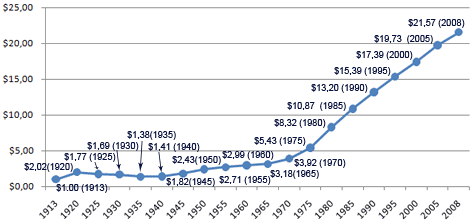
While here in the US, we do not really have an inflation problem, and many simply ignore inflation altogether. On average (from 1913 to 2006), the rate of inflation in the US is 3.45 percent per year, at this rate, price level doubles every 21 years. This is equivalent to saying that a dollar today is worth only 50 cents 21 years from now. Keep this in mind the next time you decide to invest in a bond or want to plan for your retirements – inflation really do eats away at those returns!

value-dollar over time

  1. Frequencies of hyperinflation

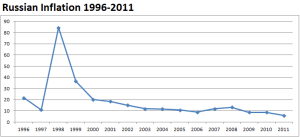
Hyperinflation happens more often than you think. From 1900 to 2013, there have been 56 recorded cases of hyperinflation (essentially runaway inflation that made that results from a combination of bad fiscal policy and a lack of public confidence in the value of the currency). It happened not only during 1920s Germany or Zimbabwe in the 2000s, but also places like Argentina and Brazil in 1989, Russia in 1992, and the former Yugoslavia in 1994.

Russian-Inflation-1996-2011

  1. When hyperinflation occurs

Historically, hyperinflation generally occurs during periods of political transitions or after a national catastrophe, usually war. Examples: in the former Soviet republics from 1992 to 1993 (in Armenia, it reached monthly inflation rates of 438 percent, in the Ukraine it reached 285%); in China immediately after the collapse of the Nationalist government in 1948 and shortly before the Communist victory; and during the devastation in the 1990s of the Yugoslav wars, etc.

historic cases of hyperinflation

  1. Inflation does not necessarily increase the cost of living

Inflation is defined as the average increase in price levels over a given period of time. However, not all of us purchase the same type of goods and services. Therefore, inflation for each person is different. For someone who spends a large chunk of their income on transportation might experience very modest increases in cost of living even if other products on the market increased in prices dramatically.

fisher-investments-Inflations-Impact-300x231

  1. Inflation in certain sectors of the economy dramatically out-paced that of others

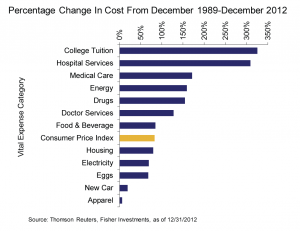
Inflation can vary dramatically, depending on which sector of the economy we look at. Certain products and services like college tuition and hospital services increased in prices by 300% from 1989 to 2012; Compare this with the increase in the price of a new car, which increased by about 20-30% over the course of the same period. Clearly, while no doubt inflation affects all sectors of the economy, some sectors are clearly more impacted. (Personally, as a college student, the high increases in college tuition is indeed a source of constant worry).

  1. Inflation is not necessarily bad

In fact, a modest amount of inflation is normal in a healthy and growing economy. Price volatility is a normal part of the economic picture and no central bank had ever set the interest rate at 0%. What is truly bad for the economy is the prospects of deflation, a general fall in prices over a certain period of time. In this scenario, businesses would invest less (resulting in lowered economic output), layoffs and mass unemployment will follow. Unsurprisingly, deflation often occurs hand in hand with recession and can in fact worsen an economic contraction. In 2009, the United States had its first case of deflation since the Depression years of the 1930s.

United-States-Inflation-rate-History

GDP: how accurate are they?

As educated citizens, there is no single measure of economy that we care more about than the GDP figure. Any increase or decrease in the change of GDP growth rate are bound to make national headlines. Witness the news media frenzy following the GDP figure release for China:

China GDP 2015 GDP news

Clearly, as a society, we regard the GDP figure as something more than a number that measures how large the economy is or the rate at which it is expanding (or contracting); but rather, we see GDP as almost a sacred figure. We take pride in our national economic output, we base our consumer confidence based on these numbers, and more importantly, politicians and decision-makers based their course of actions upon the changes in these numbers from year-to-year. We take the number as something that’s grounded in reality and something that’s unquestionable. And while some would argue about the usefulness of the GDP figure as a measure of the standard of living, most would accept the accuracy of those numbers. But how accurate is it really of a nation’s economic output? Here are several surprising facts that shows that perhaps GDP is not all that it seems. (For a similar list about inflation, click here)

  1. Ghana GDP revision: In 2010, Ghana decided to reexamine its GDP figures by using a different base year to calculate growth over time. The result? GDP was revised upward by over 60%.

Ghana GDP

  1. Nigerian GDP revision: In 2014 Nigeria recalculated its GDP (using a different base year) to include more sectors of the economy such as telecommunications. This recalculation resulted in Nigeria shifting its economic output by upwards of 80% and leading it to become the largest economy on the African continent, surpassing South Africa.

Nigeria's GDP revision

  1. Japan’s GDP calculation mistake: For the 4th quarter of 2012, Japan’s GDP was calculated as shrinking by 0.3%. In reality it increased 0.1%. This miscalculation was the result of a failure to correct seasonally-adjusted figures and misreporting of the GDP deflator (a measure of inflation).

Japan's cities at night

  1. An Excel error and its impacts on public policy debates: In 2010, two economists, Carmen Reinhart and Kenneth Rogoff, published a report claiming that countries with High Debt/GDP ratios have lower growth on average. To support their argument, they used data from 20 advanced economies and calculated their average rate of GDP growth. However, they neglected to select 5 countries (Australia, Austria, Belgium, Canada and Denmark) with both high Debt/GDP and GDP growth rates, skewing their result and the conclusions they draw. This mistake had profound implications. Congressmen and others within the federal government cited this as proof that our federal deficit each year needs to be reduced by cutting a variety of programs, so that our economic growth rate may remain unaffected.

GDP excel error

While this is not strictly a GDP error, it shows how a small mistake in calculating GDP data can seriously affect the conclusions drawn from it.

  1. US quarterly GDP revisions: For the first quarter of 2014, US GDP was revised downward a couple of times, each time suggesting that the GDP contracted further on an annualized basis. Much of the downward trend is the result of less-than-expected consumer spending on healthcare, and the lackluster performance of exports. In part, the GDP contraction was due to an exceptionally cold winter in the US.

US quarterly GDP revision

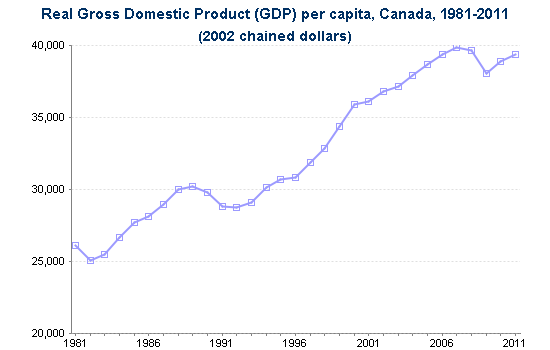
  1. Bank of Canada’s forecasting errors: Even in developed countries, economic forecasts can often go wrong. The Bank of Canada (Canada’s central bank) failed to forecast the small economic downturn in the fall of 2012. The bank of Canada’s forecasts are often overly optimistic. Out of 5 of 7 time periods studied, the average economic growth forecast is 0.6 percentage points higher than the actual; and 75 per cent of medium-term forecasts by the Bank of Canada were overly optimistic.

GDP growth in Canada per capita

So here it is. So the next time you hear in the news about GDP figures, remember that GDP is a number that’s created by people. Most often, these numbers are correct and give a good picture of our nation’s economic health. But at times, we base our GDP figures, past or future, based on faulty or incomplete information. And sometimes, we make plain simple mistakes.