China’s Future, a demographic perspective

Headlines around the world have often captured the economic rise of China in vivid details: its ever-expanding industrial output, its rapid increase in the amount of mega-corporations that threatened to upset the status quo (think of Lenovo, Huawei, and Alibaba), and above all, its mass market of consumers, who are only beginning to consume in quantities not hereto imagined. But in this blog post, I want to focus on another core aspect of its economy that perhaps is more crucial for China’s economy in the long run: its labor force.

Mao had famously said something to effect that the more populous a nation is, the more strength that it has. Initially, what he meant to suggest is that because China is so populous, it is able to survive a nuclear confrontation or any other national catastrophes that could have easily crippled other nations. And for a long time, China’s demographic growth had been remarkable, seeming to heed his words, growing from 543 million in 1950 to 814 million in 1970 (see graphs)China population pyramid 1970, whChina_Pop_Pyramid_2012 en the median age in the country is only 20. Of course, many nations have growth much fast than this, but for a nation the size of China, the impacts are quite noticeable. However, simply by adding raw number of people to the economy does not suggest that the economy has been growing as well. In fact, in certain years (see graph 2), the economy contracted quite severely during the Mao era. Overall the pace of growth is only from the duration of the period from to    .

This lack of growth during the Mao era can be contrasted to the beginning of the Deng Xiaoping era, where following a series of liberalizations, the economy had become more robust and dynamic, growing at over 9% percent each year for the period from 1979-2014Chinese economic growth compared to its neighbors. The implementation of economic reforms in the form of special economic zones, etc, helped to propel the economy into new economic heights. Another factor that propels this growth that is often neglected is the so called “demographic dividends”.

The past 35 years had witnessed what is often termed as a demographic dividend, whereby the nation have both low old-age population and low younger generation. This period in a nation’s history (particularly in the case of East Asia, where this effect is the most pronounced) is characterized by high economic growth. For instance, look at the demographic pyramid for 2012. The majority of the population is of working age and contributing to national economic output, at the same time, less economic resources are required to take care the elderly (in the form of healthcare, etc), and less is needed to take care of the young (in the form of education, etc). This saving of resources freed up more capital and labor for the economy, and enabled the phenomenal economic growth that we came to associate with the East Asian countries.

However, one can readily see that there is a catch to this scenario. Population all eventually age and the working population today is the retirees of tomorrow. With a rising share of the elderly, the demographic boom will quickly turn into a demographic bust. In China’s case, this will become an acute problem (see graph)China2050. Decades from now, when 20, 30 or even 40% of the population is over the age of 65, what do we do then? Economically, the burden will be ever greater on the central government to provide for the elderly, increasing tax burdens on already a smaller working age population. If there is a lesson from the Japanese experience for China, it’s that population is at the center of any comprehensive national development strategy. Failure to take into account the demographic factor will have catastrophic consequences.
6 Surprising Facts about Inflation

While we encounter inflation everyday in our lives, and most of us don’t think too much about it. But here are 6 surprising facts about inflation that might make you rethink how inflation might impact you. Click here for a similar list about GDP.

  1. Inflation in the US

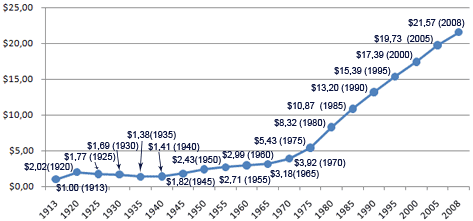
While here in the US, we do not really have an inflation problem, and many simply ignore inflation altogether. On average (from 1913 to 2006), the rate of inflation in the US is 3.45 percent per year, at this rate, price level doubles every 21 years. This is equivalent to saying that a dollar today is worth only 50 cents 21 years from now. Keep this in mind the next time you decide to invest in a bond or want to plan for your retirements – inflation really do eats away at those returns!

value-dollar over time

  1. Frequencies of hyperinflation

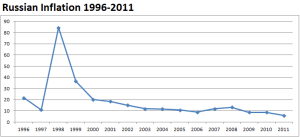
Hyperinflation happens more often than you think. From 1900 to 2013, there have been 56 recorded cases of hyperinflation (essentially runaway inflation that made that results from a combination of bad fiscal policy and a lack of public confidence in the value of the currency). It happened not only during 1920s Germany or Zimbabwe in the 2000s, but also places like Argentina and Brazil in 1989, Russia in 1992, and the former Yugoslavia in 1994.

Russian-Inflation-1996-2011

  1. When hyperinflation occurs

Historically, hyperinflation generally occurs during periods of political transitions or after a national catastrophe, usually war. Examples: in the former Soviet republics from 1992 to 1993 (in Armenia, it reached monthly inflation rates of 438 percent, in the Ukraine it reached 285%); in China immediately after the collapse of the Nationalist government in 1948 and shortly before the Communist victory; and during the devastation in the 1990s of the Yugoslav wars, etc.

historic cases of hyperinflation

  1. Inflation does not necessarily increase the cost of living

Inflation is defined as the average increase in price levels over a given period of time. However, not all of us purchase the same type of goods and services. Therefore, inflation for each person is different. For someone who spends a large chunk of their income on transportation might experience very modest increases in cost of living even if other products on the market increased in prices dramatically.

fisher-investments-Inflations-Impact-300x231

  1. Inflation in certain sectors of the economy dramatically out-paced that of others

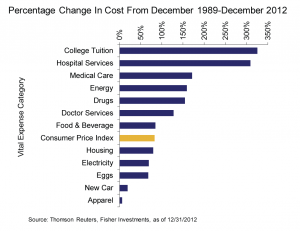
Inflation can vary dramatically, depending on which sector of the economy we look at. Certain products and services like college tuition and hospital services increased in prices by 300% from 1989 to 2012; Compare this with the increase in the price of a new car, which increased by about 20-30% over the course of the same period. Clearly, while no doubt inflation affects all sectors of the economy, some sectors are clearly more impacted. (Personally, as a college student, the high increases in college tuition is indeed a source of constant worry).

  1. Inflation is not necessarily bad

In fact, a modest amount of inflation is normal in a healthy and growing economy. Price volatility is a normal part of the economic picture and no central bank had ever set the interest rate at 0%. What is truly bad for the economy is the prospects of deflation, a general fall in prices over a certain period of time. In this scenario, businesses would invest less (resulting in lowered economic output), layoffs and mass unemployment will follow. Unsurprisingly, deflation often occurs hand in hand with recession and can in fact worsen an economic contraction. In 2009, the United States had its first case of deflation since the Depression years of the 1930s.

United-States-Inflation-rate-History

GDP: how accurate are they?

As educated citizens, there is no single measure of economy that we care more about than the GDP figure. Any increase or decrease in the change of GDP growth rate are bound to make national headlines. Witness the news media frenzy following the GDP figure release for China:

China GDP 2015 GDP news

Clearly, as a society, we regard the GDP figure as something more than a number that measures how large the economy is or the rate at which it is expanding (or contracting); but rather, we see GDP as almost a sacred figure. We take pride in our national economic output, we base our consumer confidence based on these numbers, and more importantly, politicians and decision-makers based their course of actions upon the changes in these numbers from year-to-year. We take the number as something that’s grounded in reality and something that’s unquestionable. And while some would argue about the usefulness of the GDP figure as a measure of the standard of living, most would accept the accuracy of those numbers. But how accurate is it really of a nation’s economic output? Here are several surprising facts that shows that perhaps GDP is not all that it seems. (For a similar list about inflation, click here)

  1. Ghana GDP revision: In 2010, Ghana decided to reexamine its GDP figures by using a different base year to calculate growth over time. The result? GDP was revised upward by over 60%.

Ghana GDP

  1. Nigerian GDP revision: In 2014 Nigeria recalculated its GDP (using a different base year) to include more sectors of the economy such as telecommunications. This recalculation resulted in Nigeria shifting its economic output by upwards of 80% and leading it to become the largest economy on the African continent, surpassing South Africa.

Nigeria's GDP revision

  1. Japan’s GDP calculation mistake: For the 4th quarter of 2012, Japan’s GDP was calculated as shrinking by 0.3%. In reality it increased 0.1%. This miscalculation was the result of a failure to correct seasonally-adjusted figures and misreporting of the GDP deflator (a measure of inflation).

Japan's cities at night

  1. An Excel error and its impacts on public policy debates: In 2010, two economists, Carmen Reinhart and Kenneth Rogoff, published a report claiming that countries with High Debt/GDP ratios have lower growth on average. To support their argument, they used data from 20 advanced economies and calculated their average rate of GDP growth. However, they neglected to select 5 countries (Australia, Austria, Belgium, Canada and Denmark) with both high Debt/GDP and GDP growth rates, skewing their result and the conclusions they draw. This mistake had profound implications. Congressmen and others within the federal government cited this as proof that our federal deficit each year needs to be reduced by cutting a variety of programs, so that our economic growth rate may remain unaffected.

GDP excel error

While this is not strictly a GDP error, it shows how a small mistake in calculating GDP data can seriously affect the conclusions drawn from it.

  1. US quarterly GDP revisions: For the first quarter of 2014, US GDP was revised downward a couple of times, each time suggesting that the GDP contracted further on an annualized basis. Much of the downward trend is the result of less-than-expected consumer spending on healthcare, and the lackluster performance of exports. In part, the GDP contraction was due to an exceptionally cold winter in the US.

US quarterly GDP revision

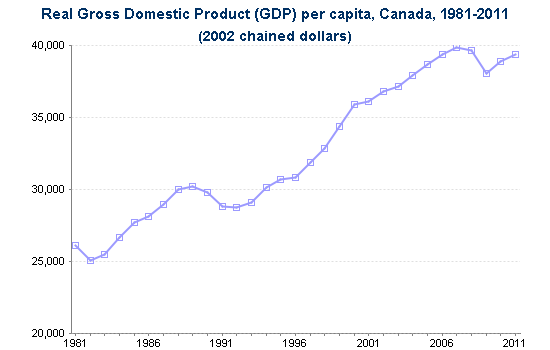
  1. Bank of Canada’s forecasting errors: Even in developed countries, economic forecasts can often go wrong. The Bank of Canada (Canada’s central bank) failed to forecast the small economic downturn in the fall of 2012. The bank of Canada’s forecasts are often overly optimistic. Out of 5 of 7 time periods studied, the average economic growth forecast is 0.6 percentage points higher than the actual; and 75 per cent of medium-term forecasts by the Bank of Canada were overly optimistic.

GDP growth in Canada per capita

So here it is. So the next time you hear in the news about GDP figures, remember that GDP is a number that’s created by people. Most often, these numbers are correct and give a good picture of our nation’s economic health. But at times, we base our GDP figures, past or future, based on faulty or incomplete information. And sometimes, we make plain simple mistakes.