Fertility Rates: Why are they so different around the world

I wrote about this topic recently for a class of mine, and I thought I would share this topic here, since it’s an issue that have interested demographers and other social scientists for a long time.

Introduction and Significance of the Study:

It has been frequently observed that women around the world today have vastly different fertility rates. Last year, a news article from CBS news suggests that the dropping birthrates, especially in developed nations, is threatening global economic growth rate.(CBS) This is indeed a worrisome issue for policy-makers, from Germany to Japan. At the same time, we note that these developed nations are also among the most densely populated regions in the world, suggesting that these nations in the past have had high population growth rates, but subsequently slowed their birth rates. At the same time, many nations in Sub-Saharan Africa have relatively low density populations and abundant agriculturally productive land (Kenya, Tanzania), yet are economically underdeveloped. In class, we spoke about the “demographic transition”, i.e. each of these countries are in a different stage of this transition from high to low birth rates (Goldstein). However, given the observation that many nations that have low birthrate already have a high population concentration, we wondered if population density in fact affects the number of children a woman will have and if other underlying factors – such as governmental actions, social norms (especially for women), and levels of economic development – will affect the number of children a women have over the course of her lifetime.

Hypothesis: Regions with high population density would have lower fertility rates; this is due to economic development over time, the role of women in society and government policies.

In this study, we looked at 3 broad geographic regions: East Asia & Pacific, Middle East & North Africa, Sub-Saharan Africa and compared their developments over time. These 3 regions were used since the cultural practices, economic fortunes, and governmental influences were vastly different and provides a good cross-sectional study for analyzing the changes in global fertility rates. We will determine if the changes in fertility rates in these three regions are indeed negatively correlated with population density and other underlying factors such as economic development, women’s employment and other factors such as the availability of contraception.

2) Data Extraction and Methods:

All data for this study came from the World Bank Data, from 2012 and 2013 depending on its availability. We utilized all available data the following variables to complete the study:

  • Total fertility rates: the average number of children that a woman is expected to have over the course of her lifetime (for 1960-2013)
  • Overall population density: total population of the country divided by its total land, in people/km^2 (for 1960-2013)
  • GDP Per Capita. The Gross Domestic Product (GDP), a measure of total national economic output, divided by the country’s population for a given year (for 1960-2013)
  • Female labor force participation rate: percentage of women active in the labor force, aged 15 or older. (for 1990-2012)
  • Contraception prevalence: the percentage of women (or her partner) who were practicing any form of contraception; for women ages 15-49. Data available only for 1990, 2000, and 2010.

In this study, we used several different prospective factors that may affect the overall population density and were associated with changes in fertility rates for women: GDP per capita, female labor force participation and contraception usage. The three regions were chosen based on their differences in changes in Total Fertility Rates, such as timing and speed of decline, in order to study what could have contribute to this different variations in their respective patterns of decline. The observed period of time was selected as the maximum number of years for which data was available to ensure that whatever correlation we observed was not do to random variations within the data set. In addition, a separate study was done for China to measure a special case of the effect of government policies on the decline in birthrates.

For the sources of data, our date ranges are from 1960 to 2013 for fertility rates, overall population density, and GDP per capita; and ranged from 1990 to 2013 for female labor participation and contraception usage. We use the largest date range available for each variable in order to more accurately determine the long-term trends for each variable.

Methodology: We decided to analyze the data by presenting the relationship between the variables in a graphical format. For readability, we divided the variables into two sets of 3 graphs each, with each graph representing a separate region. The first set of graphs presented fertility, population density and GDP per capita in each of the graphs. For the next set of 3 graphs, we presented fertility rates with women’s labor force participation and access to contraceptives. Then we calculated the correlations between the fertility rates with each of the other variables to give a more definite, mathematical result. The final graph measured specifically China’s decline in birthrate and increasing per capita income.

3) Presentation of Results:

Graphs 1-3 records data for the three regions from 1963 -2013. It measured the changes through time of fertility rates, population density and economic output. Graph 1 depicted Middle East/North African fertility, GDP per capita and population density trends over time. There were several trends common to all. First, there was a very strong negative correlation between the fertility and population density/GDP per capita in all three regions measured (a correlation between -0.8 and -0.98). Second, population density had been steadily increasing for East Asia & Pacific and Middle East, while the Sub-Saharan African density had been increasing much more dramatically. Thirdly, the most rapid phase of GDP per capita increase occurred in all regions after 2000.

For Graph 1, we saw that the fertility rate for the Middle East steadily decreased from 1960 to 1985 (6.87 to 5.88) and then had a steeper decline from 1985 to 2000 (5.88 to 3.04), and finally the decline in fertility stabilized at around 2.75. Meanwhile, the population density increased dramatically from around 10 people per square kilometer to around 36 people per square kilometer, increasing roughly linearly. Therefore, there was a strong negative correlation between population density and fertility decline in this region. Meanwhile, per capita income in the region has also increased, most significantly from 1973 to 1980 and from 2000 onward. Graphs 2 and 3 told a similar story. East Asian &Pacific fertility declined drastically from late 1960s, from 5.5 children per woman in 1968 to 1.85 per woman in 1998; economically, the region’s per capita income steadily increased until 1995, and then stagnated from 1995 until around 2002, before starting to increase drastically once again. For Sub-Saharan Africa, the decline in fertility occurred much later, starting around 1987, and had been declining at a slower pace than for the other two regions discussed. Likewise, sustained per capita increases only occurred starting around 2001.

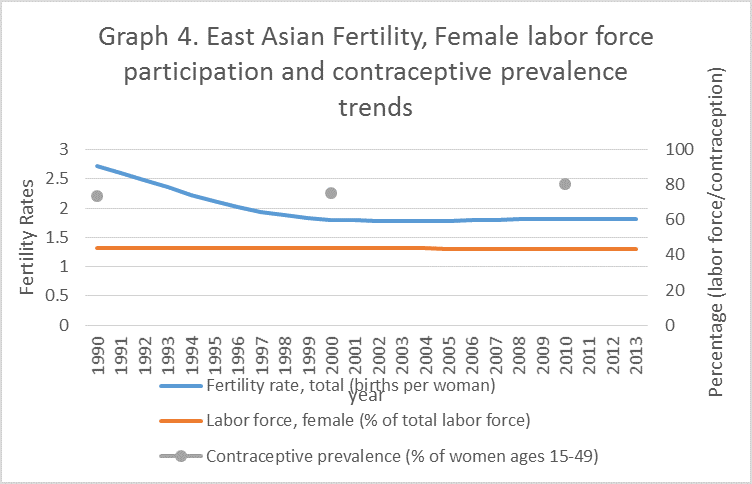
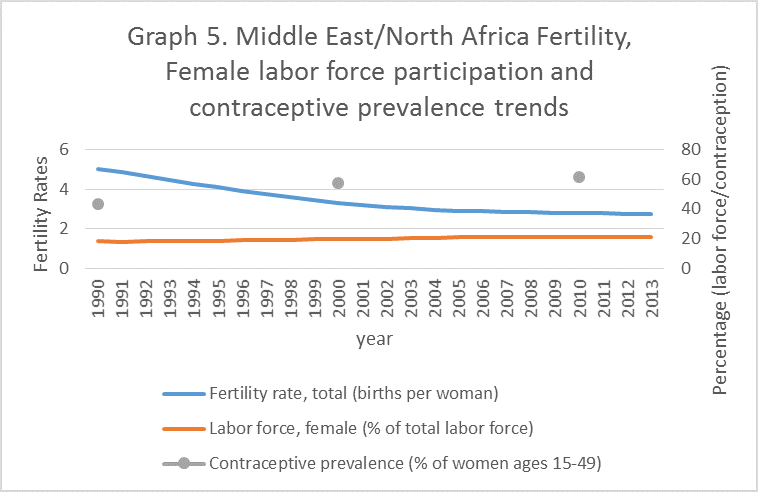
Graphs 4-6 records data for the three regions from 1990 -2010. It measured the changes through time of fertility rates, percentage of women in the labor force and the prevalence of contraceptives. All three regions witnessed the increased use of contraception: East Asia increased from 73% using contraception to 80% usage rates; Sub-Saharan Africa from 15 to 25%. Graph 4 depicted this increase in the East Asia/Pacific region and showed a roughly steady participation by women in the labor force. Aside from East Asia, there existed strong correlation between labor force participation by women and declining birth rates (-0.95 for both Middle East and Sub-Saharan Africa). Finally, a separate graph (Graph 7) was drawn for China by plotting its decline in fertility rates over time for the purposes of examining the effect of public policy on fertility. We see that fertility rates in China declined drastically from 6.3 in 1965 to 2.71 in 1980. Declining further until 1998, and it has held steady at 1.6 since then.

4). Conclusion

This paper studied the relationship between fertility rates and population density and prospective underlying causes for changing population densities. We found that there was a clear negative correlation between declining fertility rates and each of the individual factors measured: GDP per capita, female labor force participation and the prevalence of contraceptives. However, we cannot isolate any of these individual factors and point to it as a cause for declining fertility rates. Each of these factors are not mutually exclusive and acted to reinforce one another as well. For instance, increasing GDP per capita can increase contraceptive use since more women now could afford these new products; or along the lines of Boserup, increasing population could lead to greater density and more innovations and technological changes, which in turn increases income and decreasing the fertility rates. (Boserup) And it is possible that the variables examined are the result rather than the cause of fertility decline (i.e. a demographic “dividend” from having less child dependency) (Factsheet). The causes of fertility decline were complex and this paper only sought to examine a small amount of variables that can affect it.

The effect of family planning and government measures were more open to debate. For example, in China, we saw that fertility rates has already fallen to 3 by 1980, the year the so called “one-child policy” was implemented (Moore). Thereafter, the fertility rates steadily decreased, but based on comparisons with East Asia as a whole, it appeared that this fertility decline would have taken place even without the said policy. What appeared to be more significant in causing fertility decline remained the other factors discussed, such as increasing economic performances and contraception usages.

Limitations of the study:1. Exclusion of certain countries and regions from the study. There are incomplete information (missing fertility rates etc.) for certain country’s data. Therefore, these countries are not included in the regional averages. Some of the countries excluded have very high population density and relatively high birthrates (ex. some Pacific Island states) which are both factors we are attempting to draw conclusions from in this paper. This exclusion could result in errors that can affect our conclusions based on the graph and these data, once included, may result in slightly altered correlations and possible interpretations.

  1. Numerous other factors that may affect population density and fertility rates. There are other underlying factors that can cause a decline in fertility rates other than the economic development, women’s participation in the economy or government policy. Even though fertility rates negatively correlates between each of these factors, we cannot conclusively state that fertility rates rate is caused by these factors. Other factors that may be impactful include women’s educational attainment, and increasing quality and quantity of public health services. More studies need to be done how the effects of some of these other factors may directly impact fertility rates.
  2. The factors that contribute to fertility decline are not fully independent of one another. For example, the increased distribution of contraceptives may be the result of increasing economic output as measured by increases in GDP per capita, which enabled women to purchase contraceptives in the first place. The variables measured in this study can and do influence each other. Therefore, the conclusion drawn (that a negative correlation exists between fertility rates and all the other variables), may be an oversimplification.

Appendix:

Graph 1, Middle East GDP Graph 2, East Asian GDP Graph 3, Africa GDP Graph 4, East Asian labor force Graph 5, Middle East labor force Graph 6, African labor force Graph 7, China's GDP

Works Cited

Boserup, Ester. “Population and Technology in Preindustrial Europe.” Population and Development Review 13.4 (1987): 691-701. JSTOR. Web. 01 Apr. 2015.

“Contraceptive Prevalence (% of Women Ages 15-49).” World Bank, n.d. Web. 01 Apr. 2015. <http://data.worldbank.org/indicator/SP.DYN.CONU.ZS&gt;.

“Dropping Birth Rates Threaten Global Economic Growth.” CBSNews. CBS Interactive, 7 May 2014. Web. 01 Apr. 2015.

“Fact Sheet: Attaining the Demographic Dividend.” Fact Sheet: Attaining the Demographic Dividend. Population Reference Bureau, n.d. Web. 01 Apr. 2015.

“Fertility Rate, Total (births per Woman).” World Bank, n.d. Web. 03 Apr. 2015. <http://data.worldbank.org/indicator/SP.DYN.TFRT.IN&gt;.

“GDP per Capita (current US$).” World Bank, n.d. Web. 01 Apr. 2015. <http://data.worldbank.org/indicator/NY.GDP.PCAP.CD&gt;.

“Labor Force, Female (% of Total Labor Force).” World Bank, n.d. Web. 01 Apr. 2015. <http://data.worldbank.org/indicator/SL.TLF.TOTL.FE.ZS&gt;.

Moore, Malcolm. “What Is China’s One-child Policy?” The Telegraph. Telegraph Media Group, 30 Oct. 2014. Web. 01 Apr. 2015.

GDP: how accurate are they?

As educated citizens, there is no single measure of economy that we care more about than the GDP figure. Any increase or decrease in the change of GDP growth rate are bound to make national headlines. Witness the news media frenzy following the GDP figure release for China:

China GDP 2015 GDP news

Clearly, as a society, we regard the GDP figure as something more than a number that measures how large the economy is or the rate at which it is expanding (or contracting); but rather, we see GDP as almost a sacred figure. We take pride in our national economic output, we base our consumer confidence based on these numbers, and more importantly, politicians and decision-makers based their course of actions upon the changes in these numbers from year-to-year. We take the number as something that’s grounded in reality and something that’s unquestionable. And while some would argue about the usefulness of the GDP figure as a measure of the standard of living, most would accept the accuracy of those numbers. But how accurate is it really of a nation’s economic output? Here are several surprising facts that shows that perhaps GDP is not all that it seems. (For a similar list about inflation, click here)

  1. Ghana GDP revision: In 2010, Ghana decided to reexamine its GDP figures by using a different base year to calculate growth over time. The result? GDP was revised upward by over 60%.

Ghana GDP

  1. Nigerian GDP revision: In 2014 Nigeria recalculated its GDP (using a different base year) to include more sectors of the economy such as telecommunications. This recalculation resulted in Nigeria shifting its economic output by upwards of 80% and leading it to become the largest economy on the African continent, surpassing South Africa.

Nigeria's GDP revision

  1. Japan’s GDP calculation mistake: For the 4th quarter of 2012, Japan’s GDP was calculated as shrinking by 0.3%. In reality it increased 0.1%. This miscalculation was the result of a failure to correct seasonally-adjusted figures and misreporting of the GDP deflator (a measure of inflation).

Japan's cities at night

  1. An Excel error and its impacts on public policy debates: In 2010, two economists, Carmen Reinhart and Kenneth Rogoff, published a report claiming that countries with High Debt/GDP ratios have lower growth on average. To support their argument, they used data from 20 advanced economies and calculated their average rate of GDP growth. However, they neglected to select 5 countries (Australia, Austria, Belgium, Canada and Denmark) with both high Debt/GDP and GDP growth rates, skewing their result and the conclusions they draw. This mistake had profound implications. Congressmen and others within the federal government cited this as proof that our federal deficit each year needs to be reduced by cutting a variety of programs, so that our economic growth rate may remain unaffected.

GDP excel error

While this is not strictly a GDP error, it shows how a small mistake in calculating GDP data can seriously affect the conclusions drawn from it.

  1. US quarterly GDP revisions: For the first quarter of 2014, US GDP was revised downward a couple of times, each time suggesting that the GDP contracted further on an annualized basis. Much of the downward trend is the result of less-than-expected consumer spending on healthcare, and the lackluster performance of exports. In part, the GDP contraction was due to an exceptionally cold winter in the US.

US quarterly GDP revision

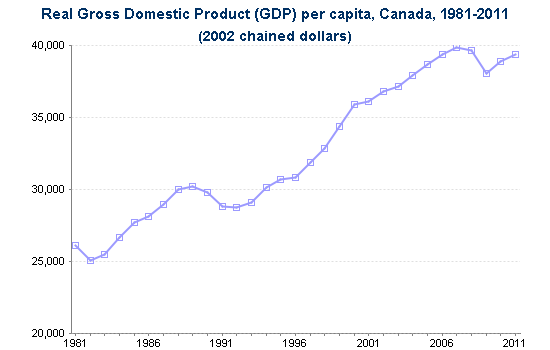
  1. Bank of Canada’s forecasting errors: Even in developed countries, economic forecasts can often go wrong. The Bank of Canada (Canada’s central bank) failed to forecast the small economic downturn in the fall of 2012. The bank of Canada’s forecasts are often overly optimistic. Out of 5 of 7 time periods studied, the average economic growth forecast is 0.6 percentage points higher than the actual; and 75 per cent of medium-term forecasts by the Bank of Canada were overly optimistic.

GDP growth in Canada per capita

So here it is. So the next time you hear in the news about GDP figures, remember that GDP is a number that’s created by people. Most often, these numbers are correct and give a good picture of our nation’s economic health. But at times, we base our GDP figures, past or future, based on faulty or incomplete information. And sometimes, we make plain simple mistakes.

Oil companies and the ethics of overseas investment

Corruption is an issue I care about deeply, and this will be one of a series of writings on it. This particular post is focuses on politico-economic corruptions with oil companies, and is written in a documented research format. (For other articles on corruption in China, see here)

Oil companies are constantly seeking new ways to acquire new resources and to expand overseas. Oil companies are no exceptions. In their case, the quest for greater access – in the form of drilling rights to oil and gas fields across the world – to resources has been intense and lead them to deal with governments around the world. However, this also presents an ethical dilemma: many of oil fields are under the ownership of governments that are often perceived as corrupt by international standards (as measured by the Corruption Perception Index[1]), so should big oil and gas companies deal with these inherently inefficient governments? On one side, oil companies have a duty to its shareholders to maximize value and a need to maintain its global competitiveness through investments; on the flip side, businesses should not provide funding to fuel corruption and social inequality, give aid indirectly to groups that threaten American national security, or to further human rights abuses as a result of economic exploitation. To narrow down the scope of this discussion, I would like to focus on the role of the six “Supermajors” in the oil industry: BP, Chevron, ExxonMobil, Royal Dutch Shell, Total SA, and ConocoPhillips, and their interactions with two countries in particular: Nigeria (ranked 144 out 175 based corruption levels, with 175 being the worst) and South Sudan (173 out of 175).

Let’s examine the societal impact that private oil companies have on the people in the countries they operate by presenting some facts. Oil industry is a multi-trillion dollar industry, and they operate in all regions of the earth.[1] In the example of Nigeria, Shell, ExxonMobil, Chevron, and Total all have stakes in Nigeria, with both on and off-shore oil production facilities, concentrated in the Niger River Delta. The companies are partnered with the Nigerian National Petroleum Corporation (NNPC), a state-owned enterprise. Nigeria, as a member of OPEC, maintains at least 51% ownership in all its joint ventures with foreign companies.[2] Foreign expertise in the oil industry is crucial for the development of Nigeria’s offshore drilling platforms, and much of Nigeria’s future earnings from oil likely will come from these areas in the Gulf of Guinea. Currently, oil and gas exports accounts for around 95% of Nigeria’s exports and 76.39% of federal government revenue, pumping hundreds of billions of dollars into the economy.[3]

These numbers all seemed great; and if indeed this is all the things that oil companies had done – creating jobs and helping provide a source of government revenue – then we have nothing to blame the Big Oil for. However, the presence of foreign companies on Nigerian soil is far detrimental than it appears at first sight. As oil increased in importance (from 3.43% of GDP in 1965 to 37.44% in 2009[4]), it fuels increasing corruption by giving an extraordinary amount of power to the government officials in charge of handing out government contracts. Kickbacks and briberies are commonplace and oil companies are unscrupulous in giving out sums of money to officials, in exchange for favorable deals. Government officials are intimately connected to the military and other social elites, giving the oil companies a leverage in influencing the politics of the nation as well. Nigeria underwent a serious of military coups since independence in 1960, and much of it occurred with the knowledge or the tacit approval of foreign oil companies, ensuring that their own interests are protected above all. This fueled an enormous amount of corruption at the very top of society. As an example, former dictator Sani Abacha, who ruled the country from 1993 to 1999, is estimated to have stolen the equivalents of 2-3 % of the nation’s GDP for each year he was president.[5]
As we can see, the presence of oil companies introduced an element of instability to the post-colonial landscape by giving rise to a plutocracy that are self-promoting and cares nothing for the nation. Moreover, oil companies, by interacting with these corrupt countries, are also destabilizing them. It causes social unrest between different groups in the county: oil vs non-oil producing regions, the business interests vs subsistence farmers. The Supermajors are extremely influential in world affairs by virtue of their size and the different areas that they operate. With this great power also comes a great responsibility: to promote the interests of the people living in the areas that they are operating. Energy companies are already under intense criticism for not being responsible, and it is time for oil companies to become more responsible stakeholders in society. From this perspective, oil companies should limit their interactions with corrupt governments such as that of Nigeria’s and restrict their investments to countries that score high on their political transparency. Companies should take into consideration processes of government approval of projects, have a basic idea of where the revenue is going, and refrain from bribery (this last point is somewhat unnecessary since bribery is already illegal under the Foreign Corrupt Practices Act in the US and elsewhere, but stricter enforcements are necessary.) Only through this careful evaluation of government transparency can the “oil majors” ensure that their investments are not only benefiting themselves but also others in the community that they are involved in.

Besides giving rise to further corruption in society, by interacting with corrupt or underdeveloped countries – they are often the same since one often leads to the other – oil companies also indirectly retards the growth of a domestic economy. Nigeria, for example, went from exporting large amounts of agricultural products such as coffee and grain, to becoming a net importer of food, even while millions of acres of its own land lay fallow due to a lack of investment in agriculture.[6] The presence of oil and natural resources shifted the focus of the company away from developing its industrial and agricultural base to becoming dependent on a commodity that fluctuates daily in the international market, a classic example of the resource curse. This causes a lack of diversification for the economy and contributes to volatile economic growth for the region.[7]

Once again, we must consider the role of the oil company as more than simply a profit-generating entity that can neglect its surroundings. Companies exist in their environment, and I believe that people tolerate the existence of corporations because of the possible benefits it brings to society. The vast majority of the people of Nigeria, a nation of over 170 million people, are not deriving any benefits from the black gold beneath their feet and off their shores. They had come to resent the oil companies for being the source of their misery and the ongoing crisis in the Niger delta (political and economic). This resentment is often expressed in the forms of oil stealing, negligence while working, and forms of demonstration. This causes disruptions in oil supplies and greater costs for oil companies to run their operations. Furthermore, tying into the overall theme of corruption, we see a relationship of how economic underdevelopment contributes to corruption: poorer people tends to favor extreme solutions to their problems, causing them to seek “strongman” to rule the country in the hope of solving their problem (or as President Truman once said, “The seeds of totalitarian regimes are nurtured by misery and want”[8]); this in turn causes concentration of power and wealth in the select few, who evolves into self-serving oligarchy; the oligarchy is afraid of losing that power and uses oppression to cement their rule, causing suffering to millions, and eventually a new leader will arise who will promise change, but who in fact only looks out for his own interests; and the cycle begins anew. Throughout this entire cycle, oil and oil companies are the lubricants that makes the machinery of corruption run. Oil companies in a country like Nigeria fosters corruption, increases reasons for oppression, and while at the same time harms the structure of an economy. It is advisable for oil companies to stay out of the market altogether, or at least not to return until conditions have changed and civil society had become stronger.

A final point arguing against the involvement of Big Oil overseas would be the existence of terrorists groups and parties hostile to the US that might benefit from the petrodollar flowing into their economy. In Nigeria, the Islamic terrorist group Boko Haram (whose name meant “Western education forbidden”) is busy stealing oil through breaking pipelines, taking control of oil fields and illegally refine oil [9]. Boko Haram, with links to the international terrorist group Al-Qaeda, presents a security threat to both the people of Nigeria and nations around the world. The group appeals to those Nigerians who felt cheated out of the benefit brought about by the exploding oil wealth in the country. The money gained from the oil refinery has given the group the means to recruit new members and increased its militancy, as demonstrated by the recent kidnapping of over 200 schoolgirls in northern parts of the country.[10] Oil companies can stop all of these by not conducting business in the country where terrorists groups operate, as listed by the US State Department. By not conducting businesses in those countries, we are decreasing the power of terrorist groups to obtain funding and eliminate some of the social inequalities that gives rise to terrorism in the first place.

Now that we have discussed several of the key points against oil companies operating overseas, let’s look at the pro-Big Oil side’s counterarguments.

The six Supermajors, whether they are the French company Total or Exxon of the US, exists in the structure of a corporation. A corporation is a separate entity distinct from its owners, but at the same time having many of the same rights as people, as the Supreme Court decision “Citizens United v. FEC” reaffirmed and expanded in 2010. Rights are necessary because companies need to be able to enter and enforce contacts with different parties with limited outside interference. These rights, as applied to businesses, essentially meant that they should be free to select who they would like to do business with without their home government come in and meddling with their decisions. From this point of view, even though governments that own the oil fields may be corrupt, this should not prevent companies from trying to enter their markets in its search for natural resources. Political goals and even human rights and global development should not be the main concerns of these businesses, and governments should not limit business operations based on these non-business goals. Corporations have a fiduciary duty to their shareholders and oil companies believe that as free entities, they should be able to pursue their interests in foreign countries. As many of the oil companies are struggling to remain competitive amid high costs, they are looking to get access to as much raw materials as possible at the lowest possible price. Furthermore, in regards to their social responsibilities, Big Oil lobbyists argue that by producing oil in foreign countries, they will eventually help the citizens of those countries by providing them with revenues for them to develop, while at the same time people in the developed world benefits by having access to cheaper fuel prices.

Another key point oil lobbyists make is that the Big Six are facing new challenges from a number of sources. Most significantly, many national oil companies (NOCs) have emerged as important players around the world. These enterprises are often state-owned, working on oil fields at home while at the same time expanding in underdeveloped areas in Africa and elsewhere. The largest among these include Rosneft and Gazprom in Russia, Petronas of Malaysia, China National Petroleum Corporation and other Middle Eastern and Indian oil concerns. In the past, the Supermajors are able to fend off these challenges because they possess the skills and technologies to outdo these competitors. But today, developing nations are catching up to the skills needed to be successful. In order to respond to these challengers, the pro-oil side argues that the oil companies must expand more overseas to markets that have been previously overlooked. However, often this is impossible because the US government has placed sanctions on certain countries, due to a variety of political reasons.

One example is South Sudan, where prior to its independence from the Republic of Sudan, US companies are not allowed to do business with due to the prevalence of state-sponsored terrorism. In 2011, Southern Sudan became an independent nation and US companies are eager to get in on this new market. However, they are still prevented from doing so; this is because South Sudan lack the proper infrastructure for transporting oil and requires pipelines through the Sudan, which is on the sanctions list by the State Department. South Sudan has also been considered to be a major violator of human rights due to the ongoing civil wars in the country. Despite these concerns, oil lobbyists pointed out that other Asian companies are not bound by these restrictions and are gobbling up oil fields in large tracts, and providing 98% of government revenue for South Sudan in the meantime.[11]

Why should Asian NOCs be allowed to invest in a corrupt government while Western companies are not? Oil lobbyists argue that this is unfair for American/European companies since they are being placed at a disadvantage by for political reasons. They argued that by staying out, we are not helping solve the human rights issue since other companies will simply step into the void, while at the same time, Western companies are missing out on a valuable opportunity to grow.

All of the arguments made in favor of oil investments in corrupt governments overseas all have good merits and deserve our considerations. However, each one also have its faults, and I will address each one individually.

Firstly, oil companies pointed out the divide between politics and business and urged governments not to interfere in the economic sphere. This division simply do not exist in real life; if anything, the natural resource extraction business depends on the protection and promotion of governments more than any other industry. Since the 19th century, oil and gas companies have often been the instigators of legislations and works closely with governments: the help the British governments provided to Anglo-Persian Oil Company (later BP) when faced with a possible nationalization in Iran[12], the substantial tax cuts of the Bush Administration on the oil industry are all some of the examples of businesses working with governments to secure their interests[13]. The hypocrisy is evident: even though the oil and gas industry actively lobbies the governments to help them, at the same time they continue to resist any form of government regulation. In this sense, we see that the oil company’s freedoms are not really affected, but rather, Big Oil have entered a sort of contract with national governments whereby oil company will get their interest promoted in exchange for some regulations, such as not doing business in countries with poor human rights records. This arrangement, in my view is fair, and Big Oil are not getting their rights violated, as they have often claimed.

Secondly, oil companies argues that if the West did not invest in African oil, then other Asian countries will simply step in. However, we need to remember that many of these Asian countries, such as China and Malaysia, also have human rights violations of their own, from cracking down on journalists to prohibiting the freedom of assembly. Can the United States and other western nations, areas with decades if not centuries of respect for human dignity, be held to the same standard as these countries? Oil and gas companies are our nation’s representative overseas, and what they do or don’t do reflect back on their country of origin, either enhancing or endangering the moral power of the United States and the West as a symbol of freedom in international relations. From another view, as countries in the developing world democratize and cast off their legacy of oppression, would the governments and people of those countries want to deal with companies that had fostered their oppression in the first place? Probably not. The developing nations also represents the biggest emerging market (Nigeria’s population are expected to more than double to 440 million by 2050[14], even exceeding that of the United States at the time), an area that oil companies simply cannot ignore. Oil companies need to consider this in the future, and good relations with these nations is crucial for Big Oil’s long term vision and success.

Finally, Big Oil companies argued that they need to bring benefits to all stakeholders. However, I would like to argue that not all stakeholders are of equal importance. It might be true that shareholders in the company can get some extra dividends through an investment, and certain government officials can become rich. But what about the millions in Nigeria or South Sudan that are living on less than $1 a day, and who are trapped in a cycle of poverty? Indeed, oil companies are neglecting the single most important stakeholder in oil development projects, which is the people who are living in the area affected the activities of oil companies. Imagine this: if a company comes by and decide to occupy large amounts of land without due compensation, pollutes the land and rivers with refinery wastes, and do not bring any job opportunities to the displaced peasants, would you support the company moving in? I would imagine not, and yet this is precisely what is happening in the Niger River Delta.[15] Can a company be said to be a responsible member of society if it brings nothing but misery to the area where it is present, no matter how much wealthier they are making executives back at home? In this situation, it is only ethical for companies to limit its investment or not invest at all.

To sum up, I believe that it is inherently unethical for Western oil companies to invest in overseas asset in corrupt/underdeveloped countries. As my examples have shown, the presence of oil companies in these regions will likely lead to economic underdevelopment, further human rights abuses and exacerbate political corruptions. In order for oil companies to be considered responsible corporate citizens, it is imperative for them to refrain from doing businesses in these regions.

[1] http://www.aei.org/publication/energy-fact-of-the-week-as-a-separate-country-the-us-oil-and-gas-industry-would-be-the-16th-largest-economy-in-the-world/

[2] http://www.nnpcgroup.com/NNPCBusiness/BusinessInformation/OilGasinNigeria/IndustryHistory.aspx

[3] http://www.ceicdata.com/en/blog/oil-dependence-hindering-nigeria%E2%80%99s-emerging-economy

[4] http://www.ccsenet.org/journal/index.php/jsd/article/viewFile/14891/10727

[5] http://www.unodc.org/unodc/en/frontpage/nigerias-corruption-busters.html

[6] http://www.ccsenet.org/journal/index.php/jsd/article/viewFile/14891/10727

[7]ITracy_l_moodledata_temp_turnitintool_793995179._60_1384335874_2108.pdf

[8] http://www.digitalhistory.uh.edu/disp_textbook.cfm?smtID=3&psid=1235

[9] http://www.trackingterrorism.org/article/new-financing-options-boko-haram/oil-theft

[10] http://www.huffingtonpost.com/2014/11/01/boko-haram-kidnapped-girls-married_n_6086420.html

[11] ITracy_l_moodledata_temp_turnitintool_793995179._60_1384335874_2108.pdf

[12] http://www.sjsu.edu/faculty/watkins/mossadeq.htm

[13] http://www.pbs.org/now/shows/347/oil-politics.html

[14] http://www.pewresearch.org/fact-tank/2014/02/03/10-projections-for-the-global-population-in-2050/

[15] http://epu.ac.at/fileadmin/downloads/research/rp_0707.pdf

[1] http://www.transparency.org/cpi2013/results