5 incredible facts about exchange rates

Currencies swap hands every second, and here is a look at some of the key (and often surprising, facts) about exchange rates. For a similar list about GDP, click here. For a list on inflation, click here.

  1. The floating exchange rate system.

The current system of international exchange rate is what is known as a floating exchange rate. Each country’s currency is not determined by a fixed rate to each other; but rather, they currency is set by the Foreign-Exchange market (Forex), which entails supplies and demands for that particular currency. Therefore, the currency can change freely and often by quite a bit, sometimes requiring central bank intervention to help maintain the currency’s values.

supply and demand for exchange rates

  1. The US dollar’s premier standing.

The US dollar is used in around 80% of international trade and it forms over 60% of the foreign exchange reserves currencies in the world. The dollar is used extensively to settle international trade and forms a large part of the foreign currency holdings in the world, which allows central banks to purchase the domestic currencies, sometimes to maintain a certain exchange rate. The largest holder of foreign exchange reserves holders are China and Japan, which holds around 4 trillion and 1.3 trillion respectively, of which a majority is held in US dollars.

Exchange_rate_03

  1. Currencies: Hard and Soft.

Not all currencies are valued equally as a store of value, and economists distinguish between hard and soft currencies. The US dollar, Euro, and Swiss Francs are generally considered to be among the top 3 hard currencies in the world, and the currency that people would move their money into in the face of economic and political uncertainty. In comparison, soft currencies are generally viewed as unreliable and fluctuates greatly in the foreign exchange markets. When the Eurozone debt crisis hits, European countries moved their currencies toward Swiss Francs and US dollars, therefore eroding the power of the Euro slightly as a safe-haven currency.

hard currencies

  1. Foreign exchange markets are among the most unregulated markets in the world and operates non-stop.

Internationally, there are few regulations on foreign exchanges, and each day, many traders (or speculators rather) enter and exit the foreign exchange market. Insider trading is not regulated on the Forex exchanges. Traders trade on any piece of information that they think is relevant and can move the market. The market operates non-stop and depending on the location (New York, London, Tokyo, etc), someone is always awake ready to do work.

dollar sterling exchange

  1. Foreign Exchange markets are enormous, and diverse.

Over 4 trillion dollars are exchanged on the foreign exchange markets each day. Profits to be made on Forex is actually pretty low, therefore the trades are done through borrowing on margins. Leverage is used to enhance profits and loss, with respect to the size of the account. Currencies are traded in pairs, and over 100 currencies are traded on exchanges. However, there are four major currency pairs, which accounts for most of the volume traded:

The British Pound and US Dollar (GBP/USD)

The Euro and US Dollar (EUR/USD)

The US Dollar and Japanese Yen (USD/JPY)

The US Dollar and Swiss Franc (USD/CHF)

The US dollar is the most traded as a part of currency pairs, accounting for 87% of daily shares (out of 200% possible since it’s traded in pairs.)

currency pictures

Related Articles:

GDP: how accurate are they?

6 Surprising Facts about Inflation

On Iran’s nuclear program: an alternative view

Iranian nuclear program has drawn a significant amount of international attention – and condemnation – since it was uncovered in the early 2000s. While the issue is complex and multifaceted, I believe a few points should be examined. First, why is the Iranian government desirous of a nuclear program? And do the people really want it? Second, how should the rest of the world respond to it? Are the current negotiations with Iran the best way to approach this issue? And lastly, how should we all proceed from here?

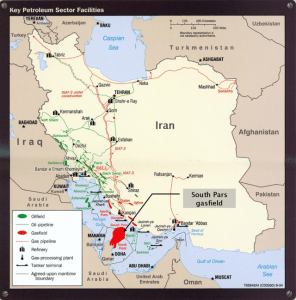
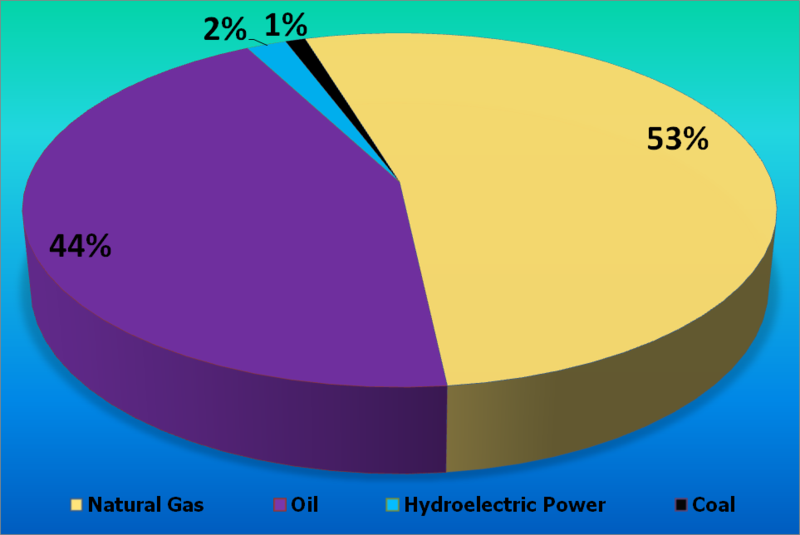
The Israeli historian Martin van Creveld once said that “Had the Iranians not tried to build nuclear weapons, they woul6a00d8341c4fbe53ef00e54f31467c8833-640wid be crazy.” Although his words may seem extreme, we need to understand what motivated the Iranian leadership to develop nuclear power, even in the face of mounting international oppositions. The Iranians’ own argument is that they need to secure their own energy needs in the form of nuclear power. This argument is hardly plausible: Iran is sitting on the world’s second largest reserves (after Russia) of natural gas. Iran’s South Pars gas field alone is estimated to contain 14×10^12 m3 of gas, around 5.6% of the entire world’s prove gas reserves. Moreover, the country contains the 4th largest reserves of oil in the world. Iran’s energy needs can largely be satisfied by its oil and natural gas, as can be seen in the chart below. iran energyIf energy security is not the real reason, then what is? The true reasons for such a program, I believe, includes the following:

  1. Scientific and cultural prestige: Let’s imagine that the Iranians do not in fact want to build a nuclear weapon (a highly unlikely assumption for reasons that I will explain later), the mere fact that Iran is capable of developing advanced technology is something that the Iranian government can be proud of. In Iran, like many other parts of the world, scientific advances symbolizes the greater progress made in a society. The Iranian government sought to legitimize itself by promoting science and technology (much like the Soviet Union spent tremendous efforts in space exploration to legitimize the ideology of Communism). The Iranian people want to see progress being made in a variety of different fields, whether it be a rocket launch or a prospective nuclear power generation plant. Iran is gaining prestige by possessing those technologies. In a sense, scientific prestige is also tied into cultural prestige. We need to remember that Iran is more of a historical civilization than a nation-state in the modern sense of the word. The Iranian people had inhabited the Iranian Plateau for thousands of millenniums, and for much of that period Iran (or Persia, as it is known for most of its history), is a leading force among the world’s nations, and not merely in technology. It is in early modern times that Iran had fallen behind. In a way, many Iranians want to regain that sense of pride which have belonged to them historically. As heirs to a rich cultural heritage, Iranians today no doubt want to relive a part of its ancient glories; developing nuclear powers along the lines of other advanced nations will symbolize a part of this regaining of prestige.Mideast-Iran-Nuclear-_Horo2
  2. Competition from regional powers: Let’s take a look at how the world appears from the position of Iran, and why its nuclear ambitions will likely lead to nuclear weapons. Geographically, Iran couldn’t be in a more dangerous position. As the map below shows, Iran is surrounded by potential or probable enemies. To its west, Iraq, despite its Shia majority (the majority religion in Iran), is embroiled in a complicated civil war with the radical Islamic State (IS). Further west, we see a similar situation in Syria, where Iran-backed government of Bashar al-Assad is fighting a multi-front war against IS and moderate rebel forces. Each of these governments, if they fall, would produce a serious threat to Iran itself; and these are just the militant organizations. Organized threats by nation-states posed a bigger problem still. In its southwest, across the Persian Gulf, the Kingdom of Saudi Arabia is ferociously anti-Iranian and possesses a powerful modern military and an alliance with the United States; other Sunni Gulf States are no more friendlier. Further to the west, Iran faces the strongest military power in the region in the state of Israel, which had spear-headed efforts to contain the Iranian enrichment program. Further to its north and east, Russia, China, Pakistan, and India are all nuclear powers. In such a dangerous neighborhood, Iran felt that by developing the bomb, it can achieve a sort of parity with the other regional and global powers, at least in part to compensate for its relatively conventional forces.
  3. Security and Geopolitical leverage: In a point related to the second one, we need to be aware of the fact that Iran really has no natural allies. Culturally, it is the product of thousands of years of Persian civilization centered in the plateau of Iran, influenced by the forces of Shia Islam for centuries (today, an absolute majority of the world’s Shia Muslims lives in Iran), and the rise of political Islam in the form of the Iranian Revolution of 1979. For good or bad, few other countries possess such a unique historical experience. While this is a point of pride for many Iranians, at the same time, this also meant that Iran cannot count on any natural allies in the sense that the UK can rely on the US or Kuwait can rely on Saudi Arabia. The allies and friends it does have among governments are less than appealing: Iraq is bogged down in a struggle of a sectarian nature between Shia-dominated government and Sunni militant Islamists; likewise Syria is fighting its seemingly interminable civil war; the militant group Hezbollah in Lebanon is considered an ally and a way for Iran to project power into the eastern Mediterranean, but is categorized as a terrorist group (its military wings at Shia_Crescentleast) by most governments around the world. Strategically, Russia can be considered an ally, but that nation is struggling in the face of western sanctions for its involvement in the Crimea and a falling oil price. (For a discussion of how falling oil prices are influencing foreign policies in Russia and Iran, see here). Iran is looking for new partners in China and India by offering them energy security; but this venture will be unlikely to result in any serious partnerships, especially if this partnership would result in possible international retaliations by the West. Iran is therefore left to defend itself against a myriad of threats. In this case, a nuclearized Iran can protect itself, or so the Iranian leadership believed, from military blackmailing. At the same time, Iran can project its power in what is known as the “Shia Crescent”, an area encompassing Iran, Iraq, Syria, and Lebanon, shaping itself into a regional power. Iran believes that thus nuclear power adds more muscle to its voice in regional and international affairs.

Needless to say, no matter what the reasons are for Iran’s acquisition of nuclear power, the rest of the world cannot be happy about the emergence of another potential nuclear power. However, the present countries that possess nuclear powers are in fact rebuilding their own respective nuclear arsenals even while they are denouncing the Iranian’s attempts to do so. We see that the rest of the world has been upgrading their own nuclear arsenals as well. In a recent article on Business Insider, the dangers of a nuclear war is emphasized more than ever before. However, the difference is that Iran is widely seen as an irresponsible government, and weapons in the hands of such a state is a worrying fact. But how should the rest of the world respond to it? Along the lines of journalist Fareed Zakaria, I believe that there are two main ways for the world to respond: 1. Forcing a Regime Change, or 2. Forcing a Policy Change. Let’s briefly define what each option meant and discuss their relative merits later:

  1. Regime Change:

In essence this would involve the fomenting of dissent, support democratic political movements, and with outside help in trying to overthrow the government of Iran in one form or another. Most likely, the United States would be the leader in such an effort. In the meanwhile, the US and other parts of the world should not have anything to do with Iran since it is an illegitimate government in their eyes. In the views many, the only way to properly address the nuclear situation with Iran is wait (or help) the government to change and then deal with them later.

  1. Policy Change:

This would mean that we will actively engage with the present government of Iran, treating them as an equal partner in these discussions, and really accept the fact that the government of Iran, however repulsive, is here to stay for some time to come. The dialogues will be conducted in an open manner and be peaceful in trying to reach a deal with Iran. For supporters of this option, they do not believe that this is a policy of appeasement, but rather, a step-by-step method toward achieving our objective, whatever they may be.

As a sophomore in college, I may not be in the best position to recommend foreign policy to those in the highest levels of government. But, nevertheless, I believe that here in the US and the rest of the world that does not desire to see a nuclearized Iran, have to decide on an option fast and not to oscillate back and forth between these two options. How can you possibly struck a deal with a government that you have every intention to help overthrow? Personally, I believe that the best option remains to bring Iran back into the international system, which it had been an outcast member since 1979, and to engage with it in more direct dialogue. We need to bring in international partners, which must include China, India and Russia, to discuss options with the Iranians on what to do. We must make Iran as an equal partner in its negotiations and not treat it as a criminal state. We need to recognize Iranian interests and why they sought to nuclearize themselves and to stress our own positions and concerns in why we do not want to see a nuclear program: no, it is not that we desire to encircle Iran on all sides, and no it is not that we desire to see a weakened Iran that is susceptible to invasions at any given moment. There are too much distrust and misconceptions between Iran and the West at the moment, each is mistrusting the other’s intentions. Therefore, if we can build an international coalition on resolving the issue, we can legitimize our intentions and make the Iranians understand that it is in the interest of the rest of world for them to denuclearize.

Current policies in delaying Iran’s nuclear programs have many merits to them. Firstly, the alternative, that of calling Iran to immediately destroy their nuclear facilities, will only strengthen their resolves in continuing to build them. If not in open, then in secret. Therefore, delaying what Iran has been attempting to do, by years (a very possible prospect), leaves the rest of the world with more options in dealing with the government. But more importantly, it buys the rest of the world time. The structure of government itself may likely change with the passage of years. I do not necessarily mean a revolution, but rather a gradual process of liberalization that will see a new generation of Iranian leaders that do not want to confront the world and or is filled with xenophobia, but rather sought peaceful coexistence. Younger generations of Iranian do not have the fervors of religious fanaticism that may have characterized some of their parents; in fact, I believe that many young Iranians today want to embrace the international system and be a part of modern society. I believe that will the passage of time, Iran can be a more responsible stakeholder in the international system and we can work with Iran toward this issue. However, in order to do this, we must first talk openly with Iran.

The importance of continuing dialogue with Iran cannot be overstated. If left isolated, Iran will retreat into itself and develop and deepen a paranoia of the rest of the world and perhaps the unthinkable will happen: a nuclearized Iran ready to use its weapons on its neighbors and beyond. As a historical analogy, imagine what if Henry Kissinger had never traveled to China to open up dialogue with that secluded nation, China today would possibly have been another North Korea: a government that is isolated and clung to an outdated ideology with a belligerent attitude toward the rest of the world. But to the credit of the US government (both the executive and the State department), rather than seeing this happen, the US government actively engaged with Chinese leadership and brought China into the international community of nations; a community that China has a stake in. In a similar line, I believe that by keeping the dialogue option open with Iran, we can hope to make some progress. Of course, this can only happen with Iranian commitment as well, and it needs to tone down the rhetoric against its neighbors and their allies, most notably Israel and the United States; it needs to show real commitment in following through with its promises; but above all, Iran needs to see that it is to its own security and benefit that it becomes a part of the international system rather than a challenger to it. Perhaps, eventually, Iran will be able to develop its own peaceful nuclear program, much as how Japan and South Korea has developed them, without feeling the need to weaponize it. All of these will likely take an enormous amount of time, likely decades; but I believe that in the end, the path of continued negotiations and dialogues with Iran will be preferable to any other alternative.

For related topics see:

Resource dependency, oil price decline, and the reshaping of the international order

Oil companies and the ethics of overseas investment

Human exploration of space: a controversial debate (Part 2)

For part 1, click here.

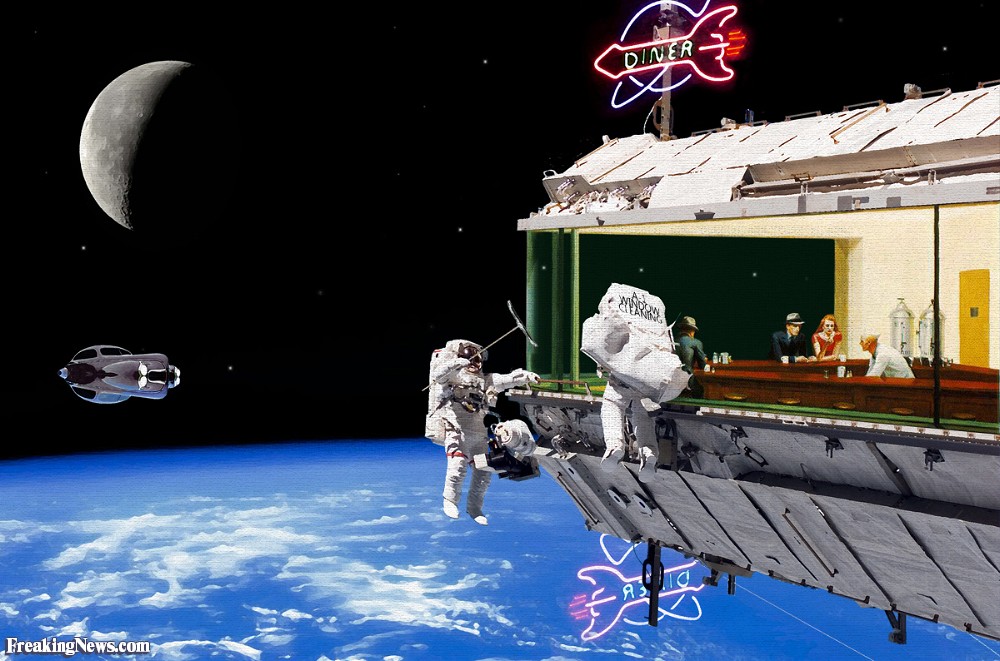
A second key contentious point is the role of private companies and national governments in space. The drive for space exploration was mostly led by governmental agencies since the very beginning, and currently a “virtual government space monopoly” exists.  In the US, National Aeronautics and Space Administration was created in 1958 to coordinate the government’s efforts to explore space.  The exploration itself is also closely linked to military endeavors, with intelligence gathering as one of the early reasons for the launching of satellites. Some argue that we should limit the role of governments and private interests in space and place exploration under the firm control of national governments, while others believed that we should open up space for commercial endeavors and to utilize space as much as possible.Edward-Hopper-s-Nighthawks-in-Space

Anti-Space liberalization groups based their arguments on several points: first, private companies would only be willing to undertake space exploration if and only if immediate and short term economic prospects are possible, and therefore they have no long range exploration goals that can serve public interests. According to pro-space advocates, private interests cannot utilize space efficiently because space exploration requires a large amount of initial capital investments that few companies can or are wiling to afford, and the fact that any ventures in space would require years to generate any results doesn’t favor private investments either.  Furthermore, there is an incentive for company to not do any original research at all and to instead rely on imitating others by doing what others have already began or done. This is not an issue when the government is the major source of research; however, with the privatization of Space R&D, company will sought to improve on their existing research than to build new ones, since the costs will be lower. According to the anti-privatization groups, only the government can sponsor basic research, without direct considerations for profitability.

Secondly, the exploration of space also brought up the points of who owns what in space, and how can governments regulate such claims of property or intellectual property. On land, the issues of property is quite simple, like in the American West in the 19th century, where the first ones to find the area and to use it to its full commercial potential can often obtain permission from the national government to gain ownership. However, no clear international agreements have been reached on using resources in space by each nation. The Outer Space Treaty of 1967 is an international agreement that guaranteed “outer space and celestial bodies are free for exploration” and under Article VI, signatory nations “bear international responsibility for national activities in outer space… whether such activities are carried on by governmental agencies or by non-governmental entities…”  In effect, the treaty defines that space is open to all and activities in space are the responsibilities of the government. This works in the days when commercial development of space seemed so far away, however, now with humans on the moon and potentially on the asteroids or Mars, the resources on those planets can have great implications.  For instance, asteroids are known to have rare-earth minerals which are commercially valuable even given the high cost of exploration.  The question therefore is who should own these resources or if they should be exploited.space shuttle leaving earth

Anti-privatization people believed that giving up space and celestial bodies, such as the moon and asteroids, to private interests is irresponsible. Indeed, if we fully privatize space among the large companies, they can effectively dominate space and create a private monopoly and close it off to future exploration, or having power concentrated in the hands of too few people. In addition, unlike governmental research where any research generated can be shared with the public, private company’s research and the technology spillovers from R&D would not be shared with others, to the detriment of society.

On the other hand, many pro-privatization advocates argue handing over certain aspects of space exploration to the emerging Space Industry will be beneficial to society at large. Among their arguments include the cheaper ways that private companies can get humans/robots to space and to utilize space resources. For instance, recently, the SpaceX Falcon Heavy launcher can in theory deliver about 50 metric tons of payload to low earth orbit at a price of $120 million, averaging to about $1000 per pound, much less than the tens of thousands of dollars per pound that NASA’s technology can deliver.  Currently, advocates of private interests in space argue, the government’s effective monopoly on space is encouraging waste, and if more company like Elon Musk’s SpaceX can be introduced to the competition, the costs of going to space will likely decline further as a result in refinement of space technology.

space vehiclesMoreover, private property rights in space should be established because only private companies can use the resources to its greatest effect. Many pro-privatization advocates pointed to the difference between the usage of Arctic (which are fully utilized economically) and the Antarctic, which have no development; whereas the Arctic’s property rights are well-defined, the Antarctic’s is highly ambiguous. Similarly, if the resources in outer space is well-defined, many people here on earth can reap its economic benefits through the efforts of private organizations.

Finally, the third main point of contention in the space debate is the effect of space exploration on long term human health, both mentally and physically. Many people cite the facts that prolonged exposure to space is fundamentally unhealthy for human beings and long term stays are simply unfeasible. However, pro-space advocates argue that we must adjust to living in space through technological means and that in order for us to survive as a race, we must look to the solar system as a source of survival.

Ever since the first human flight to space, scientists have been carefully observing the effects of space environments on the human body. For example, scientists noticed that astronauts can develop a greater “risk of getting a kidney stone as a result of space travel since the body quickly dumps a lot of fluid when gravity is no longer drawing blood down into the legs and the elastic vessels squeeze it upward”.  In addition, the body can lose large amounts of proteins, by up to 45 percent decrease in protein synthesis. In large part this is due to microgravity environment which results in a lack of muscular activity.  Other long-term health effect includes bone loss, cellular organization and radiation.liftoff1

Given these detrimental effects on human health, many argued that human travels to space should be limited in scope and argued that human settlement in space is impossible in the long run. Therefore, we as human beings should still focus our development on our only habitable planet as our bodies are physiologically adapted to life on Earth.

However, others believed that human beings should began to adopt to space. Some talk of an “astro-civilization” , where just like humans have moved from a nomadic to an agricultural then to an industrial society, our next logical step to expand to a space-based civilization. According to the pro-space advocates, the earth’s expanding millions required more and more resources to sustain itself.  Therefore, it is necessary for us to develop technologies to enable us survive in space and to produce habitats similar to those on earth in near-earth orbit. Some have outlined strategies for monitoring human reactions in space step by step, such as Edgar Mitchell, who was an Apollo 14 Lunar module pilot. He argued that humans should first continue space exploration by landing on Mars and later establish a scientific laboratory on the Moon.  This laboratory can be used to test how to adapt humans to the hostile environments in space. Once that is accomplished, we can then consider the establishment of more permanent bases with the eventual goal of settler colonies on Mars/Moon, or near earth space.

For part 1, click here.

Human exploration of space: a controversial debate (Part 1)

I wrote about this topic of human space exploration a while back, somehow, I never bothered to post on my blog. But here it is, and divided up into two parts to make it easier to read. For the second part, click here.

The question of whether or not we should sponsor human space missions had been controversial ever since the modern exploration of space began in the 1950s. A variety of arguments have been made either in favor or against the exploration, and two opposing sides developed in this debate.  My thesis for this essay is that the human exploration of space is a controversial issue since the costs of sponsoring space exploration is extremely high and the money can be better spent elsewhere, the unclear role of government and the power of private (commercial) interests in space, and the long-term and unknown health effects that traveling to space have on human beings. Key questions like property rights in space and the extent of government funding has been debated, and while some supports the private funding of space, others are more reserved.  Moreover, the possibility of human settlement of space is hotly debated as well, with some believing in the future destiny of mankind laying in space, while others believed we should focus more on planet earth, using some of the technologies we gained from space exploration. space-exploration

Firstly, the costs of going to space is enormous, and specific criticisms includes the national funding for space exploration, the real scientific need for such funding and the alternative good that the money can be used for. Many criticize the decisions by national and private organizations to sponsor such an endeavor to space. It has been estimated that the launch of a space shuttle costs about 450 million, and there have been over 130 launches from 1982 to 2011.  Not to mention the 140 billion plus that the space station has been spending. Such costs indeed add up to astronomical numbers. Currently, the vast amount of the space exploration is funded by governments of various countries. Here in the US, the federal budget funds 17.7 billion for fiscal year 2014 to NASA . The federal governments reached this number after vigorous debate and many wanted NASA to focus on more tangible results in the near-earth orbit instead of pursuing large projects that have no direct results. In today’s world, where the fight for national budget is increasingly acrimonious, spending such a sum of money on science that have little practical values is useless according to many critics. The bottom line is simple: our national economy simply do not have the necessary resources to continue the space program on a regular basis.

Regarding the amount of money being spent in human space explorations, many critics also pointed out alternatives to human exploration for the advancement of science. Chiefly, they argued that many of things that require human presence can also be carried out by robots. Robots can reach far more different places than humans, and can conduct research in a variety of different (often hostile) environments. The Curiosity spacecraft currently exploring Mars is a great example of having robots do the exploration for humans, where it has continuously been sending back data for scientists based here on planet earth, without the need for humans to travel.  The costs of these development in space is cheaper and can achieve more scientific results. In addition, critics attack the argument that scientists can use the opportunity in space to perform experiments otherwise not available on Earth. Many simulated laboratory conditions achieve the microgravity and other conditions of space, without the need to send scientists into space to perform the experiment itself. Critics argue that it will make more sense to fund laboratory facilities than to build ones in space and requires travels to space to perform the experiment.Space-EXploration-Puzzle-900x1600

Finally the money being spent in space, many argue, can be best spent here on Earth. With food and water shortages in Africa, a global environmental crisis, a lack of healthy standards of living in many places, many argue that the billions spent in space can be used to directly improve life and living conditions on earth. As the CBS news anchor Katie Couric stated in October of 2006, “NASA’s requested budget for 2007 is nearly $17 billion. There are some who argue that money would be better spent on solid ground, for medical research, social programs or in finding solutions to poverty, hunger and homelessness… I can’t help but wonder what all that money could do for people right here on planet Earth.”  Money spent in space, some argue, is a long-term discretionary spending that can be eliminated to provide money here on earth.

In contrast, pro-space organizations argued that such costs are justifiable and can be brought down to more affordable levels as our investments in space R&D and infrastructures pays off in the future, and that our investments in space can bring tangible economic benefits to planet earth. Currently, the annual budget for NASA which amount to about 17 billion every year, is indeed a tiny fraction of the overall public spending. Indeed, “For every $1 the federal government spends on NASA, it spends $98 on social programs. In other words, if we cut spending on social programs by a mere one percent, we could very nearly double NASA’s budget”.  The costs of space exploration, when put in perspective is indeed not that great, and the 16.143 billion spent on NASA in 2007 is merely 0.58 percent of the total federal budget. Pro-space exploration advocates argue that even if all the money spent on space is allocated to other spending, the differences on our society would negligible. In addition, a key role of government, many felt, is to promote the arts and sciences and NASA argues that it is fulfilling this role. NASA provided an enormous amount of scientific knowledge about space and scientific endeavors in general, and helped to educated millions of students on science.  The scientific and educational value of space exploration can never be truly quantified, for such an investment in our nation’s scientific future and the education of the youths is something that goes a long way.satellites

Moreover, many scientists argue that the investments in space can bring tangible technological and economic benefits to here on earth, many of it in the forms of spin-offs from the products initially intended for space use, or as a result of space research. Some examples include cell phone cameras based on space cameras, memory-foam mattresses, aircraft de-icing, etc.  These new technologies spurred new industries, improved the quality of life and encouraged economic growth.  “A number of studies conclude that about 90 percent of the long-term increase in output per capita in the U.S. has been attributable to technological change, increasing educational achievements…”  The spin-offs from NASA research contributed enormously to economic growth in the US and the world in general.

For part 2, click here.

The complicated story of the conquest of the American West: ideologies, economic pressures, and social forces

I realized that on this blog, I haven’t yet written much on the topics of history and have mostly been focused on current events with international or economic implementations, therefore, I have decided today to write about topics of history which interests me. As the first part of a series on history, let’s examine the story of the American West.farmers of the west

The expansion of the United States is a complex process that took place over the course of centuries and left behind a legacy that is still being felt today. The process of the “conquest” of the West involves the interactions of not only different groups of people but also different ideas that contrasts and clashes with each other often violently. In forming a true understanding of the West, we must look at three things in particular, the power of ideologies in westward expansion, the role of commercial/practical interests, and the way the whites interacted with the natives (in many ways defined by the first two ideas).

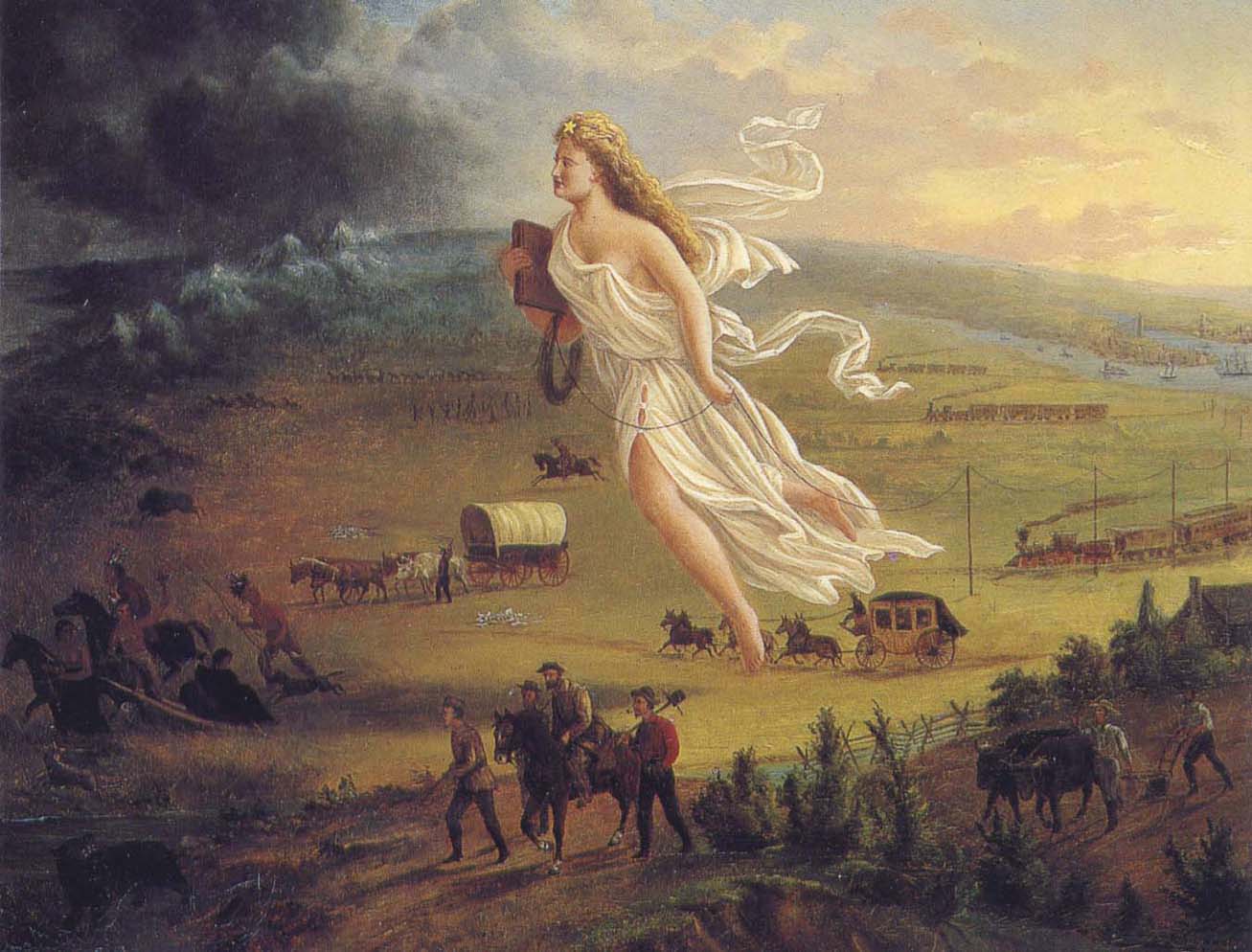
The traditional stories of the West is a story involving the ideals of Enlightenment and Liberal Humanism, the idea that all mankind has certain inalienable rights and a belief that all humans, by using logic and reasoning, can bring about improvements to society. Central to Enlightenment thinking is the concept of Progress; which in the case of the American West, is the ideas of “Manifest Destiny”, the idea that it is a God-ordained right of the American people to populate the continent.American_progress

However, this idea of progress is inherently problematic, as the Western notion of progress is not applicable everywhere, and it is most certainly hard to define. What is defined as Progress – with a capital “P” – is all political, and often progress is a way for people to legitimize the actions they have undertaken. What is progress for the Whites in the early nineteenth century is certainly not the same as those for the Indians who have been living on the land for hundreds or thousands of years. However, for the Whites, the Indians have made no progress. In many cases, the land has not been modified in any noticeable ways, especially among the Plain Indians (such as the Lakota Sioux). To White Americans, Progress is defined as having farming as well as industry as the backbones of the economy, and not in a nomadic lifestyle. However, for the natives of the Plains, the land is being used productively, as they are entirely self-sufficient in using the land and its products for their needs. Here we see the contrasting notion of what is Progress and what is being productive, with white farmers and industrialists pushing toward the West for what they believed was being productive, with Natives viewed as counterproductive forces that inhibited the full exploitation of the West and must be removed in order to fully exploit the area for the benefit of all.Native Americans group

This perceived lack of progress is also used as a justification for the taking of the land from the Natives. An example would be the taking of the land from the Plains Indians. Since the introduction of the horse, the tribes of the Northern plains have been living in a largely nomadic lifestyle. In their case, it is the view of many Americans that by bringing farming and large-scale mining of the Black Hills of South Dakota, the land can be used productively.

Enlightenment ideologies also serves as a guiding force for the expansion of the country, and not merely for its justification. For example, the one of the central argument for the early expansion of the United States is the need for the country to find agricultural land for its expanding population. This is part of the Jeffersonian ideal, as the yeoman farmer is believed to be the very foundation of the democracy and stability, and best serve the interests of the country by being tied to a stable home and resources; or as John Adams stated, “Power always follows property”. However, this assumes that the land is empty for the taking, which it is not. Hundreds of tribes lived here and some have been farming for many years, such as the Five Civilized Tribes of the Southeast, who have even adopted many aspects of US laws. The Whites wanted the land, but to simply rob the land of its rightful owners is in contrast to Enlightenment ideals of equality. Therefore, in order to justify this taking of the land, Whites interpreted theses rights of the individual as belonging to White males only, and the rights of the natives were largely ignored, and that a Native no matter how educated he becomes or how he adapts western culture will never be fully integrated. Here, we see a double standard: where whites are superior to natives and the forces of western civilization is stronger than the forces of native ideals, and we assume that these relationships will hold true in any situation. This is a way for certain groups to systematically deprive the Natives of their rights and their claims on the land and to clear them unto reservations where they will be truly “civilized”.

The Jeffersonian ideals of the early 19th century did not last very long, already, with Jackson we see a trend of having governmental powers serving the interests of industrial and corporate needs rather than that of small independent parties. For instance, the clearing of the Cherokee Indians is in large part due to the discovery of gold in the region, and this is a pattern that will repeat itself over and over again in the course of the 19th century, in the discovery of silver in Nevada and Colorado, and in the discovery of gold in the Black Hills of South Dakota. Every time, a need for natural resources arises, the natives that controlled the land would often be the first ones to go, to be moved to a barren reservation. Indeed, in many cases, what motivated Westward expansion is not so much as a commitment to ideals as desire for money and other natural resources.

In looking at the West, we must understand how the Nature of the West appears to Americans from the colonial era into the 19th century. While the borders of frontier is being constantly pushed westward, there is the constant idea that the wilderness beyond the frontier is filled with danger. The West is perceived as a wild land that needs to be tamed. To many White Americans growing up with the Christian tradition, the Wilderness is a hostile place where the devil resides, and it takes the forces of civilization, of mastering nature to turn the West into a civilized place. To different people, the West can be personified either as a seductive female waiting to entrap the civilized man if he is not careful, or a virgin waiting for civilization to come. In any case, we see Nature being personified as a female as contrasted with the largely male explorers and later miners and other workers. Again, this is an example of hierarchal dualism, where the female (perceived as weak but potentially dangerous) as being subordinate and subjected to the forces of the male dominated civilization of the Eastern US. For the Indians that have always call the “wilderness” home, the construction of the pre-settled West as a wild uncivilized land is certainly inaccurate. Here we see the social construction of nature, where White civilization imposes its view of what is Nature and what is wilderness on the environment, with little regard to what the Native inhabitants of the land believed in.

With connection to the nature and exploration, a uniquely American concept was also introduced in the 19th century, the concept of “rugged individualism”. look outThe myth of this individualism states that the American Protestant man and his family overcame great hardships to venture West and establish for himself a home in the wilderness, where he, again, through his hard works and resourcefulness, overcame all sorts of difficulties and prospered. In every stage of his home-building, he is always independent of the society around him and is always. This is also part of the grand narrative of the West, where individualism (as exemplified by cowboys, rangers, and sheriffs as well homesteaders) is praised.

However, nothing could be further from the truths. One woman who moved to Nebraska in the 1880s, commented that everyone seems to “live out of cans”. This demonstrates an intimate connection to the East, where manufacturing and canning occurs. Indeed, while the people is living in the West, the people have not severed from their roots. Besides relying on the East for manufacturing support, the West is also reliant on the East for market and for exports to Europe and the rest of the world. The economy of the West is based on commodities: Gold, minerals, cattle, crops, etc, which cannot be consumed in the West alone. The West is not self-sufficient and has never been so. To argue the opposite would run contrary to historical facts.

So the next time you hear or read about the American West, do not merely think of gold rushes, cowboys, individual heroisms, or other things we normally associate with the region. Instead, remember that the west is a part of the larger historical narrative of America, something that is far more complicated than it first seemed to our mind.

Approaches to freedom: struggles for independence as depicted on films

Over winter break, out of boredom, and being the history buff that I am, I decided to watch two films on colonial struggles: the first, “Gandhi” (1982), is an Academy Award winning film that depicted the Indian leader’s life and works in its historical contexts. (In fact, it completely dominated the Academy Awards ceremony in 1983, it won 8 out of the 11 awards it got nominated for, including Best picture, Best Director, and Best Actor (Ben Kingsley). The second film I watched is the “Battle of Algiers” (1966), it’s original title is “La battaglia di Algeri” in Italian. It is shot in black and white in newsreel formatting, and depicts the collectivist struggles for freedom by a guerrilla group based in the city of Algiers in Algeria. The two films could not have been more different. For the purpose of this blog, I will talk mostly about “Gandhi” and compare it with the “Battle of Algiers” briefly.Gandhibattle of algiers

“Gandhi” was directed by Richard Attenborough, and is a notable biographical film based on the life and work of Mohandas Gandhi, the spiritual leader of India that led the nation towards freedom. In examining this film, we must place the film in the context of colonialism, examining the film as work of history and a biopic, and look at individual elements of the film.

Firstly, even though “Gandhi” is a work of fiction about the life of a man, it is also the struggles of a nation embodied in the life of one its most beloved figures. Indeed, the life of Gandhi is closely tied to his struggles through non-violent means to end colonialism in India. From the 17th century, the British began to gradually dominate the Indian subcontinent through the British East India Company; after the Indian Mutiny in 1857, India became directly administered by the British government as the British Raj. In time, the British began to educate a group of Indians of the upper castes, men like Gandhi, to serve as educated leaders of India. Nevertheless, the British did not materially advance the well-being of the average Indian during this time period, and Indian economy stagnated during the centuries of British rule.

It is against this backdrop of colonialism and exploitation that Gandhi came to the forefront. In many ways Gandhi is the type of Indian that is destined to be successful in the colonial framework: born in the Bania (Merchant) caste, his family is well-to-do and he was trained in England to become a lawyer. However, as depicted in the film, he was made painfully aware of the inequalities faced by Indian subjects of the British Empire when he encountered racism on a train in South Africa when he was 23. The film depicts this as the beginning of Gandhi’s non-violent resistance to enact changes in society, and his decision to fight against injustice not with a sword but through acts of resistance against what he sees as unjust laws. Gandhi later returned to India in 1914, and in association with other prominent Indians, continued the struggles for rights of Indians, this time in their home country. The film depicted the struggles that Gandhi faced as a member (and leader) of the Indian National Congress, frequently jailed for his beliefs by the British; as well as his struggles he faced with other members of the Indian resistance movement, some of whom pushed for more violent means to achieve freedom. However, despite such pressures, Gandhi held fast to his belief of “Satyagraha”, using “soul-force” to overcome injustice. The film’s nonviolent themes is in contrast to other colonial struggles of the time, most notably to the struggles against colonialism in French Algeria as depicted in “Battle of Algiers”. The two films are similar in using the theme of anticolonial struggles; but while “Gandhi” is a treatment of anti-colonialism through the life of a single individual, “Battle of Algiers” lacked such a definitive figure and is instead portrayed as a collectivist struggle, led by the National Liberation Front (in French, “Front de Libération Nationale”, or FLN). The violence accompanying the Battle of Algiers is all the more shocking when compared to Gandhi’s lifelong struggle against any such violent acts. However, as one of leaders in Battle of Algiers pointed out “Acts of violence don’t win wars. Neither wars nor revolutions. Terrorism is useful as a start. But then, the people themselves must act.” Perhaps, in end, the two messages in the films are similar: a revolt against colonialism must be a mass movement that takes to heart the needs and wants of the people it is trying to serve.batllealgiers_original

Given the film’s focus on Gandhi and his struggles for Indian independence, we must then examine the film through two different lens: as a work of historical drama in the traditional sense and as work of biopic. This movie is a traditional historical drama, a dramatic feature film. The individual is the focus of these kind of historical dram films, and the film tries to make the viewer see, hear but above all to feel what is happening on screen. When Gandhi is pleading with Jinnah, the leader of the Muslim League, urging the Muslims and Hindu to become united in post-independent India, we can feel his pain as his life-long dream of religious diversity in India is being shattered. A traditional historical drama uses all the standard conventions of plot elements, and tells the story to elicit a response from the viewer; “Gandhi” does all of these and it succeeded in telling us the story. As a work of biopic, Gandhi can best be classified as a “serious biofilm”, as the director have tried to follow the history as closely as possible instead of merely use history as a backdrop for certain events. We must bear in mind the director is under severe time constraint (in the span of a few hours) to cover the essential elements of Gandhi’s life and as such the film may seem crammed and overly dramatic at times, but that is not the purpose of the film.grabk-top-5-mahatma-gandhi-portrayals-on-screen

Finally, a film like Gandhi is without its critics, especially with regard to its factual accuracies. For instance, the film depicts Gandhi as completely innocent and naïve on the train in South Africa in 1897, refusing to leave the first class carriage when he was asked to. It is not very believable that Gandhi is so “ill-informed about the racial code of South Africa”. However, despite such mild inaccuracies, the overall direction of the film had the factual accuracies in mind, and the director meant for every event in the movie to be important and to collectively present to the viewer the image of Gandhi as truthfully as possible. Moreover, the film did not deliberately distort fact to suit its purpose, and taken as a whole, the film is a great work, both as a work of history and a biography. In any case, “Gandhi” is a great film to watch, and if you have time, please watch “Battle of Algiers” as well, just so gain a better understanding of what colonial struggles is all about.

Resource dependency, oil price decline, and the reshaping of the international order

In today’s economy the need for a diversification of the economy is more important than ever. In particular, at the time this post is written (February 13th, 2015), oil prices are its lowest prices in years as a result of the proliferation in supplies and sluggish global demands. All nations, whether they are a net importer or a net exporter, are feeling this squeeze on their national income.

The impact of this fall in oil prices are wide and cuts deep on those countries that depend on this resource. Witness the current crisis that Russia is facing: an economy that that facing sanctions on its key pillars: defense, which is a legacy of the Cold War era competition; energy and mining, both of which are resource based and depends on the global commodities market, and financials, which are in large part the results of capital inflows as a result of the sales of natural resources). And now, with the decline in the price of oil, Russia is finding less and less takers for its petroleum and natural gas reserves, while at the same time, Europe is moving away from the Russian gasman by investing more in green energy and meeting their energy needs through other needs, such as natural gas imports from America. As a result of this, investors have been pulling money out of Russia, resulting in a steep fall in the value of the ruble, a fall of around 50% at its lowest point. While the fall of the Ruble had stabilized recently, the impacts have been far reaching and severe, and it may take years for Russia to come back from this deep crisis. (on oil and national corruptions, click here.)

And Russia is not alone in facing such a challenge to its state coffers as the country tries to balance its budget moving forward to 2015. Iran, whose economy is even more dependent on the selling of natural resources, has been even harder hit. The stagnating national economy can only be expected to be getting worse in the coming years. Likewise, Venezuela, a nation that stylized itself as an example of 21st century socialism, is in fact heavily dependent on oil to fund many of the social programs that the country is currently undertaking. A fall in its chief exports is likely to cause price rises on a variety of goods, such as food and fuel, which are heavily subsidized using state oil revenues. Moreover, it will likely increase the populace’s discontent with the national government, challenging the government’s very own legitimacy.

The overdependence on natural resource is what is often termed a “resource curse” or the “Dutch disease”, based on the supposingly devastating effects of the discovery of natural gas off the coast of the Netherlands on the Dutch domestic industry during the 1970s. In short, the theory suggests that with an increase in oil revenue, which are in essence easy money that does not take much investment, the government and society as a whole will move away from other sectors of the economy such as manufacturing and research and development. There is simply too little incentive to focus on growing the economy long-term when in the short-term, easy cash flows are being generated. The long term determinants of growth, which includes the accumulation of capital and the improvements in technology (according to the Solow model), are ignored in favor of the easy money that the country can easily receive from selling its natural resources. The government may then distribute this oil wealth to the populace to increase its popularity, or to pursue its own political agendas abroad (Iran in the case of interventions in Iraq and Syria, Russia in the case of its Near Abroad of Georgia and Ukraine). Such a huge amount of easy money in good times will give the government tremendous power in international affairs, leading to the state being called an “energy superpower”.

Another important point to note, as no doubt many have already observed, is that resource dependency tends to breed authoritarian forms of governance. In any case, a government that receives 60% or more of its revenue from selling its natural resources tends to be less free than those that are more resource-scarce. There are a couple of reasons for this:

First, remember the slogan of the American Revolution, “No Taxation without Representation”? Have you ever considered how true this is literally? In other words, if a government do not tax its citizens, or at least not tax them as much, does the government still have responsibility to provide its citizens with a representative form of government? In the cases of the oil-rich countries, when the government’s revenue does not depend on the cooperation of its citizens, there is little incentive for them to give rights to their citizens for a form of participatory democracy. Any sort of social benefit provided to the country’s citizens can be thought of as a “gift” to the populace, since it is not with their tax dollars that these programs are funded. The government may not feel like they owe their citizens anything, and thereby giving the government more leeway in pursuing their own goals.

Secondly, as this is a national resource, the ones who will be managing it most closely will likely be government bureaucrats, acting on behalf of the entire population. Obviously, such an arrangement will lead to corruption, cronyism, oligarchies, etc, since so much money and power are concentrated in the hands of so few people. This is simply too tempting for government officials not to abuse their power to enrich themselves in one way or another. Often, governments will sought to protect their own interests by clamping down on those who threatened their monopoly on the national wealth, leading to increasing authoritarianism and undemocratic forms of governance. For further discussion on oil and global corruption see here.

How is all of these going to affect the international arena as we move forward in 2015? It is interesting to note that the three countries we have mentioned thus far – Russia, Iran, and Venezuela – are in one sense or another a geopolitical rival of the United States. As we have previously noted, increased amounts of oil revenue will leads to more undemocratic forms of government, which in turn leads to more irresponsible governments, which are more likely to engage in forms of military adventurism and assertive foreign policies. I would argue that Russian would not have invaded Georgia in the summer of 2008, when the world’s attention has been focused on the Beijing Olympics, if it had not been for the fact that oil prices had been at its historic heights and much of Europe depends on the oil and natural gas provided by Russia. The anti-western rhetoric of Hugo Chavez would not have gained traction had it not been for the fact that Venezuelan oil had given him the economic foundation and confidence to do so.

But with the dramatic decline in oil prices since the middle of last year, all of these geopolitical conditions are bound to change. The large net oil exporters, not only Iran, Russia, and Venezuela, but also US allies such as Saudi Arabia, are going to see a drastic decline in their influence, which will require them to adjust their respective foreign policies accordingly. Let’s go through the three main powers we talked about here one at a time:

  1. Russia: The current involvement of Russia in the Ukraine started when the oil prices were still relatively high, and when American natural gas exports to Europe are only starting. But now, a year later, Russia simply no longer have the sort of leverage to keep the European Union from fighting back against Russia designs, whatever it may be. My prediction for the current conflict would likely be for Russia and the separatists to drag things out a little longer to maximize their gains and to destabilize the situation in the Ukraine further and then to come up with a peace treaty with greater autonomy for the east of Ukraine in mind. In the end, Russia’s geostrategic goal is not necessity annex the region as it did with Crimea, but rather to influence it in such a degree that Ukraine’s foreign policies would still have to take Russia into consideration.
  2. Iran: Without a sufficient source of oil revenue, the Iranian backing of Assad’s regime in Syria and the ongoing fight against the Islamic State will be in jeopardy. This compounded with the continuous international actions against Iran will seriously hurt the Iranian nation. Therefore, it is likely that we will see an Iran that is more willing to compromise on many key issues, from Syria to its nuclear program, diminishing somewhat its power in the Middle East.
  3. Venezuela: The populist government of President is already under tremendous economic and political strain from before the fall in the prices of oil. And now, if oil decline continues, we may see increasing pressures for political reforms in Venezuela.

And to talk about it briefly, we may also expect to see the relative increase in power among the net oil importers, which includes large sections of East and Southeast Asia, and non-oil producing South America. Although, this increase in power for the net importers may be less than the decrease in power of the oil exporters, in part because there simply more oil importers than exporters.

Significantly, countries that are energy poor but are growing through economic means, such as Turkey and China, may become stronger than before. Their freedom to maneuver will likely increase, and they may become more assertive in their respective neighborhood. The impacts of their rise will remain yet to be seen. In political relations, we speak of both “hard” and “soft” powers, with “hard power” defined in military means, while soft power is described as cultural influences. Country’s national power is no longer measured by what they can produce or how they can impose their wills on the world. Some countries, particularly in Europe and East Asia, may see themselves benefitting from the oil decline as beneficiaries of tourism and places of interest for the entertainment industry. Whatever the shift in geopolitics may be, we may be guaranteed that we will see a shift in the international order in the coming years (assuming oil prices remained low), where countries that have obtained enormous power through using energy as a chess piece will see a decline in their influence and more power will be shifted toward nations with strong economic performances and a more solid source for their power, whether they be strong economic performers like China or Turkey, or strong “cultural powers” like Korea or the UK.

6 Surprising Facts about Inflation

While we encounter inflation everyday in our lives, and most of us don’t think too much about it. But here are 6 surprising facts about inflation that might make you rethink how inflation might impact you. Click here for a similar list about GDP.

  1. Inflation in the US

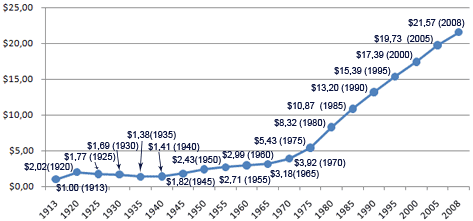
While here in the US, we do not really have an inflation problem, and many simply ignore inflation altogether. On average (from 1913 to 2006), the rate of inflation in the US is 3.45 percent per year, at this rate, price level doubles every 21 years. This is equivalent to saying that a dollar today is worth only 50 cents 21 years from now. Keep this in mind the next time you decide to invest in a bond or want to plan for your retirements – inflation really do eats away at those returns!

value-dollar over time

  1. Frequencies of hyperinflation

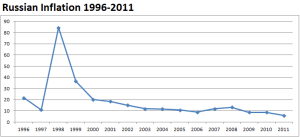
Hyperinflation happens more often than you think. From 1900 to 2013, there have been 56 recorded cases of hyperinflation (essentially runaway inflation that made that results from a combination of bad fiscal policy and a lack of public confidence in the value of the currency). It happened not only during 1920s Germany or Zimbabwe in the 2000s, but also places like Argentina and Brazil in 1989, Russia in 1992, and the former Yugoslavia in 1994.

Russian-Inflation-1996-2011

  1. When hyperinflation occurs

Historically, hyperinflation generally occurs during periods of political transitions or after a national catastrophe, usually war. Examples: in the former Soviet republics from 1992 to 1993 (in Armenia, it reached monthly inflation rates of 438 percent, in the Ukraine it reached 285%); in China immediately after the collapse of the Nationalist government in 1948 and shortly before the Communist victory; and during the devastation in the 1990s of the Yugoslav wars, etc.

historic cases of hyperinflation

  1. Inflation does not necessarily increase the cost of living

Inflation is defined as the average increase in price levels over a given period of time. However, not all of us purchase the same type of goods and services. Therefore, inflation for each person is different. For someone who spends a large chunk of their income on transportation might experience very modest increases in cost of living even if other products on the market increased in prices dramatically.

fisher-investments-Inflations-Impact-300x231

  1. Inflation in certain sectors of the economy dramatically out-paced that of others

Inflation can vary dramatically, depending on which sector of the economy we look at. Certain products and services like college tuition and hospital services increased in prices by 300% from 1989 to 2012; Compare this with the increase in the price of a new car, which increased by about 20-30% over the course of the same period. Clearly, while no doubt inflation affects all sectors of the economy, some sectors are clearly more impacted. (Personally, as a college student, the high increases in college tuition is indeed a source of constant worry).

  1. Inflation is not necessarily bad

In fact, a modest amount of inflation is normal in a healthy and growing economy. Price volatility is a normal part of the economic picture and no central bank had ever set the interest rate at 0%. What is truly bad for the economy is the prospects of deflation, a general fall in prices over a certain period of time. In this scenario, businesses would invest less (resulting in lowered economic output), layoffs and mass unemployment will follow. Unsurprisingly, deflation often occurs hand in hand with recession and can in fact worsen an economic contraction. In 2009, the United States had its first case of deflation since the Depression years of the 1930s.

United-States-Inflation-rate-History

GDP: how accurate are they?

As educated citizens, there is no single measure of economy that we care more about than the GDP figure. Any increase or decrease in the change of GDP growth rate are bound to make national headlines. Witness the news media frenzy following the GDP figure release for China:

China GDP 2015 GDP news

Clearly, as a society, we regard the GDP figure as something more than a number that measures how large the economy is or the rate at which it is expanding (or contracting); but rather, we see GDP as almost a sacred figure. We take pride in our national economic output, we base our consumer confidence based on these numbers, and more importantly, politicians and decision-makers based their course of actions upon the changes in these numbers from year-to-year. We take the number as something that’s grounded in reality and something that’s unquestionable. And while some would argue about the usefulness of the GDP figure as a measure of the standard of living, most would accept the accuracy of those numbers. But how accurate is it really of a nation’s economic output? Here are several surprising facts that shows that perhaps GDP is not all that it seems. (For a similar list about inflation, click here)

  1. Ghana GDP revision: In 2010, Ghana decided to reexamine its GDP figures by using a different base year to calculate growth over time. The result? GDP was revised upward by over 60%.

Ghana GDP

  1. Nigerian GDP revision: In 2014 Nigeria recalculated its GDP (using a different base year) to include more sectors of the economy such as telecommunications. This recalculation resulted in Nigeria shifting its economic output by upwards of 80% and leading it to become the largest economy on the African continent, surpassing South Africa.

Nigeria's GDP revision

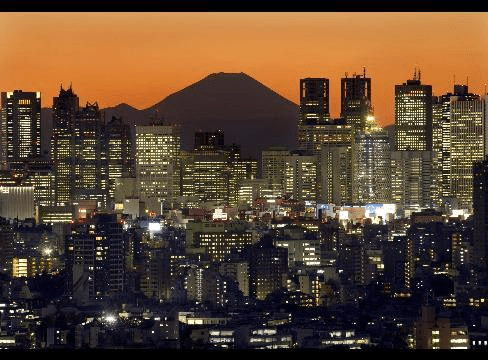
  1. Japan’s GDP calculation mistake: For the 4th quarter of 2012, Japan’s GDP was calculated as shrinking by 0.3%. In reality it increased 0.1%. This miscalculation was the result of a failure to correct seasonally-adjusted figures and misreporting of the GDP deflator (a measure of inflation).

Japan's cities at night

  1. An Excel error and its impacts on public policy debates: In 2010, two economists, Carmen Reinhart and Kenneth Rogoff, published a report claiming that countries with High Debt/GDP ratios have lower growth on average. To support their argument, they used data from 20 advanced economies and calculated their average rate of GDP growth. However, they neglected to select 5 countries (Australia, Austria, Belgium, Canada and Denmark) with both high Debt/GDP and GDP growth rates, skewing their result and the conclusions they draw. This mistake had profound implications. Congressmen and others within the federal government cited this as proof that our federal deficit each year needs to be reduced by cutting a variety of programs, so that our economic growth rate may remain unaffected.

GDP excel error

While this is not strictly a GDP error, it shows how a small mistake in calculating GDP data can seriously affect the conclusions drawn from it.

  1. US quarterly GDP revisions: For the first quarter of 2014, US GDP was revised downward a couple of times, each time suggesting that the GDP contracted further on an annualized basis. Much of the downward trend is the result of less-than-expected consumer spending on healthcare, and the lackluster performance of exports. In part, the GDP contraction was due to an exceptionally cold winter in the US.

US quarterly GDP revision

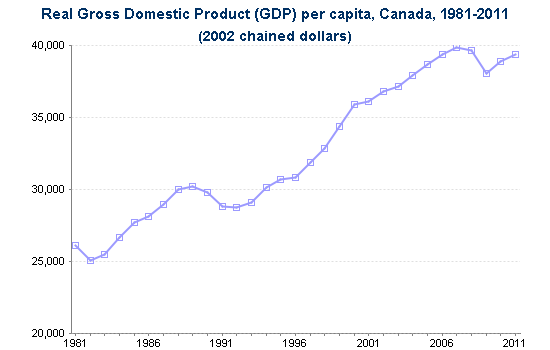
  1. Bank of Canada’s forecasting errors: Even in developed countries, economic forecasts can often go wrong. The Bank of Canada (Canada’s central bank) failed to forecast the small economic downturn in the fall of 2012. The bank of Canada’s forecasts are often overly optimistic. Out of 5 of 7 time periods studied, the average economic growth forecast is 0.6 percentage points higher than the actual; and 75 per cent of medium-term forecasts by the Bank of Canada were overly optimistic.

GDP growth in Canada per capita

So here it is. So the next time you hear in the news about GDP figures, remember that GDP is a number that’s created by people. Most often, these numbers are correct and give a good picture of our nation’s economic health. But at times, we base our GDP figures, past or future, based on faulty or incomplete information. And sometimes, we make plain simple mistakes.

Investment Analysis: Struggling industries and prospective short-sell candidates

As 2015 is starting, many in the investment circle are looking at what new industries and companies are presenting opportunities. While this is important, it is just as important to note what industries not to pick for this upcoming year. Here is my short list (no pun intended) of what industries are facing some significant headwinds and is good to avoid in this coming year. (If you are long (i.e expecting the value to go up), that is. But if you are looking for shorts (trying to profit by a falling in stock price), feel free to be as aggressive as you like; but be warned, as the great the economist John Maynard Keynes said, “The market can stay irrational longer than you can stay solvent”.)

  1. Small Oil and Gas companies with high fixed costs

Oil and gas are among the largest industries in the world (with an estimated 5 trillion dollars in revenue, rivaling the tech industry). Due in part to the massive stock market boom in the last few years, many small oil and gas companies emerges in the public markets. They range from extraction companies to oil exploration to small manufacturers of drilling equipment. With a falling oil price that is not likely to rise any time soon, these small producers with limited resources will likely falter. Moreover, natural resources extraction is a highly capital intensive industry and the firms will likely take on massive amounts of debts to finance its projects. It is estimated that drilling each oil well costs about 3 to 4 million dollars and small companies with a highly leveraged structure and few prospects for growth will be the likely victim in 2015. (Interested in Big Oil and corruption? click here For more on how the falling oil prices are affecting nations around the world, see here)

  1. Small tech companies that have no prospects of being bought up by the big guys

In this category, the companies that come to mind will be the small software development firms, such as app-makers that makes their business around a single app. For example, Zynga, the maker of the popular app game “Farmville”, is one such company. The company is involved in the social gaming category and have not expanded by much in the last couple of years, and are instead are trying to monetize its existing products. For a company involved in app-development, if no new apps are introduced continually, then the firm will simply wither away when demands for the current app disappears (as it most certainly will since consumer tastes are constantly changing). Monetization will be difficult, since a majority of the company’s revenue still comes from selling of advertising space and the market is increasingly saturated by the amount of advertisings out there, and increasing diminishing rates of return. Of course, the best that these tech companies can hope for is to be bought up by the larger players such as Facebook. However, with the proliferation of software companies, larger tech companies have more options to choose from and will take care to only add firms that adds value to the company’s operations.

  1. Small biotech or pharmaceuticals purporting to have “wonder drugs” or new “breakthrough technologies”

For those of you who subscribes to some form of investment newsletters (it doesn’t matter if they are free or charge you hundreds of dollars per year), you have no doubt saw a number of different promotions that talks about how a certain company is on the verge of growth. With a booming biotech sector, a lot of less credible companies have been swept up as well. These companies can have the following traits in common:

  1. Involving cancer-curing or purporting to cure multiple diseases at once with a single drug. These are often simply scientifically unsound, and investors should do some basic research on the subject and use common sense in sorting some of these issues out.
  2. Often in the early stages of the clinical trials, often Phase I and II. The early trials is to simply establish the safety of these medicines and their efficacy; these can often be subjected to statistical manipulation. (ex. in a trial for breast cancer treatment intended for women, the results show that no significant results have been found. However, the company claimed that the results work for a sub-group of that population. The population becomes much smaller and perhaps is simply the results of random chance.)
  3. Long clinical stages and delays in pushing forward to the next stage or toward FDA approval. If a company is a scam or have a drug that is on the verge of failure, the company will likely take as long as possible to “test” the drug. They will take their time for as long as possible in order to reap profits for insiders. Sometimes, some of these companies will even “retest” their drug once more for a certain stage, claiming insufficient data. This is a huge red flag, for a successful drug company will want to rush forward to start monetizing the drug by getting FDA approval. Delays to do so could suggest that the company is nothing but an elaborate promotion.

Note, I am not suggesting the biotech sector as a whole will do poorly this year; after all, the biotech sector, as measured by NASDAQ Biotechnology Index (ETF), is up around 30% from over a year ago and there is no reason to think such a trend will not continue, albeit at a slower pace.

  1. Restaurants and related services that are heavily dependent on consumer cyclical spending

Last year, several newly IPOed restaurants have taken a hit following the miss in expected earnings (ex. Potbelly’s, El Pollo Loco). The struggles in the restaurant industry is not lost upon many professional investors; in fact, some of the most heavily shorted stocks (as measured by short interests) in the US are in the restaurant sector. Restaurants in general are low-margin, with high fixed costs, with tremendous competition, and susceptible to variances in consumer sentiments. All of these makes them good companies to avoid investing in at any given time. But in 2015, there are macroeconomic factors at play here as well. Even though the US economy have outperformed its peers in the developed economies, consumer disposable incomes have not risen appreciably over the past year or so. Americans simply aren’t spending as much on restaurants as before, and the growing competition for healthy food options left many traditional restaurant chains and fast-food restaurants little options but to change what they are offering to clients. These changes will take a long time to implement, and will be extremely costly, even if they are successful at all. (McDonald’s recent advertising campaign is a good example of a restaurant trying to reshape their brand image).

Then there are these companies that have certain characteristics that makes them a bad investment in any scenario, but especially so with the bull market that we have been having for the past few years.

Among many economists, the longer the bull market runs, the more likely the crash in the market will be severe. Therefore, the companies that have been swept up in the bull market ride will be the first ones to fall.

  1. Companies in industries with low barriers to entry and no competitive edge that cannot be replicated

A name that comes to mind in this case is GoPro. The company essentially does one thing, which is to produce cameras that are frequently used by outdoorsman. This sole area of operation is inherently risky in itself. However, with the passage of time if the business is successful, there is no reason to suspect why larger companies with significantly more resources will not pursue a similar line of business and crush the competition. Companies that are reliant upon a single product or service are extremely vulnerable.

  1. Foreign based companies with obscure operations

The stock market boom not only attracted bad domestic companies to IPO. Many foreign companies are also taking notice of the market and want to raise money as well. Some of these companies may indeed have good intentions of raising money to fund their operations. Or they may simply be a fraud and simply want a piece of the actions in the market and enrich themselves. These companies can have names that sound grand, invoking their national titles and inflate their own importance. (They may have a naming structure like “‘name of country’ – ‘industry’ corporation”. i.e. Sino-Forest Corporation). Many of these companies claimed that they have great growth potential in their respective home country and it is next to impossible to ascertain what they are saying is true. A few years back, there was a huge wave of Chinese reverse mergers (i.e. a private company is taken public by purchasing a public shell company) that IPOed in the United States. Many of these companies banked on the investing public’s optimism in the economic growth of China and cooked their books to paint a rosy picture for themselves. Eventually, the frauds were eventually exposed. Many of these companies have complicate structures with unclear relationships with their parent company or its subsidiaries. Sometimes, it is also unclear how the companies make their money or the level of their debt obligations (often disguised as other business segments).

One of the things you might have noticed is how many times I have used the word “small” in the preceding passages. This is key. Smaller companies in all the industries mentioned have a much higher chance of going bad or simply being fraudulent that the large ones. I believe that the market is efficient for the large-cap companies that have been carefully scrutinized, and the prices are likely where they should be. (Of course, there are cases like Enron, but in that case, the business is so indecipherable that it is bad idea to be even thinking about it). So when investing, remember to keep the company’s size in mind.

Note: The above article expresses solely my personal opinion. This is a blog, after all. Please do not utilize the articles as investment advices; or if you do (I will be sincerely flattered that you would listen to a sophomore in college), please do your own due diligence before investing. I do not hold any stocks or any form of investments whatsoever.