GDP: how accurate are they?

As educated citizens, there is no single measure of economy that we care more about than the GDP figure. Any increase or decrease in the change of GDP growth rate are bound to make national headlines. Witness the news media frenzy following the GDP figure release for China:

China GDP 2015 GDP news

Clearly, as a society, we regard the GDP figure as something more than a number that measures how large the economy is or the rate at which it is expanding (or contracting); but rather, we see GDP as almost a sacred figure. We take pride in our national economic output, we base our consumer confidence based on these numbers, and more importantly, politicians and decision-makers based their course of actions upon the changes in these numbers from year-to-year. We take the number as something that’s grounded in reality and something that’s unquestionable. And while some would argue about the usefulness of the GDP figure as a measure of the standard of living, most would accept the accuracy of those numbers. But how accurate is it really of a nation’s economic output? Here are several surprising facts that shows that perhaps GDP is not all that it seems. (For a similar list about inflation, click here)

  1. Ghana GDP revision: In 2010, Ghana decided to reexamine its GDP figures by using a different base year to calculate growth over time. The result? GDP was revised upward by over 60%.

Ghana GDP

  1. Nigerian GDP revision: In 2014 Nigeria recalculated its GDP (using a different base year) to include more sectors of the economy such as telecommunications. This recalculation resulted in Nigeria shifting its economic output by upwards of 80% and leading it to become the largest economy on the African continent, surpassing South Africa.

Nigeria's GDP revision

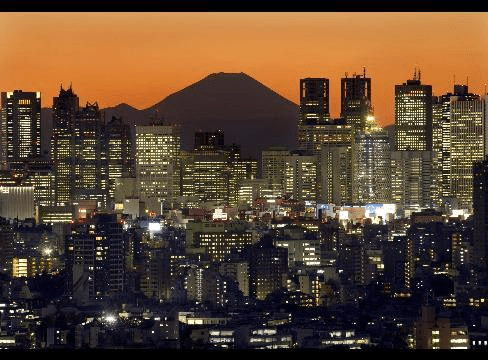
  1. Japan’s GDP calculation mistake: For the 4th quarter of 2012, Japan’s GDP was calculated as shrinking by 0.3%. In reality it increased 0.1%. This miscalculation was the result of a failure to correct seasonally-adjusted figures and misreporting of the GDP deflator (a measure of inflation).

Japan's cities at night

  1. An Excel error and its impacts on public policy debates: In 2010, two economists, Carmen Reinhart and Kenneth Rogoff, published a report claiming that countries with High Debt/GDP ratios have lower growth on average. To support their argument, they used data from 20 advanced economies and calculated their average rate of GDP growth. However, they neglected to select 5 countries (Australia, Austria, Belgium, Canada and Denmark) with both high Debt/GDP and GDP growth rates, skewing their result and the conclusions they draw. This mistake had profound implications. Congressmen and others within the federal government cited this as proof that our federal deficit each year needs to be reduced by cutting a variety of programs, so that our economic growth rate may remain unaffected.

GDP excel error

While this is not strictly a GDP error, it shows how a small mistake in calculating GDP data can seriously affect the conclusions drawn from it.

  1. US quarterly GDP revisions: For the first quarter of 2014, US GDP was revised downward a couple of times, each time suggesting that the GDP contracted further on an annualized basis. Much of the downward trend is the result of less-than-expected consumer spending on healthcare, and the lackluster performance of exports. In part, the GDP contraction was due to an exceptionally cold winter in the US.

US quarterly GDP revision

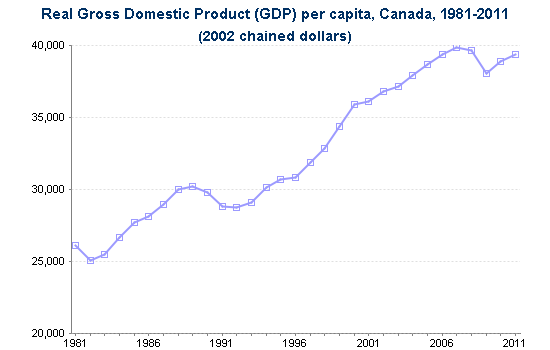
  1. Bank of Canada’s forecasting errors: Even in developed countries, economic forecasts can often go wrong. The Bank of Canada (Canada’s central bank) failed to forecast the small economic downturn in the fall of 2012. The bank of Canada’s forecasts are often overly optimistic. Out of 5 of 7 time periods studied, the average economic growth forecast is 0.6 percentage points higher than the actual; and 75 per cent of medium-term forecasts by the Bank of Canada were overly optimistic.

GDP growth in Canada per capita

So here it is. So the next time you hear in the news about GDP figures, remember that GDP is a number that’s created by people. Most often, these numbers are correct and give a good picture of our nation’s economic health. But at times, we base our GDP figures, past or future, based on faulty or incomplete information. And sometimes, we make plain simple mistakes.

On China’s Anti-Corruption Drive

In China, ever since president Xi Jinping launched his promise to crack down on corruption both high and low (or to use his phrase, “striking tigers and flies at the same time “), a dark cloud seemed to have engulfed Chinese politics. The corruption drives seemed to have consumed absolutely everyone, and has been the talk both within China and abroad. Hardly a day seemed to go by without some “high ranking official” getting sacked for alleged embezzlement, misconduct, or plain neglect of official duties. Yet, despite all the fanfare, how much of an impact is the crackdown really making?

First, it needed to be said, this official drive against corruption has been popular with the Chinese people. Official corruption has long been a source of anger among most Chinese and they resent the way that government officials are able to use their given authorities to further their own ends. To many Chinese, the direct actions from the Central Government in Beijing are the only ways for which corruptions can be combated, since the national government are the only ones able to protect the defenseless people from the greedy and vicious local officials.

President Xi’s role as a corruption buster would hardly be the first in the long history of China, although it is arguably the largest such drives since the Communist victory in 1949. Throughout China’s imperial history, corruption has always been present in China’s vast bureaucracy. Therefore, it is the duty of the imperial court and the emperor to periodically send out officials from the capital to the provinces to inspect local officials and to hand out punishment to those officials found to be corrupt. One of the key reasons for the Communist victory of 1949 is the ability of the Communist leadership to present an image of themselves as the “incorruptibles”, and portraying their opponents, the Nationalists, as a group of corrupt bandits.

Now fast-forward to 2014, and we see that if we substitute the imperial bureaucracy with the Party bureaucracy; the imperial court with the Central Government in Beijing; the traveling officials of the court with the Central Commission for Discipline Inspection (a branch of the Central Government); and the emperor, dare I suggest, with the General Secretary of the Communist Party, Xi Jinping himself; and we then see a parallel system of combating corruption. Namely, by arresting those responsible and seize their ill-gotten assets. However, if we look at this method of combating corruption, we see that it is neglecting the true causes that enabled these corruptions to happen in the first place. Arresting officials may be easy to do in the short run and may discourage corrupt practices briefly. Eventually, the energy of a government get tired out and it would declare the corruption drives a success and wrap it up. This sort of solution could not be sustainable in the long run and is merely a stop-gap measure. Or to use our historic analogy, one key reason why every dynasty falls in China is its inability to handle reforms and had to rely on temporary measures to stop these failures in governance; eventually, only a popular uprising and revolution is able to change the status quo.

I’m sure this point is not lost upon the officials who instigated this sort of investigations in the first place. The question we must ask ourselves then is why this corruption drive if everyone knows it is destined to fail? I can divide up the reasons as follows: first, the desire to appear responsible and to gain popularity among the people, and gain credibility and praise for its leaders, most important of which is Xi Jinping himself; second, more importantly, to use this opportunity to eliminate domestic rivals and challenges to the ruling group’s rule through the process of arrest and public humiliation via a media campaign; and thirdly, as an explanation to the method of anti-corruption drives, to preserve the legitimacy of the party and to root out some of its abuses without actually loosening the ruling party’s hold on power.

The Chinese public, like publics everywhere, are eager for sensational news (how much funds he embezzled, how many apartments has he gotten, how many mistresses are being supported by him), and is willing to let the sensational take over the need for true substance, which is the need for institutionalized reform. For those in the highest levels of government right now, this ability to satisfy a public that is eager to combat corruption and see the downfall of corrupt officials makes the corruption drives worth the effort. Boosting its image among the public and gaining their support, the government is able to have a freer hand in dealing with other domestic issues such as the problems relating to environmental degradation; or in the international arena, such as the island disputes in the East and South China Seas. President Xi himself, by seeming to remain aloof from charges of corruption (while in reality his family assets are no less questionable), can gain the credibility needed to implement his political agendas.

In the opaque environment of Chinese politics, power is never as secure as it looks to the outsiders. There exists numerous factions with the Party itself, jousting for influence with one another. President Xi had gained power over the years by outmaneuvering his political opponents, most important of whom is Bo Xilai, a disgraced former Party regional leader who had been a key contender for national leadership and who was now found guilty of murder and numerous corruption charges. Now, as a part of his official anti-corruption campaign, Xi is moving against some of his other opponents such as Zhou Yongkang, an ex-security chief arrested for corruption and leaking state secrets. Indeed, the corruption drive, despite its wide scope, has targeted very specific individuals and groups that have opposed Xi in the past and are threatening his own power base. Arguably, partly as a result of the anti-corruption campaign, which rendered his opponents either in a state of confinement or politically powerless, Xi is now arguably the most powerful Chinese leader since the death of Mao Zedong, the founder of the People’s Republic.

Finally, the Chinese leadership, in spite of its political agendas, recognized the need to combat corruption on a serious level, as it presents a threat to its legitimacy in the eyes of the Chinese people. However, the most obvious solution, which is implementing reforms to the structure of governance, will invariably involve the loosening the Party’s grip on power. This is unacceptable to all party officials large and small, past and present. Moreover, the political institutions of China or the lack thereof presents serious challenges to be overcome: the lack of an independent judiciary not subject to political pressures, the intimate relationships between officials and heads of state-owned enterprises (SOEs), the pervasive cronyism as a result of the system of political appointees that run from the top down, etc. All of these are serious problems that needs to be addressed. The problem is, the Party is unable and unwilling to address these problems without themselves becoming discredited and falling from its position as the ruling party of China. Therefore, it had to resort to the sort of temporary stop-gap measures that have been the hallmark of central governments since antiquity. (And, likewise, destined to fail with the passage of time)

I recall reading a book a while back about China, which compared China to the bus in the movie “Speed” (1994), which features Keanu Reeves, Dennis Hopper, and Sandra Bullock. In the movie the cops must prevent a bomb from exploding in the city bus, while keeping the bus hurtling through the streets above 50 miles an hour. Any speed below 50 miles an hour and the bus will explode. Needless to say, China is this bus. Now let’s imagine for ourselves that we are the national leaders of China, and we recognized that there is a ticking bomb on this China bus. However, to keep China going, we must keep the Chinese economy growing at over 7% per year, keep the machineries of government working, and to maintain order onboard. All of these while we are navigating through the streets of international relations, and make sure that no one else is affected by our problems. Corruption is that ticking bomb that will likely explode and will be a problem for the national government if left untreated. However, to tackle it, the national leaders must take into considerations the numerous other factors at play. For now at least, it is simply easier to keep China going forward by developing its economy and distracts the people from the problems the nation is facing, than to tackle issue of corruption through institutional reform.

For more on the Chinese housing market, click here. For more on corruption in the oil industry worldwide, click here.
Questions of Identity: What defines our nation?

While having dinner at Berkeley’s dining commons, I was talking with an international student from South Korea. We were discussing our respective backgrounds. He was telling about how in South Korea, everyone identifies with one another, mostly in the form of culture and a similar language. He also mentioned an identifying factor that is hard to imagine in the US: race and ethnicity. In Korea, everyone belongs to the Korean “race” and this ethnic identifying factor is important in how Koreans see themselves as a nation. Then he asked me about something that he is confused about: What defines America? What is it that makes America stick together as a nation? Taken aback by this question, I couldn’t come up with a response. Then I stated that in the US, we do not value race, ethnicity, or even culture or language as much; rather, we as Americans share a certain set of values such individualism, respect for the law and democracy. However, as soon as I uttered those words, I realized how textbook like I sound, for these are the responses a course of American politics would probably gave. While he nodded in assent, I myself wasn’t entirely satisfied my response.

I have always enjoyed talking with international students, they often offers a fresh perspective on things that some of us born in the US or living in the US have taken for granted. Take the question of what defines the US for example, I have never thought about how bewildering the American Identity must have seemed to others. We are a nation that is multi-race, multi-religion, multi-cultural, and even multi-lingual (even though English is the de facto language of communication); indeed how is it that the American nation can stay together for so long?

After careful thought, I came to the conclusion our national identity is defined by several values. Most importantly, I believe that the US is defined by our inclusiveness to people of all different background, at the same time, we helped to foster immigrants and native-born citizens with a certain set of values that define America. And I believe the acquisition of an American identity happened in several stages. Firstly, those who immigrated to the United States are already breaking the bound with their old home country for political, religious, economic, and a variety of other regions that causes them to be no longer attached to their old identity. This is important because by forming a new blank slate (a table rasa if you will), a new identity can be imprinted upon them. Secondly, the gradually process of assimilation, or at least acceptance of American culture and the American way of life happens gradually. Through working, interacting with others, watching TV and accessing the internet, individuals can acquire a new perspective on things, a perspective that respects the diversity of American society. One key aspect of this acculturation to the US lies in the learning of the English language. This is not necessary merely for the cultural sense, but also to facilitate the understanding of what the larger society is about. Finally, the acquisition of an American identities is completed when citizens began to appreciate the political institutions of the United States, possess an understanding of the American political culture, and appreciate the nation for what it is. The acquisition of citizenship status is merely a formalization of the process of becoming an American. Throughout this process, a person began to identify more and more closely with the identity of an American.

However, this process of becoming an American is not without its challenges. At each stage of the process, a person may fail to progress to the next stage. For example, a person may remain so attached to their home country that they refuses to accept anything else even though they physically had come to America. Moreover, a person may refuse to learn the English language, or work, or interact with anyone else in the US. Or they may choose to fill their living rooms with foreign media and essentially recreating their home country in America, and isolate themselves from their surroundings. Under these circumstances, a person cannot become an “American” in the cultural sense of the word. And even when they chose to became a citizen, they did not truly complete the process of becoming an American in their heart and mind.

But what about remaining American after we began to identify with each other in a community? I believe that the decision of remaining American is an expression of our personal choice. We take pride in the community in which we belong in. Here, I draw upon the ideas of the famous French theorist, Ernest Renan, who argued that choosing to belong to a nation is a daily process of affirmation in a community. A nation is not a concrete concept that is defined by its borders, institutions, or other perceived similarities. Here in the United States, we are not defined by the 49th parallel North or the Rio Grande, but rather by a set of values and shared experiences that all of us treasure. The fact that we are living together and form a community is a testament to our continual will to be American; for if not, we can easily move away from this country, or “vote with our feet”. Each day, while we might not think of it as such, we are constantly reaffirming our desire to remain American by exercising our right to work, to express our opinions, and paying attention to the things going on around us.

However, this is not without its challenges as well. For the values that define us need to be constantly reinforced through more direct actions such as engagement with the political process by the simple act of voting. As Americans, we not only have rights but also responsibilities and if we neglected some of these simple acts, in a way, we forfeit our right to remain in the American community. If a nation is indeed a larger community of people that chose to remain together, then it is the duty for every member of that nation to constantly reaffirm their commitment to that community through their engagement with the nation and other members of the community. If the members of a nation cease to become engaged with one another, then the nation and the force that is binding it together will cease to function as a cohesive force.

This issue of what defines America affects me personally, for not too long ago, I became a citizen of the United States. As I was sworn in to become an American, I was overcame by a sense of apprehension. For what it is that I need to do, now that I am a member of the American “nation”. Should I behave in a different manner? Are my loyalties completely transferred over to this new nation? After the sworn-in ceremony, I did not feel any different than before, does this mean that I have failed in this transformative process?

Later, I recognized that the best way to feel at ease in this nation is to engage with its nation- and community-building process. By that I am suggesting that I will go out and vote and encourage others to engage in the political process as well, and volunteer my time and efforts and engage with the community around me. To appreciate on a daily basis what we do in this nation and to cherish the social, political, and cultural institutions that define the United States. But I above, I will continue to value and uphold the bonds that unites Americans together and to encourage others to do the same, making us stronger than ever before. A nation at its core is a community and it is the duty of each member of this community to develop a strong bond with one another, so that together we may progress into the future.

Labor market in Japan: Is female participation the key to economic recovery?

I came across this article quite recently on NPR news, “Is ‘Womenomics’ The Answer To Japan’s Economic Woes?” http://www.npr.org/blogs/parallels/2014/12/03/368143686/is-womenomics-the-answer-to-japans-economic-woes . The author posed the question of whether or not Japan’s recent policy, dubbed “Abenomics”, is going to pull the nation out of economic stagnation. One key component of this economic revitalization is to introduce women into the workplace and to provide a more talented pool of workers for the economy to draw upon. However, his policies have been controversial as well, since he is accused of helping only a small group of women, and not doing enough to help advance the careers of others. The debate, therefore, revolves around what is the economic role for women in a society such as that of Japan’s?

It is no secret that the Japanese economy is in a sluggish condition, with many structural problems present. Personally, I believe in the importance of sustained economic growth to bring benefits to society, and if having greater participation can contribute to the economic development, then I believe it is the duty of a government to help women assimilate into the workforce. This will no doubt face considerable resistance from many in a traditional society such as that of Japan, where women in the workplace, especially in jobs like manufacturing, is still something rarity, and women are expected to become the child-bearers and homemakers in society. But we must not forget the fact that the Japanese workforce is shrinking due to population decline, and immigrations are still being severely restricted in the nation. Therefore, it is imperative for Japan to increase the size of its labor force by including more women than before in order to save many of the industries in the country from being relocated elsewhere.

This sort of change requires a fundamental shift in the way a society views how their economy should be organized. If we look back at the history of Japan, we see that Japanese society reorganized itself from a feudal agricultural nation into an industrial one in the late 19th century; and post-World War Two, when Japan orientated itself to become an exporting nation, with an emphasis on electronics. These sort of changes did not happen overnight and had to overcome challenges within society, the landowners and domestic industrialists respectively. Also in each case, the government, in the form of a centralized bureaucracy and the Ministry of Economy, Trade, and Industry (METI), helped to propel the nation into greater economic advancements.

In today’s Japan, societal views of women have not changed in decades, even though the economic fortune of Japan have shifted considerably. In response to this new crisis in the labor market, I believe that the government has the opportunity to once again take a proactive role in society, and to encourage economic development by making drastic changes in the social framework. By providing subsidies to industries that hire women, by giving better childcare and social benefits, by opening technical training programs for women, the Japanese government can introduce more women into the workforce. Japan has done it before, spear-heading changes in its economy and transformed itself into the 3rd largest economy in the world today. I believe that with the right amount of political will to foster these social changes, Japan can once again become an engine of global economic growth.

The return of manufacturing jobs to the US: challenges and responsibilities

In a recent article from NBC news, a report came out that suggested that manufacturing jobs are returning to the United States, mostly in the form of work in auto-plants and other machinery manufacturing plants. However, the article also pointed out that even though the jobs are returning to the US, the quality of the job simply is not the same: the pay is lower and job security is also far less, with many temporary and contract workers. This poses a dilemma for both policy makers as well as auto manufacturing firms: while it is good to have jobs returned to the United States, is it okay to pay workers poorly and not offering other forms of benefits? Or should companies also have a responsibility to give “good” jobs to Americans?

I believe that the first order of business for a government is to ensure that jobs exist for the vast majority of its peoples, and while things like health benefits for workers and higher wages are important, this should come after jobs have been secured. Of course, that is not to say that in our quest for jobs, we can let businesses have a free rein over what they want to do; they must still adhere to legal regulations and other government regulations. As the cost of fuel have risen dramatically in the past decade (the current dip in prices of oil may only be temporary), and the cost of labor have risen elsewhere, it makes more sense for firms to manufacture in the United States, which remains one of the largest consumer market for products in the world. This is a historic opportunity that our government should not ignore, for a couple of reasons. First, millions of Americans are still out of work, and often manufacturing jobs can provide for those lacking skills in other fields. Secondly, and more importantly, a manufacturing base here in the US can help us wither more business crisis in the years to come. A more-manufacturing based economy can help in the following way: suppose an economy is in a recession and aggregate demand is down. A government stimulus can help the economy by ordering more goods even though there is no demand, and this in turn triggered greater output, greater employment, greater income, and kicks off a multiplier effect. A more service-oriented economy simply cannot do that, since government cannot purchase a service when there is no demand, and government spending can have a difficult time stimulate spending. So, in this sense, the return of manufacturing to the US, even at lower wages, can help us recover from a recession faster in the future.

Moreover, we must adjust our mindset toward large manufacturers like GM. Gone were the days when a factory worker can have enough wages to support a family of 4 and enjoy middle-class living standards. Manufacturing is no longer what is used to be because of the increased competition from overseas markets and greater automation in the workplace. But we must not let this fact deter us from taking advantage of opportunities that comes our way. After decades of “de-industrialization”, with industrial capacity being moved offshore, perhaps it is now time to “re-industrialize” and to leverage our country’s unique advantages to form a new, rebalanced economy.

The changing social climate of UC Berkeley: activists or those who need to be activated?

Recently, in Berkeley, we celebrated the 50th anniversary of the Free Speech Movement that took place during the 1960s, with campus-wide events hosted by a variety of clubs and organizations. It happens that while walking with a friend out on Sproul Plaza (the center of UC Berkeley’s political and social life, where much picketing and demonstration happens), I asked her if she is doing anything in relation to this event. I wasn’t expecting an affirmative response, for most people don’t really care too much; but to my astonishment, she does not even know what Free Speech Movement was! After talking with her further, I realized that she does not know anything about the history of the University, and especially the activism of the early 60s and the Vietnam era, or even Berkeley’s reputation as one of the most liberal colleges in the US. However, soon I remembered that she is an international student who did not care to do the research on the social aspects of this university and instead applied simply for the university’s reputation as a center of research.

Later, after I came back into my room, I began to ponder about how Berkeley has changed since the 60s. The students are simply no longer the same. Traditionally, those students who are most actively have come from the American middle or lower-middle class, those who have received an excellent education, but also who has an extensive amount of interactions with the socially disadvantaged. The hippies and the liberal atheistic type that abounded during that time no longer exists. (Well, not if you count the large homeless population in the city of Berkeley, many of whom holds liberal views. The student population as a whole do not regard them as a source of enlightenment, but rather as a nuisance with ideas of a bygone era.)

The changing demographic of Berkeley has changed what it means for Berkeley as a left-leaning or liberal university. Increasingly, the student composition of UC Berkeley have come from outside the state and outside the country. Based on the 2014 admission statistics, we see that around 25% are out-of-state students and 10% are international. The differing academic acceptance rates are partially political in nature: since traditionally the UC system depends upon state funding to continue its operations, and therefore accepting an overwhelming amount of in-state students; but now with the continual low amount of state funding, the school depends on out of state tuition fees to cover some of its expenses.  These changes have profoundly changed the view Berkeley students viewed themselves and the world. The background of these students are often upper middle class or even from the very top echelons of their respective countries. This resulted in them being less interested in social issues and more interested in their education or their enjoyment of college, in more extreme cases, they are treating the college experience almost as a 4-year vacation. As a Berkeley student, I note with interest the difference between those who are born in the state of California and those who are from other parts of the US or around the world, who in general are wealthier: students from affluent overseas families would often prominently display their Coach bags or Prada shoes, while those of us of middle or lower class background in California walks around in our simple clothing, with nothing flashy to show.

This changing demographics are partly to blame for an increasing amount of apathy in political and social affairs. Here in UC Berkeley, many of students (from a different location or background) do not know of anything important that’s going on around them, and display no interests whatsoever in local or community issues. On national issues, their awareness is just as low. This results in an interesting situation on campus, where the professors are often far more liberal – being from a different era – and more caring about issues around them than the students themselves, despite the great age differences.

This is a disturbing trend for many reasons. Firstly, college is not simply a place where we learn in a classroom, despite the importance of it. Most of us learn through interactions with others and caring about the community is the first step in learning what it means to be a member of it. Caring about issues at hand – whether it is immigration reform or the Keystone pipeline – should still interest us. And interests frequently lead to social change. Moreover, Berkeley is a place where we prepare future leaders who have ideas on how they want to change the world. How can we accomplish this without have an activist student body? Student activism is not limited to picketing and sit-ins, but also in talking with those in a position of authority, writing about issues they care about, make their voices heard on social media and so much more. Every student should have an activist part within them, and college is the best time to discover themselves and act on their activism.

What should we do to change this? By no means do I suggest that Berkeley stop accepting students from other locations or those above a certain level of income; the diversity is what made us who we are, and we should keep it that way. But I do think that we should encourage activism among the students by offering more selections of classes or programs whereby we can learn about contemporary issues and provide forums in which students can explore more. Perhaps, even in the college admission processes, we can weigh more portions on the activism aspects and look for students who demonstrated potential for activist changes. This way, we can ensure that our University continues to be not only the top school for education, but also continue as a place of student activism.