12 Important metrics for short selling

Intro:

In my previous experience in short-selling, many different quantitative and qualitative metrics were used to filter through prospective short-sell candidates. Many of these that I am about to discuss are frequently used in the entire industry, and you will definitely find a list that are even more comprehensive elsewhere on the web. Of course, as the sophisticated investors know, each fund is unique in its approach in determining what metrics are important and weigh it accordingly in their overall model. For instance, some more quant-driven funds prefer to include as many variables within their models as possible and to encompass all possible factors that can affect a company’s earnings (causing the earning to go lower, in the case of short-selling); while more fundamental funds focus on a few core variables and do more in-depth investigations to build up a story of the company and decide then whether or not to short the company’s stock.


Most of the information presented here can be found through one of the financial services websites/tools commonly used in the industry. Personally, I have used Capital IQ for many of the financial metrics. More sophisticated investor may decide to use a combination of different services and/or build their own tools to gather data. In this article, I have used the words “quantitative” and “financial” rather loosely and at times interchangeably; and “qualitative” and “non-financial” as well. I apologize in advance some of the confusions this may cause.


Without further ado, here are some of the most important metrics, 6 each for both quantitative and qualitative factors:


Quantitative/Financial factors:


  1. Short Interest: This ratio essentially tells us what percentage of the shares outstanding is held for purposes of short-selling a stock. The higher the short interest, of course, the more likely the investor believed that the stock is likely to fall in price.


What it means: For investors, this can be an indicator that the market is overly pessimistic on the stock or that everyone already knows that it is a bad stock. I would recommend that investors not get into stocks with high short interest for a few reasons. First, this suggests that there is likely few profits to be made if everyone already recognized the mispricing. Second, for short-sellers to profit, they must buy back their position, which causes a spike in the price. This can be a rapid increase if too many short-sellers “cover” at once, resulting in a situation that is termed as a “short-squeeze”. Investors many not profit in this case. Finally, as hedge funds and active investors in general want to “beat” the market, it is important to realize that you can’t “beat” them if you invest like what the rest of market is thinking.


  1. Stock Loan Fee: This is the price that an investor will have to pay to borrow a stock. This is provided in a percentage (the cost of borrowing/share price). Generally the short-seller’s prime brokers (the guys who loans out the stock) will provide the borrowing cost number to the borrower.


What it means: As with short-interest, a higher percentage of borrowing cost suggest that many investors are expecting the stock value to fall. Depending on the demand and supply, borrowing cost can become exorbitantly high, and investors should be aware that this interest can eats away at returns substantially the longer the short position is held out.


  1. Days Inventory Outstanding: This financial ratio from the balance sheet is simply how long the company takes to collect its inventory. It is calculated by (inventory/COGS)*365. This ratio – also going by the name of “Days Sales of Inventory” – generally gives a good indication of how long the inventory is held by the company before sales occur.


What it means: In general, the longer the inventory is stored, the worse it is for the company. This means that the company is having a ton of inventories but aren’t able to generate sales on those inventories. This can suggest that a firm is incapable of selling goods due to operational issues. As with all ratios, comparisons over time is crucial, if the firm has been increasing its in Days Inventory Outstanding, that is definitely a bad sign. Similarly, horizontal analysis between different firms within the same industry tells us how the firm is doing in comparison to its peers.


  1. Days AR Outstanding: like its cousin “Days Inventory Outstanding”, this ratio also measures a company’s collection period. In this case, it measures how long it takes for companies collect on their accounts receivables, and turn them into cash.


What it means: This ratio is frequently used in forensic accounting due to the fact that many accounting frauds involve 1) overselling to their buyers even when there are no demands, and thereby increasing their revenues or 2) companies book fictitious AR sales when in fact no such transactions happen. Higher Days AR outstanding is certainly not good, and a pattern of increase days AR outstanding is certainly worrisome.


  1. Comparison between cash flow from operation increases and net income increases: There probably is an actual name for this type of comparison, but the name is escaping my mind right now. Company’s net income and cash flow from operations should move in the same direction, and with some exceptions, be of the same magnitude.


What it means: comparisons between cash flow and net income is important because this tells us whether or not the company is truly turning those “net incomes” – which is an accounting construct – into something more tangible – cash. The general idea is that while earnings (net income) can be easily manipulated, cash flow is much harder to be tinkered with.


  1. EV/EBITDA: This is perhaps the most commonly used and the most important among all the ratios discussed. It is calculated by EV: (market common stock value +debt + preferred equity + minority interests – cash/cash equivalents) divided by EBITDA (Earnings Before Interest, Tax, Depreciation, and Amortization). This is the theoretical value that an outsider buyer would have to pay to by this company from the market.


What it means: Value investors use this frequently to find the whether or not a company is undervalued, and this offers a much more comprehensive look than the more commonly used P/E ratio, since it takes into consideration debt. It is often thought of as giving a “truer” value of the company.


Experienced investors will notice from the above list that several of the mostly important metrics that the long-side use to discover “value” stocks are not used; namely: P/E ratio, P/S, Debt/Equity, Interest Coverage ratios, etc. These ratios are absolutely necessary to look at as well, but for the purpose of this article, I am emphasizing only the important ones for short-selling. Value investing and short-selling are in fact two-sides of the same coin; whereas value investors want to find undervalued companies, short-selling want to find overvalued ones.
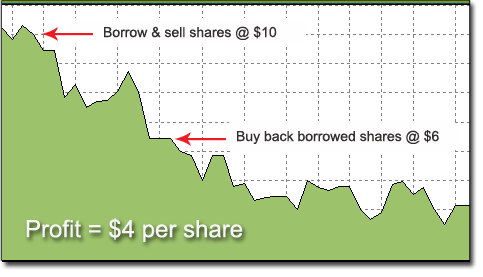
short-selling graph 

Qualitative/Non-Financial Factors:


This section is much more open to debate and I included only the 6 that I have come across the most often to give a sense of the wide variety of non-financial factors that can affect stock performance. Many of these can be tracked, and especially with advancements in natural language processing, these qualitative factors can in fact be quantified and placed into a model.


  1. Location of firm’s headquarters, region of operation, etc.: Always beware of where the company is based at, as some locations are inherently more questionable than others. An investor should also beware of constant changes in a company’s location as well.


What it means: Location, location, location. This matters in more than just a real estate sense of the word. Where a company is headquartered matters and having its operation based in a region with more governmental oversights versus less oversights is vital in evaluating the firms’ long-term survivability when the regulations do tighten.


  1. Number of years of experiences of management team: Looking at the average number of years of experience for the managers of a company can give a good idea of how the firm will be able to weather the next financial storm.


What it means: A younger average age for a management team is not necessarily a bad thing, as the young can always bring fresh ideas to the top. It is however, always questionable when someone with no real prior experience in managing companies suddenly becomes a more senior member of the team. Experience at the top is generally a desired quality.


  1. Number of documented SEC filing changes: This is a very well know one, and academic studies have been done on this subject. Firms must file to the SEC certain material changes to their operations, namely that of 8-K (current report), and other mandatory press releases. More frequent filing generally does not bode well for the company.


What it means: It has been found that firms that file more SEC filings have a tendency to engage in fraudulent activities, since they may be constantly trying rebrand themselves to investors. Firms, as a rule, should expand orderly and methodically, and any changes to its operations should be done infrequently and with plenty of preparations. Frequent SEC filings suggest otherwise.


  1. Number of CEO/Top Management changes: Technically this counts as part of SEC filings. But I would like to break this out because management is such a critical component of a company. As with SEC filings, the more frequent the management changes, the less credible the company becomes.


What it means: As the people in charge of setting a strategic direction for the company, we want to see consistency in the direction-setting for the company. Frequently changes at the top affects the morale down to the employee, and suggests that the company do not really have a good sense of where is heading toward.


  1. Executive pays in relation to firm’s performance: While it is difficult to fix a ratio to executive pay to firm’s net income, a much more realistic ratio lies with percent of executive pay increases versus earnings increases. Executive pays tie into stock performance (This is all part of the “shareholder model” of corporations where there is a perceived “principal-agent’s problem” and be partly solved by incentivizing management with stocks), and the pay can be lopsided in favor of management even when they are not really delivering value to shareholders.


What it means: When management team have been paying themselves a handsome salary while the firm is still deep in the red or have a lackluster performance, that should most certainly be a red flag.


  1. Insider transactions: SEC also requires this to be disclosed, as it shows how much stocks the company’s executives are buying or selling.


What it means: While insider buying almost always is a good sign for the company, as it shows the insider’s confidence in the company’s ability to generate revenues and profits in the future, insider selling can be a bit mixed. However, if all insiders are unloading their stocks simultaneously over roughly the same time period, this is certainly not a good sign.


Here again, I must emphasize that the non-financial factors are highly controversial and every firm approaches it differently, and these lists are far from exhaustive.

financial graphs


Conclusion: As we can see above, a number of ratios and metrics have been used by professional investors in identifying short-sell candidates. When using these metrics, always make sure to compare it with the same company over time (i.e. vertically), and with similar firms within the same industry (i.e. horizontally). Valuation does not mean much if you cannot compare it to another firm or the same firm over time.


In practice, I believe that all of the metrics can be quantified in one way or another, perhaps some can be quantified with a greater precision than others. Short-selling is certainly filled with risks and dangers, but with the right tools and the correct analysis, I do believe that “Alpha” can be generated on the short-side. Good luck investing.


Disclosure: This article represents opinions that are entirely my own, and should not be taken to be the opinion of any individual/company that I have worked for, past or present. I am not and do not purport to be a registered investment advisor. This is not an offer to buy, sell or market any securities. Short-selling is risky and you may lose all of your initial invested capital. Short-selling is recommended for experienced investors only.




Another look on Valeant Pharmaceuticals (VRX)

Given the latest scrutiny over Valeant Pharmaceuticals, I would like to point to some of the inferences that I had drawn over this issue based on the facts; and the facts does not add much confidence for investors in this company.

The bombshell: Citron Research’s report[1]

Much of the recent decline in prices can be attributed to the publication of a negative report by Citron Research on Tuesday, October 21st, an online newsletter that has exposed many corporate frauds of recent years. Citron Research is fairly credible as a research group; based on a recent Wall Street Journal analysis[2], out of the 111 stocks that Citron has wrote about since the website was founded in 2001 (including its predecessor, StockLemon), 90 were lower one year later, and experienced an average stock price decline of 42%.

The main issue, as pointed out by the report, revolves around the issue of Philidor, which appears as a distributor of Valeant Pharmaceuticals that most sell-side analysts were unaware of until early last week. Citron reached out to the Philidor’s founders and key people that are associated with its operations; but they refused to talk about the company and its relationship with Valeant. However, as it turns out, Philidor is actually an exclusive distributor of Valeant’s products. Another issue came up when a company by the name of R&O Pharmacy filed a lawsuit claiming payment from Valeant in the amount of $69 million; however, based on Citron’s investigations, it appears that Philidor OWNS R&O pharmaceuticals. Moreover, it also appears that Valeant also have a network of other pharmacies, including westwilshirepharma, safexpharma, orbitpharmacy, that only does business with Valeant.

Before we delve into what these facts meant, we need to dispel several misconceptions regarding Citron Research. Many have made the argument that Mr. Left, the editor in charge of Citron Research, is a short-seller, and therefore have every incentive to beat the stock price down, and that this report is nothing more than a “bear raid”. However, before we start criticizing the short-sellers, investors should understand the enormous risks that Mr. Left had taken on by publishing this report. If it turns out that Mr. Left is wrong, the lawsuits that he will face will no doubt force him into serious financial distress. This report is not written without thoughts to its consequences. As Mr. Left himself have stated, he had been more right than wrong, and this is how he remain active.

The question that we have to ask ourselves is what exactly is the purpose of Philidor? It is simply very difficult to understand what is the purpose of these subsidiaries when a company like Valeant can distribute their products more directly. Philidor, as far as anyone can tell, is a secret distributor that Valeant tries not to publicize. Philidor ONLY distributes Valeant’s products and nothing else, and it appears that Valeant is selling to an off-balance sheet entity that buys only from Valeant.

Let’s assume that the intentions of Valeant are benign, and in this best case scenario, they have created a complicated financial structure and is simply making the accounting more opaque. If the intentions of the Company are more malicious, they have created a fairly convenient venue for them to conduct fraud and create fictitious transactions and sales (this is what Citron alleges). Next Monday, October 26th, the company will discuss Philidor and respond to criticisms; how the management explains the purpose of Philidor will be an issue of great importance.

Before moving on, I would like to point out on October 19th, the famed investigative reporter Roddy Boyd, had also discussed Valeant Pharmaceuticals in his article with the Southern Investigative Reporting Foundation[3] (SIRF) the extent to with Valeant Pharmaceuticals tried to obfuscate the relationships between the two companies.

Here are other issues of concern in addition to those that are brought up in Citron’s report:

Flawed business model:

Valeant operates by buying smaller drug companies and then raise the prices of those drugs to make a profit. The company does not really engage in original R&D and acts more as a marketer of pharmaceuticals. The company, therefore, was able to enormous margins on the drugs that they are selling. Hedge Funds, Bill Ackman’s Pershing Square Capital included, are absolutely in love with this model as shown by some of the largest holders of Valeant[4] as of Q2 2015,

  1. Pershing Square (Bill Ackman): 19,472,993 shares, 5.71%
  2. ValueAct Holdings (Jeff Ubben): 14,994,261 shares, 4.39% (sold 4.39 million shares in Q2)
  3. Paulson and Co. (John Paulson): 9 million shares, 2.64% (added 6.95 million shares in Q2)
  4. Lone Pine Capital (Steven Mandel): 5,310,143 shares, 1.56% (sold 259,317 shares in Q2)
  5. Viking Global (Andreas Halvorsen): 4,616,738 shares, 1.35% (added 558,395 shares in Q2)

In fact, at the annual Sohn Investment conference, Bill Ackman even claimed that Valeant could be the next Berkshire Hathaway due to its strategy of acquiring diverse companies in the pharmaceutical space[5].

Last year, Valeant attempted to take over Allergan in a much publicized deal. Valeant offered a tremendous sum to purchase the company using shareholders and lenders money. In many ways, this deal resembled the AOL-Time Warner deal in which an overvalued company attempts to take over another company with a more well-developed network of product and services. The deal failed and called into question the model that the company had been operating under. The company aims to grow through acquisitions at all costs and it is highly doubtful that they will be able to grow through outside purchases alone. In fact, the Company’s CEO stated that soon the Company would start having to produce their own drugs, as the prospective markets for future acquisitions have lessened[6], Valeant is running out of smaller drug companies and drugs to acquire. The market was not expecting this, and the stock traded down a bit on the news. To put it quite simply, Valeant’s model of growth up until this point is unlikely to continue forever.

Here is partial list of acquisitions that the company has made in the last couple of years[7]:

2014

PreCision Dermatology, Inc. (“PreCision”). July 2014

Solta Medical, Inc. (“Solta Medical”). January 2014

2013

B&L August 2013

Obagi Medical Products, Inc. (“Obagi”). April 2013

Natur Produkt International, JSC (“Natur Produkt”). February 2013

2012

Medicis. December 2012

OraPharma Topco Holdings, Inc. (“OraPharma”). June 2012

Certain assets of Gerot Lannach. March 2012

Divestiture

2014

Facial aesthetic fillers and toxins. July 2014

Metronidazole 1.3%. July 2014

Tretin-X® (tretinoin) cream and generic tretinoin gel and cream products. July 2014

2013

Divestiture of certain skincare products sold in Australia. October 2013

2012

Divestitures of 1% clindamycin and 5% benzoyl peroxide gel (“IDP-111”) and 5% fluorouracil cream (“5-FU”). February 2012

In addition, the company’s way of raising the price of the drugs (sometimes by over 1000%) had also faced serious scrutiny. Currently the company is facing a Congressional investigation on the price increases of two medications[8]: Isuprel, which is used to treat cardiac arrest, was raised from $215 to $1,346; while Nitropress, a medication used to treat congestive heart failure and life-threatening high blood pressure (hypertension), was raised from $257.80 to $805.61 a vial. As the New York Times have put it, “Valeant’s Drug Price Strategy Enriches It, but Infuriates Patients and Lawmakers”[9]. On October 14th of this year, the company issued a press release stating that the CEO, Michael Pearson, is now responding to these allegations and talked about Valeant’s reasoning “underlying Valeant’s pricing decisions, and Valeant’s programs designed to improve patient access, among other topics.”[10] As the regulators continue to scrutinize the company’s pricing decisions, we can expect certain regulatory actions that can impact the firm’s margins.

Aggressive and questionable sales techniques:

Valeant is aggressive when it comes to generating sales for its products, and they offer a number of incentives for the patients to purchase the company’s medications. For example, for several of the medications that the Company sells, Valeant’s venders offers to pay for the patient’s copay and to essentially give it off free of charge for the customer. Neither the doctors nor the patients have asked for it. The patients, of course, do not mind this as long as they need to pay nothing, and the patients end up having more medications than they possibly need. For Valeant, however, they are able to increase their sales volume and revenue tremendously. Moreover, the margins on those products are tremendous, and paying for the copays of the customers if it meant more sales made economic sense for Valeant.

However, the Company itself believes that their ability to generate sales is all due to organic growth. In the Q3 earning held by the company on Monday, October 19th, the company’s CEO, in response to a question regarding how Valeant was able to recognize revenue of about $460 million after initial projections of around $300 million, stated, “… again, there’s no sales incentive, I think it’s all growth. The products continue to grow above what we had forecasted in our deal model…”[11] The company insists that sales incentives are not the cause of their product sales, and that the Company’s products are extremely popular among users. This argument appears shaky at best.

In addition, the company received subpoenas from the U.S. Attorney’s Office for the District of Massachusetts and a subpoena from the U.S. Attorney’s Office for the Southern District of New York. Both are now requesting “documents with respect to our [Valeant’s] patient assistance programs, and also include requests relating to financial support provided by the company for patients, distribution of the company’s products, information provided to the Centers for Medicare and Medicaid Services, and pricing decisions.”[12] These “patients assistance programs” are highly problematic, and is one of the key drivers of sales for the company and what enables it to have such high sales growths year-on-year.

As can be imagined, insurance companies are the ones that are cheated by this deal. While the strict legality of these actions are questionable; in the past, several insurance companies have filed lawsuits against surgeons who waived copays for patients and who instead charge enormous fees on the insurance companies. It remains to be seen in court whether or not it is legal for drug distributors paying the copays of the patients[13].

Other new developments since Tuesday, 10/20:

Earlier in the week (10/21), the company halted the trading of the company’s stocks and called Citron’s report “erroneous”[14]. At that time, the stock was down 40%. On Friday, October 23rd, the stock rallied for a bit as many hedge funds, including Pershing, reiterated their commitment in going long on the stock, as well as Valeant’s announcement that they will address these issues at Monday’s conference call[15]. Other pharmaceutical companies – Akron, Allergan, Endo – all issued statements stating that they do not own other pharmacies for distribution and attempts to distance themselves from Valeant.

Finally, investors in this company should be aware of the fact that Valeant now have to face new lawsuits coming their way, such as Morganti Legal’s lawsuits[16] alleging that the company issued “materially misleading business information to the investing public including potentially inflating revenues by recording intercompany sales in its revenue figures” and many others; in addition, on Thursday October 22nd, a class-action lawsuits was filed against the company accusing the company of creating phantom accounts aimed at defrauding investors[17].

It remains to be seen after Valeant responds to these allegations on Monday what the market will do. Until then, investors beware.

[1] The full report can be found here: http://www.valuewalk.com/2015/10/valeant-pharmaceuticals-vrx-citron/

[2] http://www.wsj.com/articles/the-short-who-sank-valeant-stock-1445557157

[3] http://sirf-online.org/2015/10/19/hidden-in-plain-sight-valeants-big-crazy-sort-of-secret-story/

[4] http://www.businessinsider.com/hedge-funds-that-own-valeant-2015-10

[5] http://fortune.com/2015/05/04/bill-ackman-valeant-could-be-next-berkshire-hathaway/

[6] http://www.fiercepharma.com/story/valeant-changes-its-spots-promises-limit-price-hikes-spend-more-rd/2015-10-20

[7] Company’s 2015 10-K

[8] http://www.mccaskill.senate.gov/imo/media/doc/20150923McCaskilllettertoValeant.pdf

[9] http://www.nytimes.com/2015/10/05/business/valeants-drug-price-strategy-enriches-it-but-infuriates-patients-and-lawmakers.html?_r=0

[10] http://ir.valeant.com/investor-relations/news-releases/news-release-details/2015/Valeant-Provides-Update-Regarding-Government-Inquiries/default.aspx

[11] Earnings Transcript,

[12] http://ir.valeant.com/investor-relations/news-releases/news-release-details/2015/Valeant-Provides-Update-Regarding-Government-Inquiries/default.aspx  Emphasis are mine.

[13] http://www.bloomberg.com/news/articles/2012-07-19/silicon-valley-surgeons-risk-moral-authority-for-200-returns

[14] http://www.zerohedge.com/news/2015-10-21/vrx-halted-down-40-news-pending

[15] http://www.thestreet.com/story/13336555/1/valeant-pharmaceuticals-vrx-stock-rebounds-ahead-of-call-to-address-allegations.html?puc=yahoo&cm_ven=YAHOO

[16] http://finance.yahoo.com/news/shareholder-alert-morganti-legal-announces-155700510.html

[17] http://www.usatoday.com/story/money/2015/10/23/valeant-class-action-lawsuits/74457788/

Investment Analysis: Struggling industries and prospective short-sell candidates

As 2015 is starting, many in the investment circle are looking at what new industries and companies are presenting opportunities. While this is important, it is just as important to note what industries not to pick for this upcoming year. Here is my short list (no pun intended) of what industries are facing some significant headwinds and is good to avoid in this coming year. (If you are long (i.e expecting the value to go up), that is. But if you are looking for shorts (trying to profit by a falling in stock price), feel free to be as aggressive as you like; but be warned, as the great the economist John Maynard Keynes said, “The market can stay irrational longer than you can stay solvent”.)

  1. Small Oil and Gas companies with high fixed costs

Oil and gas are among the largest industries in the world (with an estimated 5 trillion dollars in revenue, rivaling the tech industry). Due in part to the massive stock market boom in the last few years, many small oil and gas companies emerges in the public markets. They range from extraction companies to oil exploration to small manufacturers of drilling equipment. With a falling oil price that is not likely to rise any time soon, these small producers with limited resources will likely falter. Moreover, natural resources extraction is a highly capital intensive industry and the firms will likely take on massive amounts of debts to finance its projects. It is estimated that drilling each oil well costs about 3 to 4 million dollars and small companies with a highly leveraged structure and few prospects for growth will be the likely victim in 2015. (Interested in Big Oil and corruption? click here For more on how the falling oil prices are affecting nations around the world, see here)

  1. Small tech companies that have no prospects of being bought up by the big guys

In this category, the companies that come to mind will be the small software development firms, such as app-makers that makes their business around a single app. For example, Zynga, the maker of the popular app game “Farmville”, is one such company. The company is involved in the social gaming category and have not expanded by much in the last couple of years, and are instead are trying to monetize its existing products. For a company involved in app-development, if no new apps are introduced continually, then the firm will simply wither away when demands for the current app disappears (as it most certainly will since consumer tastes are constantly changing). Monetization will be difficult, since a majority of the company’s revenue still comes from selling of advertising space and the market is increasingly saturated by the amount of advertisings out there, and increasing diminishing rates of return. Of course, the best that these tech companies can hope for is to be bought up by the larger players such as Facebook. However, with the proliferation of software companies, larger tech companies have more options to choose from and will take care to only add firms that adds value to the company’s operations.

  1. Small biotech or pharmaceuticals purporting to have “wonder drugs” or new “breakthrough technologies”

For those of you who subscribes to some form of investment newsletters (it doesn’t matter if they are free or charge you hundreds of dollars per year), you have no doubt saw a number of different promotions that talks about how a certain company is on the verge of growth. With a booming biotech sector, a lot of less credible companies have been swept up as well. These companies can have the following traits in common:

  1. Involving cancer-curing or purporting to cure multiple diseases at once with a single drug. These are often simply scientifically unsound, and investors should do some basic research on the subject and use common sense in sorting some of these issues out.
  2. Often in the early stages of the clinical trials, often Phase I and II. The early trials is to simply establish the safety of these medicines and their efficacy; these can often be subjected to statistical manipulation. (ex. in a trial for breast cancer treatment intended for women, the results show that no significant results have been found. However, the company claimed that the results work for a sub-group of that population. The population becomes much smaller and perhaps is simply the results of random chance.)
  3. Long clinical stages and delays in pushing forward to the next stage or toward FDA approval. If a company is a scam or have a drug that is on the verge of failure, the company will likely take as long as possible to “test” the drug. They will take their time for as long as possible in order to reap profits for insiders. Sometimes, some of these companies will even “retest” their drug once more for a certain stage, claiming insufficient data. This is a huge red flag, for a successful drug company will want to rush forward to start monetizing the drug by getting FDA approval. Delays to do so could suggest that the company is nothing but an elaborate promotion.

Note, I am not suggesting the biotech sector as a whole will do poorly this year; after all, the biotech sector, as measured by NASDAQ Biotechnology Index (ETF), is up around 30% from over a year ago and there is no reason to think such a trend will not continue, albeit at a slower pace.

  1. Restaurants and related services that are heavily dependent on consumer cyclical spending

Last year, several newly IPOed restaurants have taken a hit following the miss in expected earnings (ex. Potbelly’s, El Pollo Loco). The struggles in the restaurant industry is not lost upon many professional investors; in fact, some of the most heavily shorted stocks (as measured by short interests) in the US are in the restaurant sector. Restaurants in general are low-margin, with high fixed costs, with tremendous competition, and susceptible to variances in consumer sentiments. All of these makes them good companies to avoid investing in at any given time. But in 2015, there are macroeconomic factors at play here as well. Even though the US economy have outperformed its peers in the developed economies, consumer disposable incomes have not risen appreciably over the past year or so. Americans simply aren’t spending as much on restaurants as before, and the growing competition for healthy food options left many traditional restaurant chains and fast-food restaurants little options but to change what they are offering to clients. These changes will take a long time to implement, and will be extremely costly, even if they are successful at all. (McDonald’s recent advertising campaign is a good example of a restaurant trying to reshape their brand image).

Then there are these companies that have certain characteristics that makes them a bad investment in any scenario, but especially so with the bull market that we have been having for the past few years.

Among many economists, the longer the bull market runs, the more likely the crash in the market will be severe. Therefore, the companies that have been swept up in the bull market ride will be the first ones to fall.

  1. Companies in industries with low barriers to entry and no competitive edge that cannot be replicated

A name that comes to mind in this case is GoPro. The company essentially does one thing, which is to produce cameras that are frequently used by outdoorsman. This sole area of operation is inherently risky in itself. However, with the passage of time if the business is successful, there is no reason to suspect why larger companies with significantly more resources will not pursue a similar line of business and crush the competition. Companies that are reliant upon a single product or service are extremely vulnerable.

  1. Foreign based companies with obscure operations

The stock market boom not only attracted bad domestic companies to IPO. Many foreign companies are also taking notice of the market and want to raise money as well. Some of these companies may indeed have good intentions of raising money to fund their operations. Or they may simply be a fraud and simply want a piece of the actions in the market and enrich themselves. These companies can have names that sound grand, invoking their national titles and inflate their own importance. (They may have a naming structure like “‘name of country’ – ‘industry’ corporation”. i.e. Sino-Forest Corporation). Many of these companies claimed that they have great growth potential in their respective home country and it is next to impossible to ascertain what they are saying is true. A few years back, there was a huge wave of Chinese reverse mergers (i.e. a private company is taken public by purchasing a public shell company) that IPOed in the United States. Many of these companies banked on the investing public’s optimism in the economic growth of China and cooked their books to paint a rosy picture for themselves. Eventually, the frauds were eventually exposed. Many of these companies have complicate structures with unclear relationships with their parent company or its subsidiaries. Sometimes, it is also unclear how the companies make their money or the level of their debt obligations (often disguised as other business segments).

One of the things you might have noticed is how many times I have used the word “small” in the preceding passages. This is key. Smaller companies in all the industries mentioned have a much higher chance of going bad or simply being fraudulent that the large ones. I believe that the market is efficient for the large-cap companies that have been carefully scrutinized, and the prices are likely where they should be. (Of course, there are cases like Enron, but in that case, the business is so indecipherable that it is bad idea to be even thinking about it). So when investing, remember to keep the company’s size in mind.

Note: The above article expresses solely my personal opinion. This is a blog, after all. Please do not utilize the articles as investment advices; or if you do (I will be sincerely flattered that you would listen to a sophomore in college), please do your own due diligence before investing. I do not hold any stocks or any form of investments whatsoever.

On the future of Hedge Funds

This has been bothering me a while, and I recently found an article online (http://www.businessweek.com/articles/2014-09-15/calpers-has-had-it-with-hedge-funds) that talks about similar ideas, so I think I will simply talk more about it today. I have always been thinking about how is it that hedge funds and other money management firms are earning millions while at the same time having performances that are below that of the market (as measured by the S&P 500). The article talks about how hedge funds currently have 2.8 trillion in assets under management, yet their performance is mediocre at best; and in any case, their rate of return is far lower than the market as whole in the past 2 years of raging bull market.

Of course, the arguments is and has always been that hedge funds aren’t designed to outperform the market. People in favor of the hedge fund industry argued that hedge funds utilizes a number of different market strategies that have different purposes and not every one of the hedge funds have the end goal of maximizing profit all of the time; and some cited that the hedge fund industry actually performed okay during the bleak years of ’08 and ’09, when mutual funds and other large funds that have a wide basket of stock or those that focuses on a particular index suffered enormous losses. In other words, the hedge fund’s returns has been less-negative than the market as a whole. There is a reason, after all, why they are called “hedged” since they try to stay more market-neutral. Some argues that perhaps that hedge funds delivers return in accordance with the risk-tolerance and desires of the investors, while the hedge fund itself simply find a niche market of consumers who have particular wishes. All of these are valid points, and some might argue that hedge funds might not be too bad, and perhaps they reduce some of the risks involved.

However, the key problem with these sorts of arguments in favor of hedge funds is that these funds have a very high fee-structure, which can seriously eat away investor’s return. Most of them have what has been called the 2-20 structure. Namely, charging 2% for their assets under management, and 20% for the profits that they are able to generate. While I do not have any numbers to back that up at the moment (this is a blog after all), we can easily see where the investors might not be making as much money as they might have hoped. Compare this to say a more diversified personal holding, or perhaps an index fund of some sort (having less commissions because they are not actively managed), and we can see why investors might be having second thoughts about giving money to hedge funds. Unless hedge funds can generate enormous amounts of returns to justify the fees they are charging, there is no reason for an investor focused on total return to invest with these funds, since the fee structure would simply reduce their returns.

For me personally, as someone interested in business and who might work in the financial services in the future, I worry about the viability of the industry as whole in the future. Would the hedge fund industry disappear altogether as more people switch to managing investments themselves or perhaps alternative forms of managing money that have a considerably lower fee structure? Or perhaps hedge funds would shrink down to a small size and making them something of a marginal business form?

It is interesting to note that hedge funds have not been around for too long. We credit it to Alfred W. Jones, who came up with the “hedged fund” back in 1949 with its invention. It is not until the 1960s that we see a boom in hedge funds, when people first heard about it. And it was not until the late ‘80s and ‘90s that we see hedge funds as something that takes a significant place in our financial landscape. Men like Paul Tudor Jones, who famously shorted the stocked market crash of 1987, profiting from the market’s spectacular decline, became something of a celebrity in our world. Perhaps, if the article in Businessweek is correct, are we seeing the hedge funds best years behind them? This is an interesting thought. However, I do not think hedge funds will be displaced in its entirety. The past couple of years have been absolutely extraordinary in the returns that the stock market has been generating. This is partly due to the Fed’s quantitative easing program, pumping billions and billions into the American economy while at the same time keeping interests near zero. The reasons and justifications for these measures have been many and subject to debate, but the result is that an enormous amount of money have been made available for investors (who behave increasingly like speculators) to invest in stock market. The low interests made leverage buying of a stock attractive, while at the same time, the safety of the bond market are not attractive since they the returns on their investments are so low. And in such times, the value of a stock have risen beyond all common and logical expectations, deviating from any fundamental reasons for a stock’s growth. This being the case, it will be difficult for any hedge funds to replicate the sort of fantastic returns that the market has been generating by itself. Over the long term, I do believe that hedge funds, with their unique strategies, will find a place in the investment community, although their size and influence might shrink in size, as people began to diversify further into other forms of investment that can generate even higher returns in a bull market.

Interested in investment ideas? click here.