
Iranian nuclear program has drawn a significant amount of international attention – and condemnation – since it was uncovered in the early 2000s. While the issue is complex and multifaceted, I believe a few points should be examined. First, why is the Iranian government desirous of a nuclear program? And do the people really want it? Second, how should the rest of the world respond to it? Are the current negotiations with Iran the best way to approach this issue? And lastly, how should we all proceed from here?
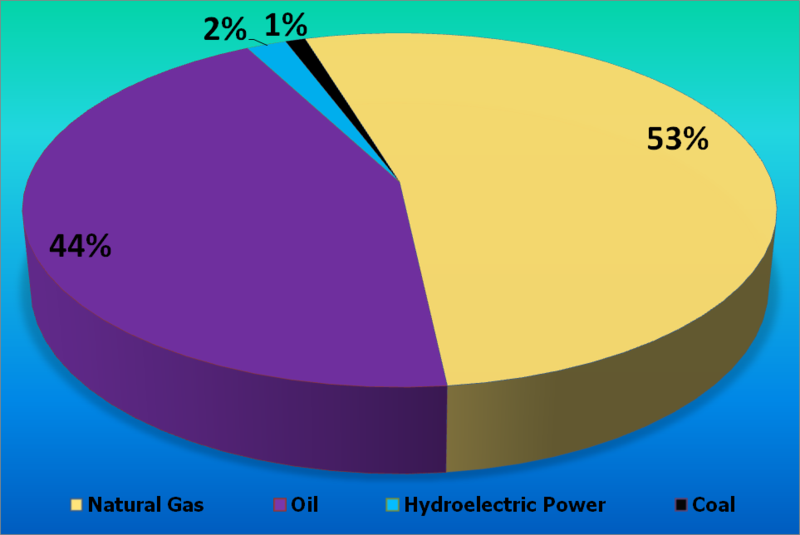
The Israeli historian Martin van Creveld once said that “Had the Iranians not tried to build nuclear weapons, they woul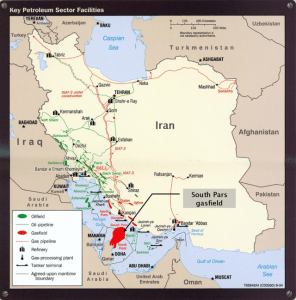 d be crazy.” Although his words may seem extreme, we need to understand what motivated the Iranian leadership to develop nuclear power, even in the face of mounting international oppositions. The Iranians’ own argument is that they need to secure their own energy needs in the form of nuclear power. This argument is hardly plausible: Iran is sitting on the world’s second largest reserves (after Russia) of natural gas. Iran’s South Pars gas field alone is estimated to contain 14×10^12 m3 of gas, around 5.6% of the entire world’s prove gas reserves. Moreover, the country contains the 4th largest reserves of oil in the world. Iran’s energy needs can largely be satisfied by its oil and natural gas, as can be seen in the chart below.
  If energy security is not the real reason, then what is? The true reasons for such a program, I believe, includes the following:
- Scientific and cultural prestige: Let’s imagine that the Iranians do not in fact want to build a nuclear weapon (a highly unlikely assumption for reasons that I will explain later), the mere fact that Iran is capable of developing advanced technology is something that the Iranian government can be proud of. In Iran, like many other parts of the world, scientific advances symbolizes the greater progress made in a society. The Iranian government sought to legitimize itself by promoting science and technology (much like the Soviet Union spent tremendous efforts in space exploration to legitimize the ideology of Communism). The Iranian people want to see progress being made in a variety of different fields, whether it be a rocket launch or a prospective nuclear power generation plant. Iran is gaining prestige by possessing those technologies. In a sense, scientific prestige is also tied into cultural prestige. We need to remember that Iran is more of a historical civilization than a nation-state in the modern sense of the word. The Iranian people had inhabited the Iranian Plateau for thousands of millenniums, and for much of that period Iran (or Persia, as it is known for most of its history), is a leading force among the world’s nations, and not merely in technology. It is in early modern times that Iran had fallen behind. In a way, many Iranians want to regain that sense of pride which have belonged to them historically. As heirs to a rich cultural heritage, Iranians today no doubt want to relive a part of its ancient glories; developing nuclear powers along the lines of other advanced nations will symbolize a part of this regaining of prestige.
- Competition from regional powers: Let’s take a look at how the world appears from the position of Iran, and why its nuclear ambitions will likely lead to nuclear weapons. Geographically, Iran couldn’t be in a more dangerous position. As the map below shows, Iran is surrounded by potential or probable enemies. To its west, Iraq, despite its Shia majority (the majority religion in Iran), is embroiled in a complicated civil war with the radical Islamic State (IS). Further west, we see a similar situation in Syria, where Iran-backed government of Bashar al-Assad is fighting a multi-front war against IS and moderate rebel forces. Each of these governments, if they fall, would produce a serious threat to Iran itself; and these are just the militant organizations. Organized threats by nation-states posed a bigger problem still. In its southwest, across the Persian Gulf, the Kingdom of Saudi Arabia is ferociously anti-Iranian and possesses a powerful modern military and an alliance with the United States; other Sunni Gulf States are no more friendlier. Further to the west, Iran faces the strongest military power in the region in the state of Israel, which had spear-headed efforts to contain the Iranian enrichment program. Further to its north and east, Russia, China, Pakistan, and India are all nuclear powers. In such a dangerous neighborhood, Iran felt that by developing the bomb, it can achieve a sort of parity with the other regional and global powers, at least in part to compensate for its relatively conventional forces.
- Security and Geopolitical leverage: In a point related to the second one, we need to be aware of the fact that Iran really has no natural allies. Culturally, it is the product of thousands of years of Persian civilization centered in the plateau of Iran, influenced by the forces of Shia Islam for centuries (today, an absolute majority of the world’s Shia Muslims lives in Iran), and the rise of political Islam in the form of the Iranian Revolution of 1979. For good or bad, few other countries possess such a unique historical experience. While this is a point of pride for many Iranians, at the same time, this also meant that Iran cannot count on any natural allies in the sense that the UK can rely on the US or Kuwait can rely on Saudi Arabia. The allies and friends it does have among governments are less than appealing: Iraq is bogged down in a struggle of a sectarian nature between Shia-dominated government and Sunni militant Islamists; likewise Syria is fighting its seemingly interminable civil war; the militant group Hezbollah in Lebanon is considered an ally and a way for Iran to project power into the eastern Mediterranean, but is categorized as a terrorist group (its military wings at
 least) by most governments around the world. Strategically, Russia can be considered an ally, but that nation is struggling in the face of western sanctions for its involvement in the Crimea and a falling oil price. (For a discussion of how falling oil prices are influencing foreign policies in Russia and Iran, see here). Iran is looking for new partners in China and India by offering them energy security; but this venture will be unlikely to result in any serious partnerships, especially if this partnership would result in possible international retaliations by the West. Iran is therefore left to defend itself against a myriad of threats. In this case, a nuclearized Iran can protect itself, or so the Iranian leadership believed, from military blackmailing. At the same time, Iran can project its power in what is known as the “Shia Crescent”, an area encompassing Iran, Iraq, Syria, and Lebanon, shaping itself into a regional power. Iran believes that thus nuclear power adds more muscle to its voice in regional and international affairs.

Needless to say, no matter what the reasons are for Iran’s acquisition of nuclear power, the rest of the world cannot be happy about the emergence of another potential nuclear power. However, the present countries that possess nuclear powers are in fact rebuilding their own respective nuclear arsenals even while they are denouncing the Iranian’s attempts to do so. We see that the rest of the world has been upgrading their own nuclear arsenals as well. In a recent article on Business Insider, the dangers of a nuclear war is emphasized more than ever before. However, the difference is that Iran is widely seen as an irresponsible government, and weapons in the hands of such a state is a worrying fact. But how should the rest of the world respond to it? Along the lines of journalist Fareed Zakaria, I believe that there are two main ways for the world to respond: 1. Forcing a Regime Change, or 2. Forcing a Policy Change. Let’s briefly define what each option meant and discuss their relative merits later:
- Regime Change:
In essence this would involve the fomenting of dissent, support democratic political movements, and with outside help in trying to overthrow the government of Iran in one form or another. Most likely, the United States would be the leader in such an effort. In the meanwhile, the US and other parts of the world should not have anything to do with Iran since it is an illegitimate government in their eyes. In the views many, the only way to properly address the nuclear situation with Iran is wait (or help) the government to change and then deal with them later.
- Policy Change:
This would mean that we will actively engage with the present government of Iran, treating them as an equal partner in these discussions, and really accept the fact that the government of Iran, however repulsive, is here to stay for some time to come. The dialogues will be conducted in an open manner and be peaceful in trying to reach a deal with Iran. For supporters of this option, they do not believe that this is a policy of appeasement, but rather, a step-by-step method toward achieving our objective, whatever they may be.
As a sophomore in college, I may not be in the best position to recommend foreign policy to those in the highest levels of government. But, nevertheless, I believe that here in the US and the rest of the world that does not desire to see a nuclearized Iran, have to decide on an option fast and not to oscillate back and forth between these two options. How can you possibly struck a deal with a government that you have every intention to help overthrow? Personally, I believe that the best option remains to bring Iran back into the international system, which it had been an outcast member since 1979, and to engage with it in more direct dialogue. We need to bring in international partners, which must include China, India and Russia, to discuss options with the Iranians on what to do. We must make Iran as an equal partner in its negotiations and not treat it as a criminal state. We need to recognize Iranian interests and why they sought to nuclearize themselves and to stress our own positions and concerns in why we do not want to see a nuclear program: no, it is not that we desire to encircle Iran on all sides, and no it is not that we desire to see a weakened Iran that is susceptible to invasions at any given moment. There are too much distrust and misconceptions between Iran and the West at the moment, each is mistrusting the other’s intentions. Therefore, if we can build an international coalition on resolving the issue, we can legitimize our intentions and make the Iranians understand that it is in the interest of the rest of world for them to denuclearize.
Current policies in delaying Iran’s nuclear programs have many merits to them. Firstly, the alternative, that of calling Iran to immediately destroy their nuclear facilities, will only strengthen their resolves in continuing to build them. If not in open, then in secret. Therefore, delaying what Iran has been attempting to do, by years (a very possible prospect), leaves the rest of the world with more options in dealing with the government. But more importantly, it buys the rest of the world time. The structure of government itself may likely change with the passage of years. I do not necessarily mean a revolution, but rather a gradual process of liberalization that will see a new generation of Iranian leaders that do not want to confront the world and or is filled with xenophobia, but rather sought peaceful coexistence. Younger generations of Iranian do not have the fervors of religious fanaticism that may have characterized some of their parents; in fact, I believe that many young Iranians today want to embrace the international system and be a part of modern society. I believe that will the passage of time, Iran can be a more responsible stakeholder in the international system and we can work with Iran toward this issue. However, in order to do this, we must first talk openly with Iran.
The importance of continuing dialogue with Iran cannot be overstated. If left isolated, Iran will retreat into itself and develop and deepen a paranoia of the rest of the world and perhaps the unthinkable will happen: a nuclearized Iran ready to use its weapons on its neighbors and beyond. As a historical analogy, imagine what if Henry Kissinger had never traveled to China to open up dialogue with that secluded nation, China today would possibly have been another North Korea: a government that is isolated and clung to an outdated ideology with a belligerent attitude toward the rest of the world. But to the credit of the US government (both the executive and the State department), rather than seeing this happen, the US government actively engaged with Chinese leadership and brought China into the international community of nations; a community that China has a stake in. In a similar line, I believe that by keeping the dialogue option open with Iran, we can hope to make some progress. Of course, this can only happen with Iranian commitment as well, and it needs to tone down the rhetoric against its neighbors and their allies, most notably Israel and the United States; it needs to show real commitment in following through with its promises; but above all, Iran needs to see that it is to its own security and benefit that it becomes a part of the international system rather than a challenger to it. Perhaps, eventually, Iran will be able to develop its own peaceful nuclear program, much as how Japan and South Korea has developed them, without feeling the need to weaponize it. All of these will likely take an enormous amount of time, likely decades; but I believe that in the end, the path of continued negotiations and dialogues with Iran will be preferable to any other alternative.
For related topics see:
Resource dependency, oil price decline, and the reshaping of the international order






 fqzhang